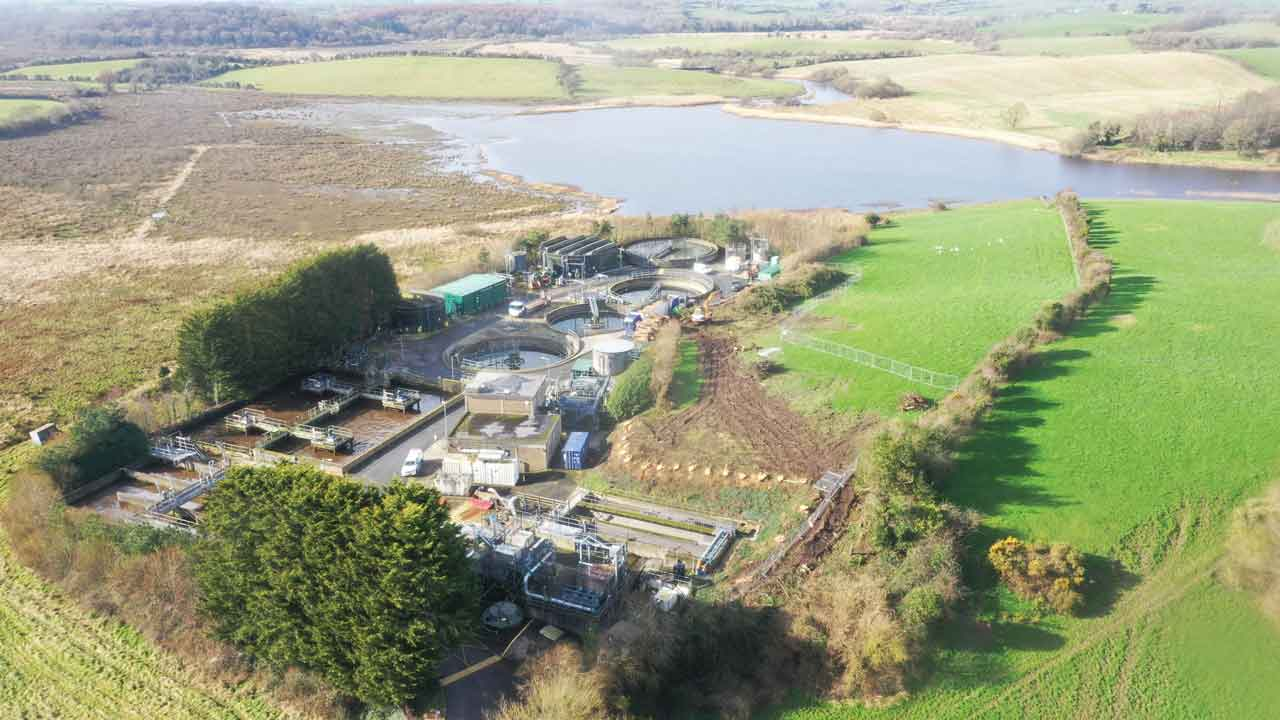
NI Water is beginning an £8 million programme at Downpatrick Wastewater Treatment Works to replace ageing equipment, maintain environmental compliance, and prepare the site for a later expansion in treatment capacity.
BSG Civil Engineering is mobilising for the first phase at the Belfast Road facility, which was originally constructed in 1995 and extended in 2010. The work is expected to continue for approximately two years while the treatment plant remains operational.
Civil construction will be combined with mechanical and electrical engineering as critical assets approaching the end of their service life are replaced. The programme is intended to preserve the plant’s ability to meet current environmental discharge consents before further capacity is added.
Keeping a wastewater plant in service during major replacement work creates a more complex delivery problem than construction on an empty site. Incoming flows must continue to be received, treated, monitored, and discharged while contractors isolate equipment, install temporary systems, and commission new assets.
Project sequencing will therefore govern much of the work, since pumps, blowers, screens, tanks, electrical distribution, instrumentation, and sludge equipment cannot all be removed where they contribute to the same treatment duty. Temporary pumping, staged isolation, and duty and standby arrangements may be required to protect process continuity.
Commissioning also has to account for biological treatment conditions, which cannot always be stopped and restarted like a conventional mechanical production line. Changes in aeration, flow, sludge age, or nutrient loading can affect performance over several days, requiring close coordination between contractors and plant operators.
The first phase will concentrate on current reliability and compliance, while a proposed second phase would extend treatment capacity within the existing site. That expansion is intended to support future housing and economic development in Downpatrick, although it remains dependent on additional funding.
Separating asset replacement from capacity growth reflects a common constraint across water infrastructure, where utilities must preserve ageing plants before creating headroom for new connections. Equipment may remain functional beyond its expected design life, but failure risk rises as corrosion develops, spares become scarce, and maintenance interventions increase.
Planned replacement allows isolation, temporary arrangements, procurement, and commissioning to be organised around the process. Emergency failure can force utilities to rely on tankering, temporary treatment, intensive manual operation, or urgent equipment hire while environmental risk is already increasing.
Insufficient wastewater capacity can delay residential, commercial, and industrial development even where planning demand exists. Sewer networks and treatment works must accept additional loading without increasing spill risk or breaching discharge limits, making wastewater infrastructure a direct constraint on regional growth.
Modern treatment performance depends on the interaction between civil structures and an increasingly complex range of electrical and digital equipment. Motors, variable speed drives, flow measurement, dissolved oxygen control, telemetry, automation, and process data now determine how efficiently a plant responds to changing conditions.
Older works often contain equipment installed through different procurement programmes and under different control philosophies. Replacement projects can uncover undocumented interfaces, obsolete communications, limited spare capacity in switchgear, and instruments whose historic readings do not align neatly with newer systems.
Cyber security has also become part of plant renewal as treatment works connect pumping stations, process controllers, alarm systems, and asset platforms. New equipment can improve visibility and maintenance, although every remote connection and digital interface has to be controlled within the operational network.
Energy consumption will form another consideration during equipment selection. Aeration, pumping, sludge treatment, and liquid movement account for substantial power demand, so replacing motors, drives, and blowers provides an opportunity to reassess control range, efficiency, process settings, and maintenance costs.
Low pressure blower development is increasingly centred on wastewater efficiency and variable process demand, reflecting the operating cost attached to equipment that runs continuously or for long duty cycles. Correctly sized machinery and responsive control can produce savings throughout the asset’s service life.
Whole life performance will also depend on access, maintainability, spare part availability, and the ability to isolate individual assets without disrupting treatment. Equipment that performs efficiently under clean test conditions can become costly if routine inspection, cleaning, or replacement requires extensive temporary work.
NI Water says it invests around £2 million each week across water and wastewater services and has committed £1.9 billion to Northern Ireland’s water and sewerage infrastructure over the past decade. That programme extends across treatment works, networks, pumping stations, storage, and drinking water quality systems.
Downpatrick will now move from planning into construction while live treatment continues around the work. Maintaining compliance through the first phase will provide the immediate measure of delivery, while the site’s longer term capacity will depend on whether funding is secured for the proposed expansion.