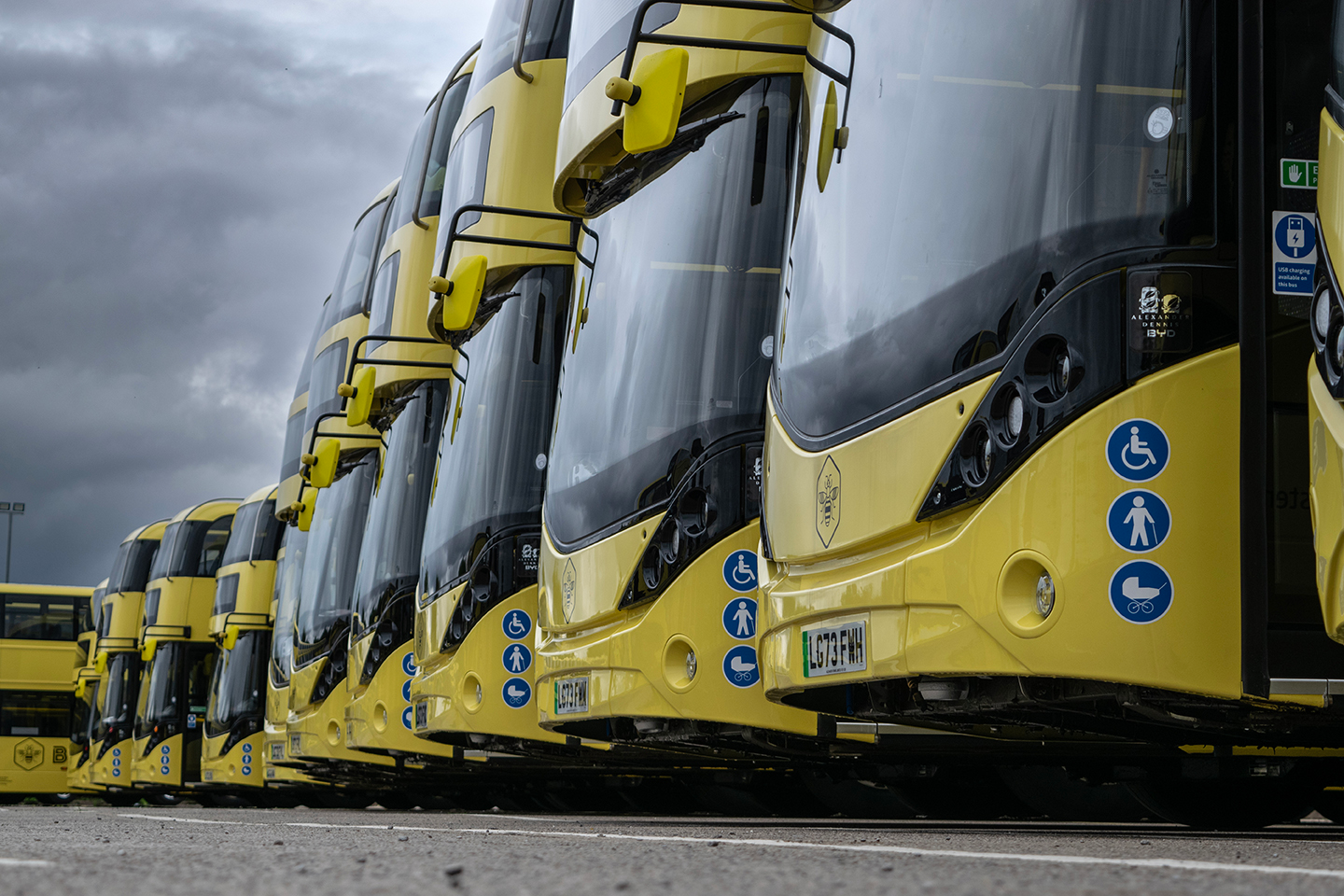
The UK market for new buses, coaches, and minibuses contracted by 50.6% during the second quarter of 2026, with registrations falling to 1,465 vehicles after two unusually strong years of fleet renewal.
Figures from the Society of Motor Manufacturers and Traders show that every major vehicle category declined, although the sharpest movement came from minibuses. Registrations in that segment fell by 70.9%, from 1,803 units in the second quarter of 2025 to 525 vehicles this year.
Double-deck bus registrations dropped by 20.1% to 413 units, while single-deck volumes declined by 18.7% to 527. Across the first half of 2026, the combined market reached 3,043 vehicles, which was 44.7% below the 5,500 registered during the same period last year.
Much of the headline fall therefore came from the retreat of the minibus market, whose share slipped from 60.7% in the second quarter of 2025 to 35.8% this year. The quarterly result was nevertheless the fourth consecutive decline, leaving vehicle builders with a much weaker production outlook than they faced a year ago.
Regional performance varied sharply. England remained the largest market with 1,190 registrations, but volumes were down 49.9%; Scotland recorded 141 units, a decline of 71.9%; and Northern Ireland fell 64.1% to 14 vehicles. Wales moved in the opposite direction, rising 138% to 119 units as investment in the TrawsCymru network fed through into deliveries.
Zero emission bus registrations also fell, dropping by 37% to 388 vehicles. Because that reduction was smaller than the decline across the overall market, zero emission models increased their quarterly share from 20.8% to 26.5%, while battery electric and other zero emission vehicles accounted for 32.1% of first-half registrations.
The figures expose the gap between a rising technology share and a stable manufacturing base. Bus production is low volume, highly configurable, and closely tied to public procurement cycles, so delayed funding decisions can leave body builders, chassis suppliers, battery manufacturers, and systems integrators with abrupt gaps in their order books.
Long lead times make those fluctuations difficult to absorb. Manufacturers must plan frames, body structures, drivetrains, battery packs, power electronics, interiors, software, certification, and workforce requirements months before delivery, while operators may still be waiting for government support, local authority approval, or certainty over depot works.
Electrical infrastructure can become the critical path even after vehicles have been ordered. Battery electric fleets require grid connections, transformers, switchgear, chargers, energy management software, revised parking layouts, and new maintenance procedures, and several of those elements can take longer to install than the buses take to build.
The engineering scale is visible at Liverpool’s Gillmoss depot, where an electrification programme for more than 100 battery electric buses combined grid upgrades, intelligent high-power charging, fleet scheduling, and operational preparation. Similar projects are needed across the country if vehicle deliveries are to translate into dependable services.
Financing is evolving alongside the hardware. Operators increasingly need commercial packages that combine vehicles, batteries, charging equipment, energy management, maintenance, and residual-value risk, because few of those costs can be treated independently once a fleet moves away from diesel.
A £980m facility secured by Zenobē in June is intended to support more than 1,200 electric buses and associated infrastructure over three years, showing that large pools of capital are available where projects can be assembled into investable programmes. Smaller operators and depots, however, may struggle to produce the same scale or certainty.
Stop-start demand also works against the productivity gains needed to reduce vehicle prices. Suppliers are less willing to expand capacity, train workers, or commit to new tooling when orders arrive in short bursts, while manufacturers face higher unit costs if production lines repeatedly move between low utilisation and rapid catch-up.
A long-term zero emission bus order pipeline could improve visibility, although its value will depend on confirmed funding, realistic grid connection dates, and procurement timetables that extend beyond individual annual budgets. Announced ambition will not support factory planning unless it is converted into scheduled and financed orders.
The second-quarter contraction does not indicate that bus electrification has reversed; zero emission models are taking a larger share of a smaller market, and the underlying technology has already moved well beyond pilot scale. What remains uncertain is whether procurement, finance, and depot infrastructure can produce the continuity needed to sustain vehicle manufacturing through the transition.