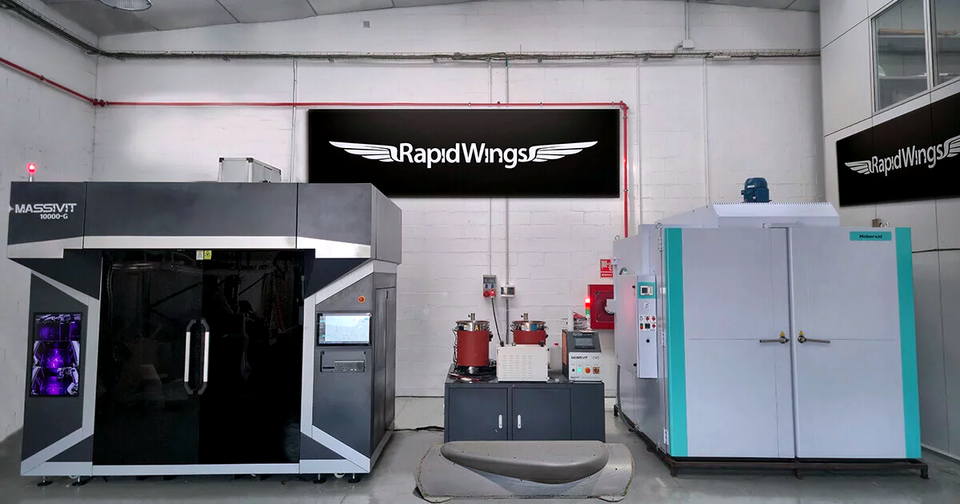
Massivit has opened a service centre in Barcelona to manufacture composite tooling for aerospace and defence customers through its RapidWings digital production platform.
The facility is the company’s first Europe-based RapidWings centre and will produce moulds, masters, mandrels, jigs, fixtures, and prototype tools on demand. It forms part of a planned network intended to place production capacity closer to customers and reduce the transport requirements associated with large tooling structures.
RapidWings uses Massivit’s Cast-In-Motion process, which combines large-format additive manufacturing with thermoset casting. A sacrificial shell is printed to define the geometry while a two-component resin is deposited within the structure to create the body of the tool.
After curing, the printed element is removed and the remaining surface is finished for production use. The company is targeting isotropic tooling with the dimensional stability, temperature resistance, and surface performance required for composite manufacture.
Traditional aerospace tooling may be produced from metal, machinable board, or conventionally manufactured composite structures. Although those routes are well established, they can involve lengthy material procurement, pattern production, machining, assembly, coating, and finishing stages.
Massivit says RapidWings can reduce some tooling lead times by as much as 90%, compressing programmes that take several months into a matter of days. It has also reported cost reductions of between 40% and 70% in selected projects compared with conventional metal or machinable-board methods.
The achievable saving will depend on tool size, geometry, tolerance, surface finish, temperature, duty cycle, and required production life. A prototype lay-up tool operates under different conditions from an autoclave mould expected to complete repeated high-temperature cycles.
Customers can use the Barcelona centre without first purchasing and installing a complete RapidWings system. That lowers the entry cost for aerospace suppliers that need an urgent tool, replacement, or demonstrator but do not yet have sufficient demand to justify bringing the process in-house.
Tooling remains a substantial constraint in aerospace manufacturing because production cannot begin when the component design is released. Moulds, fixtures, drill tools, assembly aids, inspection equipment, and handling systems all have to be completed and validated before a structure can move through a stable production process.
Large composite tools are difficult to source quickly because they consume significant material, require large machines and controlled production space, and can be expensive to transport. A design revision may alter both the component and the equipment needed to manufacture it.
Digital tooling can reduce the interval between a geometry change and a revised physical tool. Engineers can update the production file without repeating every conventional pattern and machining stage, although the resulting tool must still undergo dimensional inspection, surface preparation, and process validation.
The same approach could support low-volume and replacement programmes. Aerospace and defence operators often need fixtures or tools long after the original manufacturing line has changed, sometimes in quantities too small to recreate the earlier supply chain economically.
A distributed service network would allow authorised centres to manufacture tooling from controlled digital data in the region where it is required. Shorter transport routes and additional capacity could improve resilience, but the model places greater emphasis on file security, configuration control, material traceability, and process consistency.
A tool produced in Barcelona must perform to the same standard as one made at another approved centre. Common machines, materials, curing procedures, inspection methods, finishing standards, and production records will therefore be essential as the network expands.
Aerospace manufacturers have remained cautious about additive tooling where vacuum integrity, temperature resistance, surface finish, and repeated dimensional performance are critical. Cast-In-Motion seeks to address those limits by using additive manufacturing to establish the geometry while relying on thermoset casting for the principal structure.
Customer qualification will determine which applications move first. Prototype tools, trim fixtures, drill aids, masters, and lower-temperature moulds may require a shorter approval path than equipment intended for repeated autoclave production.
Long-term performance will be assessed through thermal expansion, wear, release behaviour, repairability, vacuum retention, and the stability of the tool after repeated cycles. Manufacturing speed cannot compensate for a structure that changes dimensions or degrades before the planned production run is complete.
The Barcelona operation gives Massivit a controlled environment in which to gather that operating data across live customer programmes. It also allows the company to refine production methods, finishing requirements, and quality controls before establishing further regional centres.
RapidWings is unlikely to replace every metal or composite tool, particularly where extremely long production life or severe processing conditions favour established materials. Its strongest applications may lie where conventional lead times delay prototypes, product changes, low-volume structures, or replacement equipment.
Even a relatively simple fixture can hold up an expensive aircraft assembly when it arrives late. By adding on-demand European capacity, Massivit is seeking to convert part of the tooling schedule from a fixed programme constraint into a production service that can be ordered and adapted as designs change.