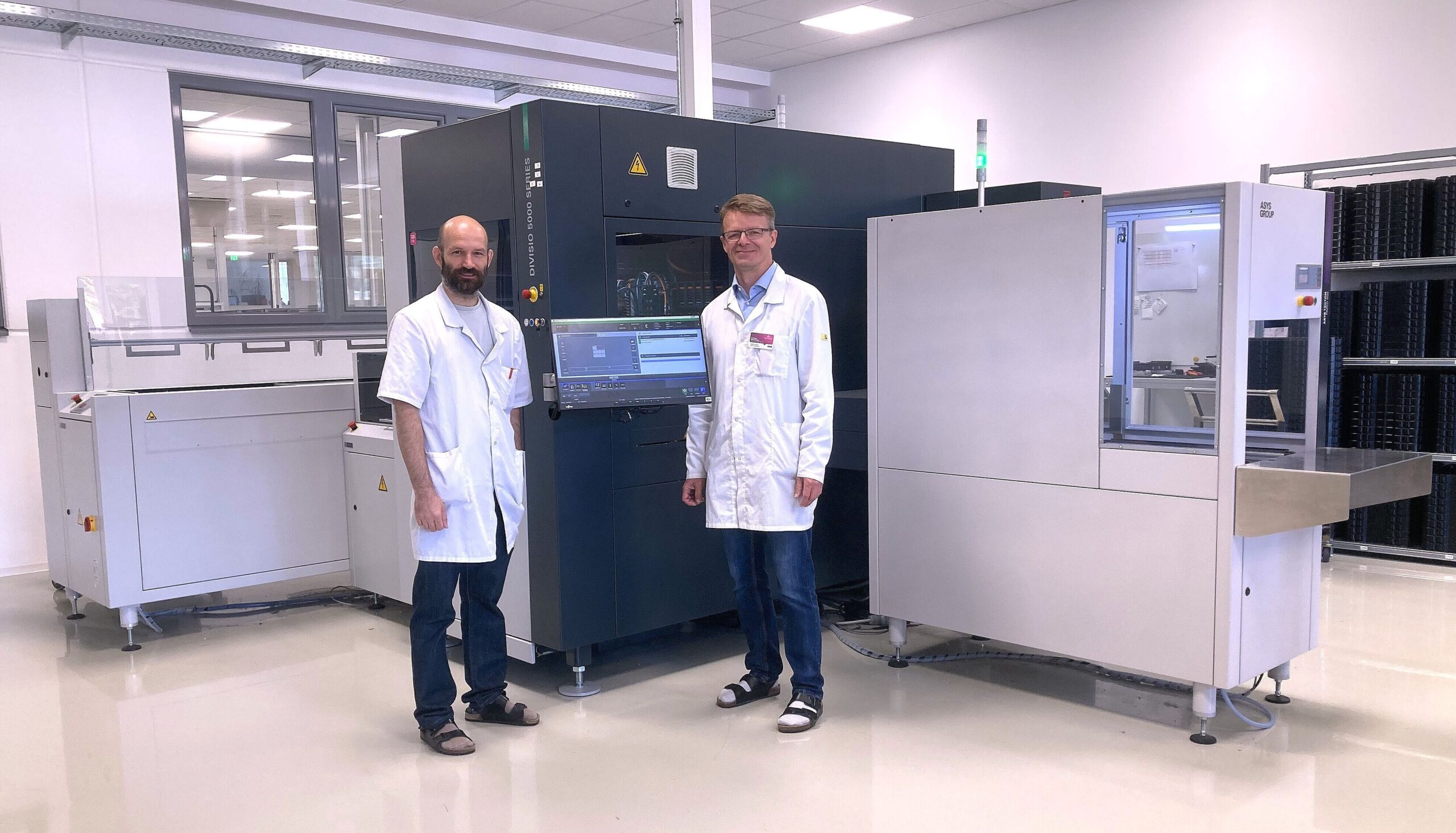
Technosert has installed an ASYS DIVISIO 5100 Gen 5 system to automate printed circuit board depaneling at its electronics manufacturing operation in Austria.
The standalone machine is configured so that an operator loads and unloads each product while the checking, handling, cutting, inspection, and tool management stages are completed automatically.
Depaneling separates individual printed circuit boards from the larger production panel used during component placement, soldering, cleaning, and inspection. Although the operation occurs near the end of assembly, an uncontrolled cut can damage components, solder joints, tracks, or laminate after considerable value has already been added.
The DIVISIO 5100 uses linear motors and is specified with positioning accuracy of up to ±10 microns. Dual-spindle and dual-gripper configurations can support cycle times below approximately 2–2.5 seconds, depending on the board geometry and cutting path.
Before a production run begins, the system checks the condition and availability of the required tools and resources. It continues to monitor the process during operation, adjusting parameters and using integrated camera and measurement functions to verify board position and cutting performance.
Automatic tool changing allows worn cutters to be replaced without a complete manual setup. ASYS says its tool-management arrangement can support extended production across as many as 20.5 shifts, although the actual interval will depend on the material, cutting length, spindle settings, and board design.
Complete cut inspection provides a record of whether the separation process followed the specified geometry. Deviations can be identified before the finished boards move into functional testing, coating, enclosure assembly, or shipment.
Force-controlled grippers and a soft-stop function are intended to minimise mechanical stress during handling. Controlled movement becomes more important when components sit close to the board edge, thin substrates are used, or irregular geometries make the assembly vulnerable to flexing.
Technosert operates as an electronics manufacturing services provider, requiring its production equipment to accommodate different customer designs, batch sizes, quality requirements, and documentation standards. Changeover time consequently carries as much weight as peak cutting speed.
High-mix operations cannot normally optimise a machine around one board for an extended run. Programmes, fixtures, cutters, and handling arrangements must be changed frequently while retaining traceability and preventing the wrong setup from being applied to a similar-looking product.
That production model is driving investment across European electronics manufacturing. Polish EMS provider Assel has expanded its placement capacity through three new ASM SIPLACE SX systems, targeting a 20% to 30% improvement in line efficiency for complex, high-mix work.
Placement equipment accounts for only one part of the production flow. Printing, inspection, reflow, testing, coating, depaneling, and final assembly must all have sufficient capacity if the factory is to convert faster component placement into higher finished output.
Automating a downstream operation can expose variation that manual handling previously absorbed. Differences in panel dimensions, fiducial quality, board warpage, material behaviour, or routing geometry may need to be controlled more closely once a machine operates at repeatable tolerances.
Inspection data produced during depaneling can help locate the source of those deviations. A recurring offset may originate in the panel, the assembly process, thermal distortion, tool wear, or an incorrect programme rather than the cutting machine itself.
When connected with board identity and process history, the information can contribute to wider production traceability. The DIVISIO platform supports industrial communication standards that allow status and manufacturing data to be exchanged with surrounding equipment and factory systems.
Automotive, aerospace, medical, rail, and industrial customers may require records showing which programme, cutter, machine, and inspection result applied to a specific assembly. Automated data capture reduces reliance on separate manual records and allows anomalies to be investigated against the complete route through production.
The installation also changes the work performed by operators. Loading and unloading remain necessary in the standalone arrangement, while routine checking, tool management, and process adjustment are transferred into controlled machine functions.
Personnel can then concentrate on product changes, exception handling, maintenance, and process improvement rather than repeatedly supervising a stable cutting cycle. That shift becomes valuable where skilled production staff are required across several lines and processes.
Technosert’s investment provides a more repeatable route through a stage where mechanical damage can undermine otherwise successful assembly work. Reduced handling, stable cycle times, lower scrap, and faster product changes will determine its contribution to the wider factory.
As boards become denser and edge clearances decrease, depaneling has developed into a precision manufacturing operation rather than a simple final cut. The inspection and process data gathered at that point may become as valuable as the speed with which the individual assemblies are separated.