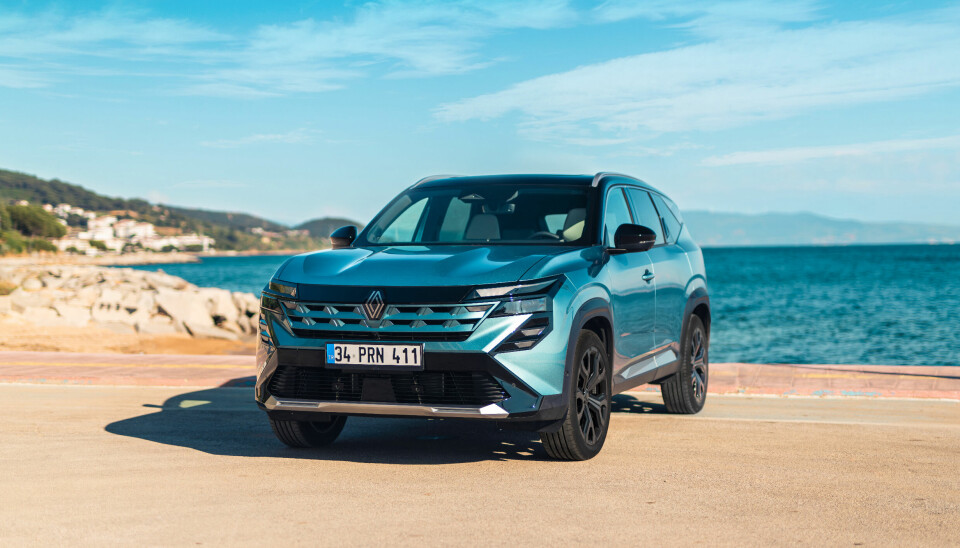
Renault will add its Bursa plant in Türkiye as the second production hub for the Boreal SUV, extending an industrial programme that began at Curitiba in Brazil.
The OYAK Renault operation will supply the Turkish market and export vehicles across Eastern Europe, the Middle East, North Africa, and sub-Saharan Africa. Bursa will also manufacture a new 160hp full hybrid E-Tech powertrain, alongside a 145hp 1.3-litre turbocharged petrol engine with an EDC transmission.
Turkish-built Boreal models will be the first Renault vehicles to receive the new hybrid system. Its introduction gives the plant responsibility for an electrified powertrain aimed at markets where charging infrastructure, taxation, emissions rules, and customer purchasing power vary considerably.
Bursa is already an established manufacturing base within the group, supported by a developed automotive supplier network and export infrastructure. Adding Boreal broadens its role from domestic and conventional European production towards a programme serving a far more diverse regional footprint.
Regional production has become increasingly attractive as vehicle manufacturers try to balance global platforms with local specifications. Common architectures provide purchasing and engineering scale, but powertrains, trim, software, safety systems, and homologation still have to be adapted for individual markets.
Producing closer to customers can shorten replenishment cycles and reduce finished-vehicle transport, while local sourcing can soften exposure to exchange-rate movements and trade barriers. The model cannot remove dependence on internationally supplied semiconductors, electronics, battery materials, and specialist components, but it can reduce some of the risks surrounding final assembly and distribution.
The production launch will require coordinated changes across stamping, body assembly, paint, final assembly, testing, tooling, internal logistics, and supplier sequencing. Even where models share equipment or architectures, differences in dimensions, content, and powertrains create new process requirements that must be introduced without destabilising existing output.
Hybrid assembly adds high-voltage safety, electric machines, power electronics, battery packs, cooling systems, and additional control software to the conventional engine and transmission process. Operators, maintenance teams, and emergency personnel need updated procedures, while end-of-line testing must cover both mechanical and electrical performance.
Renault’s decision acknowledges that electrification will proceed at different rates across the Boreal’s export markets. Full hybrid technology can lower fuel consumption and emissions without requiring external charging, which suits regions where public infrastructure and domestic charging remain limited.
Supporting combustion, hybrid, and battery electric systems at the same time nevertheless increases industrial complexity. Engineering resources, supplier capacity, validation work, and factory investment are spread across several propulsion paths, and demand can move between them more quickly than production assets can be reconfigured.
Flexible automation will help Bursa manage that variation. BMW’s work to introduce physical AI into production systems shows how vehicle manufacturers are combining simulation, machine vision, autonomous logistics, and adaptable robotics as model variety rises and conventional fixed automation reaches its limits.
Boreal’s export territory adds another layer of variation through language, climate, regulation, equipment levels, and customer preferences. Production planning must absorb those combinations without allowing option complexity, changeovers, or parts proliferation to erode throughput and quality.
Inbound logistics will be equally demanding, because suppliers must deliver the correct parts in sequence while finished vehicles move through road, rail, port, and maritime networks towards widely dispersed destinations. Border disruption or shipping delays can affect factory schedules even when production equipment remains available.
Türkiye’s automotive industry has developed around precisely that combination of manufacturing capability and export access. Vehicle makers can draw on experienced labour and local component production while reaching the EU, Middle East, and surrounding markets from a single industrial base.
Cost advantages alone will not sustain the programme. Exported vehicles must meet the software, cybersecurity, traceability, emissions, and safety requirements of their destination markets, while customer expectations for quality remain consistent regardless of where a vehicle is assembled.
The second production hub also reduces Renault’s reliance on Curitiba for Boreal supply. Geographic diversification can provide resilience when transport routes, local demand, or production conditions change, although running two plants requires disciplined control of specifications, engineering changes, and supplier quality.
Bursa must now absorb the new model, establish the full hybrid process, and coordinate a broader export network while maintaining current programmes. Renault has chosen a mature factory for the task, but the success of the expansion will depend on how smoothly the plant converts regional complexity into repeatable production.