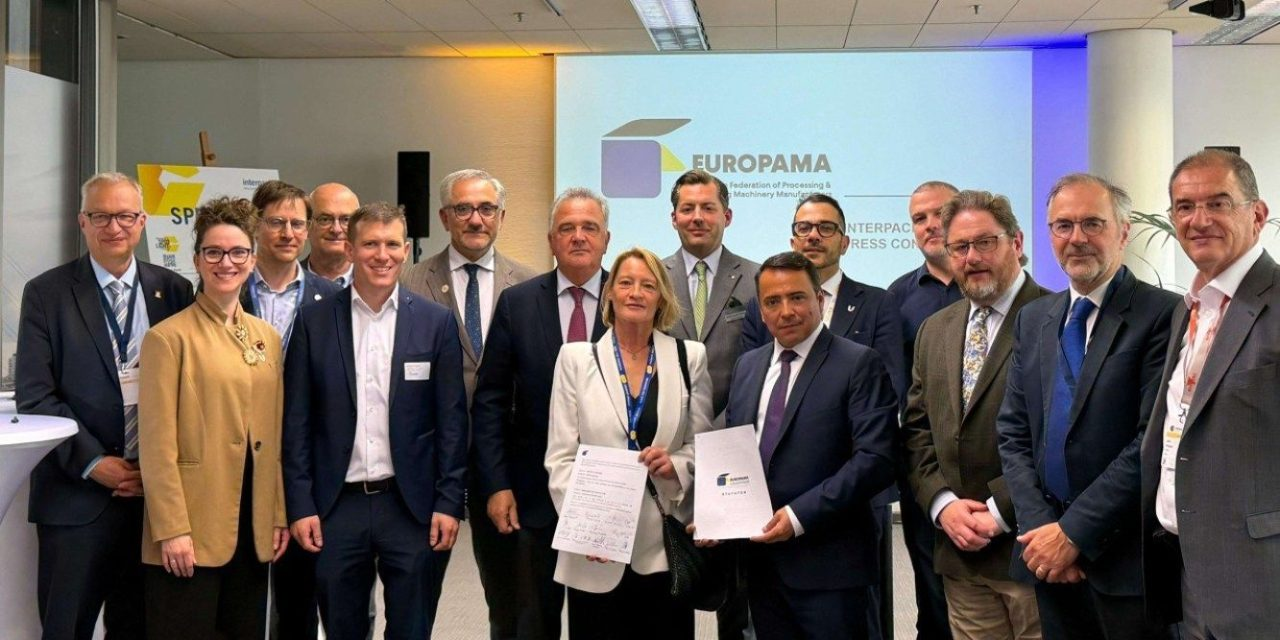
Automate UK has joined machinery associations from Germany, Italy, France, Spain, and Switzerland to establish EUROPAMA, a European federation representing processing and packaging equipment manufacturers.
Formally established during interpack 2026 in Düsseldorf, the organisation brings together Automate UK, Germany’s VDMA, Italy’s UCIMA, France’s Evolis, Spain’s AMEC, and Switzerland’s Swissmem. Its work will cover industrial policy, sustainability regulation, automation, trade, robotics, digital technology, and European manufacturing competitiveness.
Processing and packaging machinery companies are dealing with an increasingly connected set of technical requirements. Equipment that once centred on mechanical handling now combines robotics, machine vision, industrial networks, safety controls, production software, remote access, and energy monitoring within a single line.
Regulation applied to one part of that architecture can alter the design of several others. Cyber security provisions affect controls and communications, machinery rules influence mechanical and software safety, while packaging legislation can require changes to materials, inspection, forming, filling, sealing, and labelling equipment.
The EU Packaging and Packaging Waste Regulation will be among the federation’s priorities. Requirements covering recyclability, material reduction, reuse, labelling, and reporting are expected to influence the formats used by food, beverage, pharmaceutical, consumer goods, and industrial manufacturers.
Machinery builders need sufficient notice to convert those requirements into workable production equipment. A material change can affect sealing temperatures, web tension, forming behaviour, vision inspection, filling speed, product protection, and line cleaning, while a new reusable format may demand different handling and return systems.
When implementation deadlines arrive before harmonised standards or detailed guidance, equipment manufacturers can be left designing around several possible interpretations. Customers may delay capital expenditure until specifications become clearer, even where existing lines will need substantial modification.
EUROPAMA will give the participating associations a common structure for developing technical positions and presenting evidence to European institutions. Shared work can combine engineering data, export experience, implementation costs, and production constraints from several major machinery markets.
UK participation carries additional weight because domestic equipment manufacturers remain closely connected to European customers and suppliers while operating outside the EU’s formal policymaking system. Machinery placed on the European market must continue to meet the relevant technical requirements, and UK factories remain substantial buyers of equipment manufactured in EU member states.
Differences in conformity assessment, documentation, standards, or enforcement can add cost at both ends of that relationship. A UK supplier may need separate product variants or administrative processes, while a British manufacturer purchasing European equipment may have to resolve interfaces between UK and EU requirements.
Working alongside VDMA, UCIMA, Evolis, AMEC, and Swissmem gives Automate UK a route into discussions involving some of Europe’s largest machinery manufacturing bases. The federation cannot remove national or regulatory differences, but it can establish where the underlying engineering concerns are shared.
The initiative follows a change in Automate UK’s leadership structure, with Dan Thombs appointed chief executive in early July and Peter Williamson moving into a policy-focused role. The organisation is expanding its work across regulation, skills, investment, export conditions, and industrial representation.
European equipment builders are operating against a difficult capital investment backdrop. Manufacturers want higher throughput, lower labour dependence, improved traceability, and reduced energy consumption, yet machinery orders remain sensitive to financing costs, uncertain demand, and changing product rules.
Suppliers are responding with modular equipment, software-defined functions, remote service, and faster product changeovers. Customers increasingly need lines that can process several formats and materials because the product mix several years ahead is less predictable than the operating life of the machine.
Regulatory consistency can support those investments by giving manufacturers a stable engineering target. Divergent interpretations, late guidance, or uncoordinated transition periods can instead force suppliers to redesign equipment for individual jurisdictions or retain several documentation systems.
Automation policy will demand similarly detailed engagement. Rules covering artificial intelligence, machinery safety, data, cyber security, and worker interaction increasingly overlap within robotic cells, automated warehouses, inspection systems, and packaging lines.
Broad statements about innovation or competitiveness provide little help when a machinery builder needs to determine how a particular control function should be documented, tested, updated, and supported. A federation drawing on several national associations can convert those practical questions into more detailed policy submissions.
Trade and global competition will form another strand of EUROPAMA’s work. European machinery manufacturers carry high expenditure on engineering, compliance, service networks, training, and product development while competing with suppliers operating from lower-cost production bases.
Maintaining that position will require investment in controls, robotics, digital engineering, cyber security, and specialist skills, alongside regulation that can be implemented without fragmenting the market. EUROPAMA’s influence will depend on the technical depth of its proposals and its ability to present them before policy decisions have hardened into fixed compliance requirements.