Hexagon has released VGSTUDIO MAX 2026.2, adding workflow improvements designed to help quality teams manage larger volumes of industrial computed tomography inspection data.
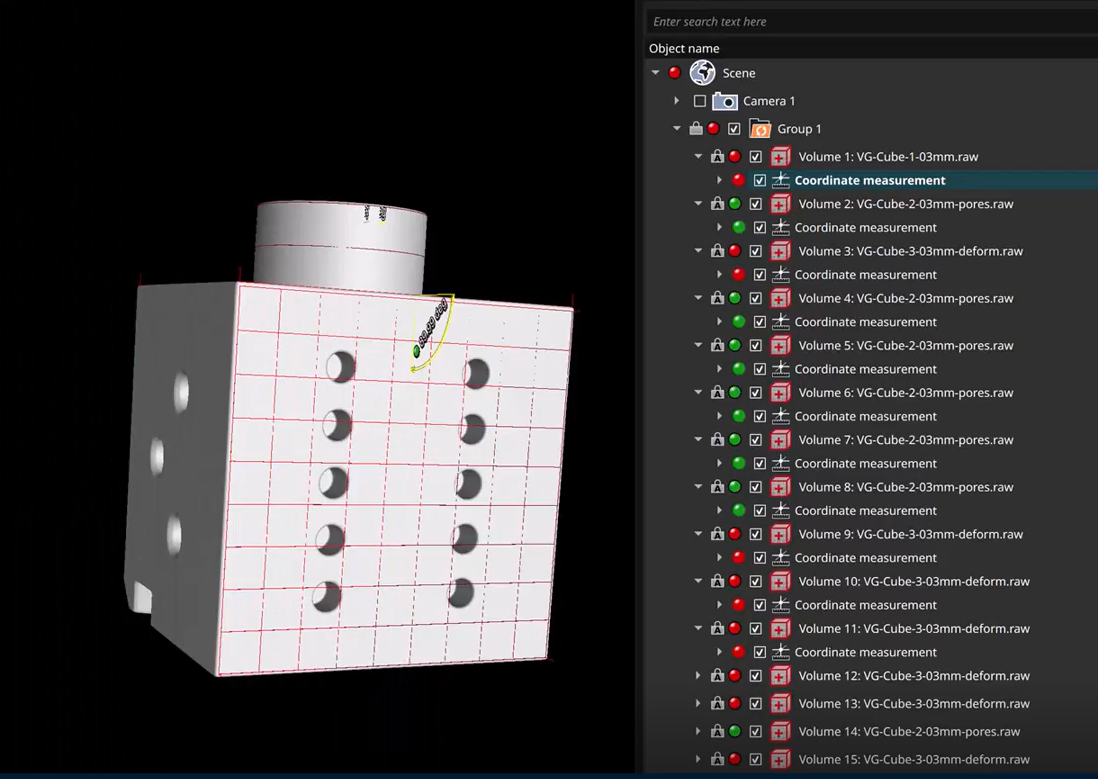
The update allows users to load entire batches of CT scans, define measurements once, and automatically apply and synchronise them across every part in a project. Hexagon has also revised its VG software portfolio around applications including non-destructive testing, metrology, batteries, casting, electronics, medical devices, aerospace, and automotive manufacturing.
Industrial CT has become an important inspection method because it allows engineers to examine internal and external features without destroying the part. It can reveal porosity, inclusions, cracks, dimensional variation, wall thickness issues, assembly errors, and defects hidden from optical or tactile inspection methods.
As CT moves from specialist investigation into routine production support, inspection data can become difficult to manage. Quality engineers may need to inspect multiple parts, align scan data, define measurement plans, compare results, produce reports, and trace defects back to production conditions. Manual handling across files can slow the process and introduce variation between operators.
Batch handling and automated measurement synchronisation address that problem by reducing repetitive set-up work. When measurements can be defined once and applied consistently across a group of parts, inspection becomes more repeatable and easier to scale. The approach also allows quality teams to focus on interpreting variation and feeding information back into production rather than rebuilding inspection routines for each scan.
The update is relevant to manufacturers working with complex parts, additive manufacturing, castings, electronics assemblies, batteries, and high-value machined components. In many of those applications, internal defects affect safety, durability, reliability, or compliance. Seeing the defect is only the first step. The inspection workflow must turn scan data into evidence that design, production, and quality teams can use.
Quality control is increasingly becoming a closed loop rather than a final gate. Data from CT scans, machine tools, sensors, test rigs, and production systems can help adjust processes earlier, reduce scrap, and improve design-for-manufacture decisions. That depends on inspection information arriving quickly enough and in a format that can be compared across parts, batches, suppliers, and production conditions.
Design engineering also benefits when CT data is used systematically. Engineers developing castings, printed parts, or assemblies need to understand how internal geometry, material distribution, voids, and process variation behave in production. CT analysis can support simulation, tolerance planning, failure investigation, and process improvement, especially where internal features are central to part performance.
Manufacturing trends are increasing the need for better inspection software. Aerospace and medical device components can include complex channels, fine structures, and critical internal geometry. Battery cells and modules contain layered materials where defects can carry safety concerns. Electronics assemblies continue to shrink while packaging density increases. Conventional inspection methods cannot always see the features that now need to be controlled.
Automated production equipment is also placing pressure on inspection throughput. Faster machining, unattended manufacturing, and integrated automation can produce more data and more parts than traditional quality workflows can easily handle. If inspection lags behind production, it becomes a constraint on delivery and process improvement.
VGSTUDIO MAX 2026.2 points toward CT inspection as a routine manufacturing intelligence tool rather than a one-off engineering investigation. Scan quality, calibration, fixture design, operator skill, and acceptance criteria will still determine success, but software that reduces manual handling can help manufacturers use CT data at the pace modern production requires.