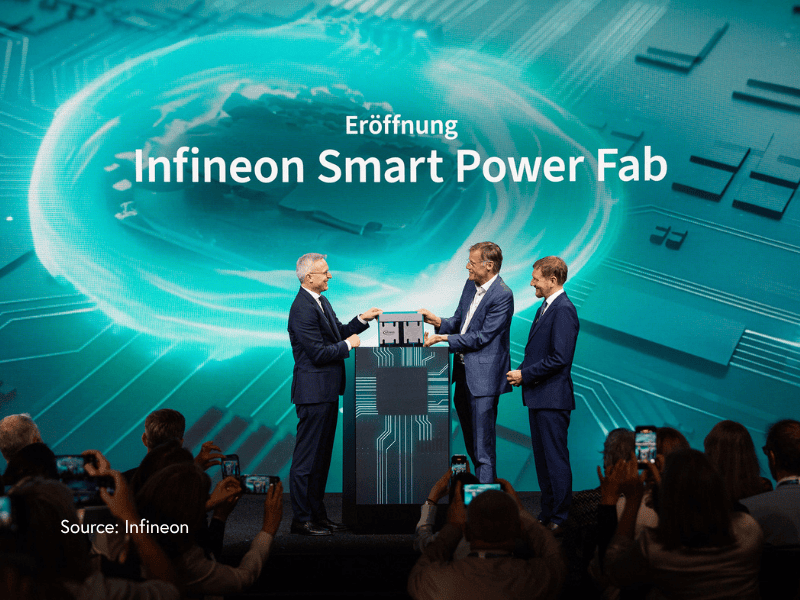
Infineon Technologies has opened its Smart Power Fab in Dresden, completing a €5bn semiconductor investment that expands European manufacturing capacity for power electronics and analogue/mixed-signal devices.
The factory was opened on 2 July 2026, three years after ground-breaking in May 2023 and ahead of the original schedule. Infineon says the site will double its manufacturing capacity in Dresden and create around 1,000 jobs, adding scale to one of Europe’s most important microelectronics clusters.
The fab will produce intelligent power semiconductors and analogue/mixed-signal chips for applications including electric vehicles, renewable energy systems, industrial equipment, AI data centres, and grid infrastructure. Those markets are expanding as more mechanical, thermal, and combustion-based systems are replaced or supported by electrified alternatives.
Power semiconductors now sit at the centre of industrial electrification. They switch, condition, measure, and control electrical power inside inverters, drives, chargers, converters, storage systems, traction systems, and power supplies. As factories, vehicles, buildings, and grids become more electrically complex, demand grows for chips that can improve efficiency, reduce losses, and operate reliably under thermal and voltage stress.
The Dresden expansion strengthens a semiconductor segment that is directly tied to manufacturing resilience. Much of Europe’s chip policy debate has focused on leading-edge logic, yet industrial competitiveness also depends on power devices, sensors, analogue chips, microcontrollers, and embedded components. A shortage in those categories can delay vehicles, automation equipment, energy infrastructure, medical systems, and industrial electronics even when headline computing supply is available.
Building wafer capacity also strengthens the surrounding industrial ecosystem. Semiconductor fabs depend on cleanroom construction, process gases, chemicals, lithography, wafer handling, metrology, ultrapure water, automation, precision facilities engineering, and highly trained technicians. A major fab therefore supports a wider network of specialist suppliers and engineering services, not only the chipmaker operating the line.
Europe’s challenge is to keep that capacity competitive over the long term. Semiconductor manufacturing is capital-intensive and sensitive to energy cost, permitting, water use, customer demand, skills, and yield performance. A new fab improves supply depth, but its industrial value depends on stable utilisation, efficient ramp-up, strong process control, and demand from markets that need regional supply assurance.
The Smart Power Fab also reflects the energy burden inside semiconductor manufacturing itself. Chip plants consume significant power and water, requiring careful management of resource use as customers place greater emphasis on the carbon and resilience profile of supply chains. Infineon has said the Dresden site will use renewable electricity and apply measures to improve water efficiency, aligning the plant with the same electrification and sustainability pressures it is designed to serve.
AI data centres add another demand layer. Rapid growth in computing load is increasing requirements for efficient power conversion, voltage regulation, thermal management, and grid connection. Power semiconductor capacity that might once have been viewed mainly through automotive or industrial markets is now tied to the infrastructure behind advanced computing.
Electric vehicles and charging infrastructure remain major drivers. Traction inverters, onboard chargers, DC fast chargers, battery management systems, and auxiliary power systems all depend on efficient power electronics. Renewable generation and storage add further demand through solar inverters, wind systems, battery converters, and grid stabilisation equipment.
Infineon’s Dresden investment gives Europe more manufacturing depth in a technology category that underpins electrified industry. It does not remove wider semiconductor dependency, but it strengthens a part of the supply chain that affects vehicles, factories, energy networks, and digital infrastructure. Power chips are becoming industrial infrastructure, and Dresden has just gained more of the capacity needed to make them.