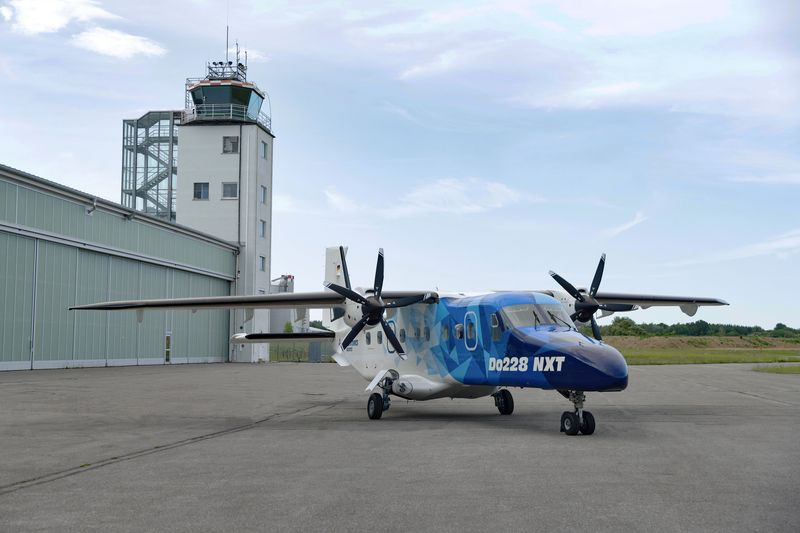
General Atomics AeroTec Systems has presented the Do228 NXT demonstrator outside Germany for the first time, using the Farnborough International Airshow to return the established utility aircraft design to a wider international market.
Based on the Dornier 228 configuration, the aircraft combines a modernised cockpit and cabin with updated components, new equipment options, and a reworked supply chain. Intended applications include passenger transport, cargo, surveillance, environmental monitoring, medical evacuation, maritime patrol, and other special missions.
The Farnborough appearance followed the demonstrator’s first flight, formal roll-out, and public debut at ILA Berlin. Potential operators can now examine a representative aircraft rather than assessing the restarted programme solely through drawings and technical specifications.
Do228 aircraft have operated in Britain for more than 40 years across passenger services, fisheries patrol, and flight-test applications. Their high-wing configuration, rectangular cabin, short-field performance, and ability to use less developed airfields have supported operations where conventional regional aircraft would be unsuitable.
While retaining the underlying aerodynamic and structural concept, the NXT introduces systems intended to improve crew workload, maintainability, mission integration, and access to replacement parts. General Atomics has also brought important manufacturing activities under closer internal control.
Wing and flight-control production has been established at Oberpfaffenhofen, strengthening oversight of components that are central to aircraft performance and certification. Rebuilding those capabilities requires tooling, jigs, documented processes, approved materials, inspection, and employees experienced in low-volume aerospace production.
Output will increase progressively rather than moving directly into high-rate manufacture, with annual production expected to rise from approximately three aircraft to as many as ten as orders, supplier readiness, and factory performance develop.
A launch customer has been identified for humanitarian and special-mission operations. Such work often requires flexible interiors, cargo access, endurance, low-speed handling, and the capacity to integrate sensors or communications equipment without developing a completely new airframe.
Established platforms return to specialist markets
The Do228 NXT reflects a wider aerospace preference for modernising proven platforms where market volumes cannot support the cost and risk of a clean-sheet aircraft. Certification expenditure, development time, and fragmented customer demand make entirely new utility designs difficult to finance.
Retaining an established airframe reduces part of the aerodynamic and structural risk, although restarting production remains an extensive industrial task. Some original suppliers may no longer manufacture the required components, materials standards may have changed, and legacy drawings must be incorporated into current production and quality systems.
Modern avionics create another integration programme because operators expect digital displays, navigation, communications, surveillance, and mission interfaces that were not available when the original aircraft entered service. Electrical loads, cooling, electromagnetic compatibility, software assurance, and cockpit certification must all be reconsidered.
Special-mission customers may add radar, electro-optical sensors, communications relays, operator consoles, medical equipment, or additional power systems. The airframe consequently needs a controlled modification route that supports several configurations without creating an unmanageable number of unique aircraft.
Low production volumes also affect purchasing because suppliers must remain willing to manufacture aerospace-qualified components in small batches over long periods, often while serving higher-volume commercial programmes. General Atomics will need sufficient commonality between aircraft to maintain viable pricing and predictable lead times.
Bringing wing and control-system manufacture in-house reduces part of that dependency, but the programme will continue to rely on engines, propellers, landing gear, avionics, electronics, raw materials, and specialist processes supplied elsewhere. Some of those components may have lead times extending well beyond final assembly.
The aircraft enters a market containing many ageing fleets whose operators have continued using older utility platforms because replacement choices are limited. A modernised design can offer a lower-risk route, provided operating cost, technical support, and long-term parts availability remain credible.
Aftermarket capability will be as important as new aircraft production because operators in remote locations require documentation, spares, repair routes, employee training, and rapid support when an aircraft is unavailable. General Atomics already provides Do228 maintenance and overhaul services, giving the programme an established support base.
Farnborough provides international visibility, while sustained production will depend on the performance of the Oberpfaffenhofen operation. Stable output, supplier delivery, certification, and repeat orders will determine whether the NXT becomes a durable manufacturing line rather than a limited restart around a small number of aircraft.