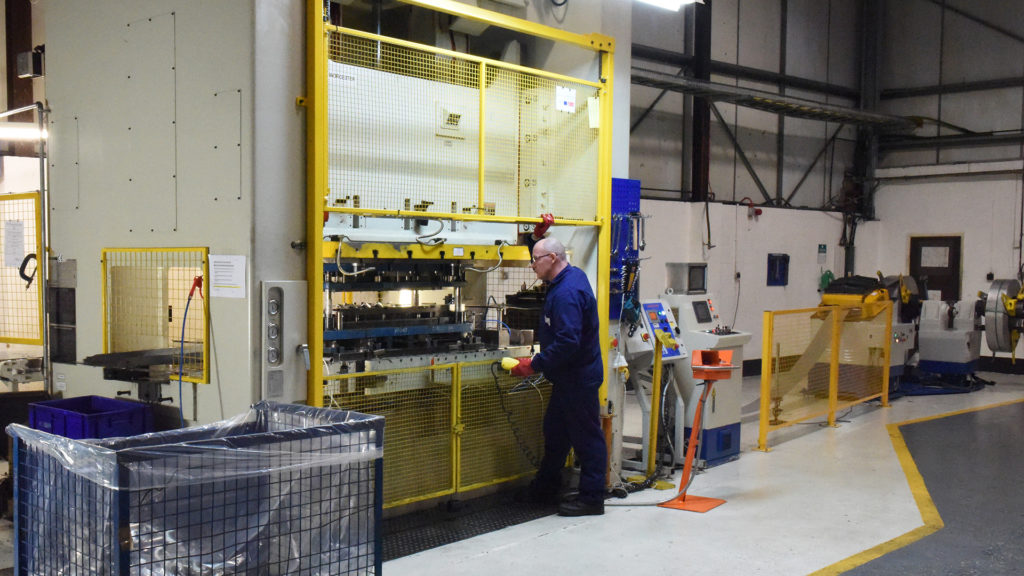
WorkJam has published research suggesting that UK manufacturers are slowing recruitment as cost pressure rises, while most remain at an early stage in scaling artificial intelligence across workforce and production operations.
The findings are based on a survey of 142 manufacturing professionals conducted at Smart Manufacturing Week 2026. More than half of respondents, 52%, said their organisation had reduced or slowed hiring over the past six months. Rising labour costs and productivity pressures were cited by 24% as a reason for slowing recruitment in skilled production and engineering roles, while 23% said they were increasing prices to offset higher costs.
Cost reduction was identified as the sector’s biggest challenge by 19% of respondents. Employee engagement and retention also remain prominent workforce concerns, named by 16% and 15% respectively. The survey suggests that manufacturers are trying to protect output while managing a cost base shaped by labour, regulation, productivity demands, and broader operating pressure.
Regulation is also changing workforce management. Nearly 40% of respondents said the Employment Rights Bill and wider labour regulations had already forced them to change how they manage their workforce. More broadly, 67% said current pressures were leading them to rethink how they organise operations, while half said cost control was taking priority over employee experience and workforce enablement.
The AI findings show a clear gap between adoption and maturity. More than three-quarters of respondents, 76%, said their organisation was using AI to support workforce or production operations, but only 11% reported deployment at scale. Just 7% said they were investing in AI primarily to improve the shopfloor experience, with most activity instead focused on efficiency and productivity.
Mark Williams, Managing Director EMEA at WorkJam, said: “Manufacturers are currently facing difficult business decisions, but as the findings suggest, many also recognise that reducing costs cannot come at the expense of workforce capability.”
The research reflects a familiar manufacturing tension. Cost pressure is not removing the need for skilled people; it is making workforce decisions harder. Companies are trying to retain experienced operators, production staff, and engineers while limiting hiring exposure and improving productivity. That combination often increases interest in digital tools, though it does not automatically lead to full operational transformation.
Work on manufacturing resilience has shown the same pattern. The Rubix Uptime Index highlighted how companies are adapting to volatility through maintenance discipline, supplier relationships, skills, inventory visibility, and digital workflows, with resilience now built through operational adjustments rather than one-off interventions. WorkJam’s survey points to the same manufacturing environment: factories are not seeing easier conditions, but they are becoming more deliberate in how they manage disruption.
The AI maturity gap is particularly revealing. Pilot projects and departmental tools can create useful gains, but production environments are harder to change than office workflows. Factory AI depends on reliable data, connected assets, integration with maintenance and quality systems, cyber controls, operator trust, and clear responsibility for decisions. A model that works in a dashboard does not automatically work on a live production line.
Industrial AI deployment plans are moving toward practical factory use cases such as predictive maintenance, quality control, supply optimisation, energy efficiency, safety, and workforce capability. The earlier focus on factory-level AI deployment showed how productivity gains depend on skills, validation, legacy equipment integration, and clean operational data. WorkJam’s numbers suggest many manufacturers are now exploring those areas, but few have reached scaled deployment.
The workforce element cannot be separated from the technology programme. AI tools introduced only as cost-cutting measures may face adoption resistance if operators and managers see little practical benefit. Tools that reduce administrative burden, improve shift communication, support training, capture operational knowledge, or simplify compliance can help maintain workforce capability while improving efficiency.
Pressure on skilled production and engineering roles is especially acute. These are not always easy positions to replace when demand returns. Slowing recruitment can protect short-term cost, but it can also increase long-term vulnerability if experienced workers leave, apprenticeships are cut, or engineering knowledge becomes concentrated in too few people.
The survey captures a sector caught between immediate financial discipline and long-term capability building. AI can help ease that tension only when it is implemented as part of a broader operating model. Manufacturers need cost control, but they also need people, skills, equipment reliability, and shopfloor engagement. Scaled deployment is likely to come from companies that treat AI as an operational system rather than an isolated software purchase.