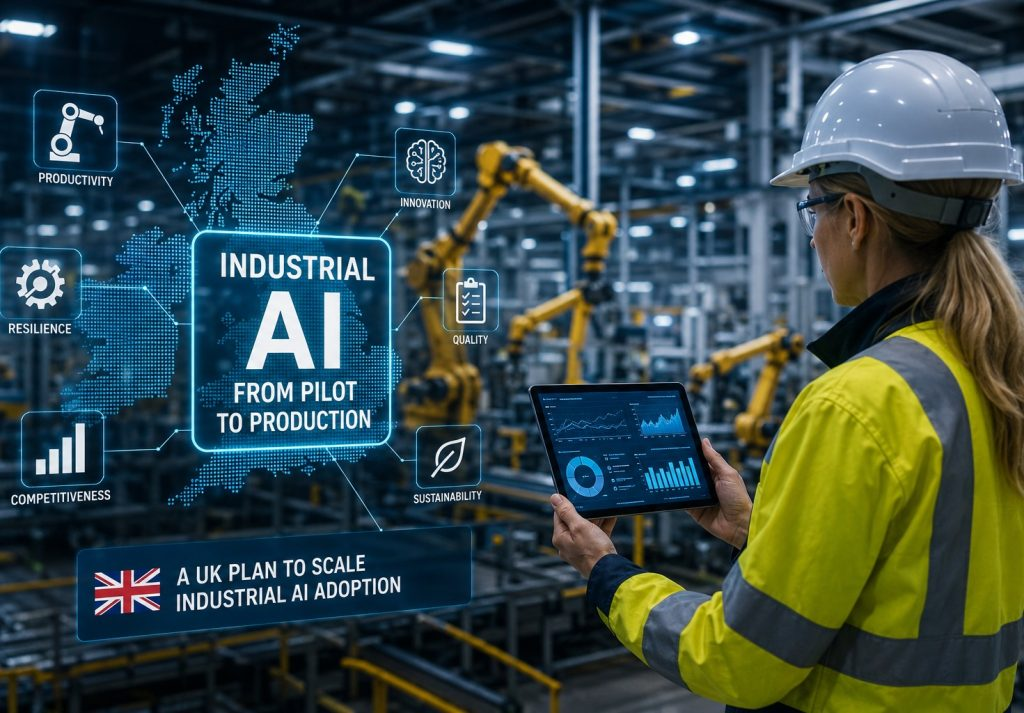
High Value Manufacturing Catapult has set out a plan to help UK manufacturers move artificial intelligence from pilot projects into sustained production use, warning that industrial AI capability will not improve competitiveness unless adoption accelerates across factories and supply chains.
The advanced manufacturing AI adoption plan, authored by Chris Dungey, AI Champion for the advanced manufacturing sector and chief technology officer at HVM Catapult, treats deployment as the central barrier. The UK has strong engineering, manufacturing research, and artificial intelligence capability, yet many industrial companies remain caught between proof-of-concept work and operational systems embedded into production.
Predictive maintenance, quality control, supply-chain optimisation, production responsiveness, energy efficiency, safety, and workforce capability are identified as practical areas where AI can create value. The plan also links AI adoption with broader automation and robotics uptake, reflecting the dependence of machine intelligence on connected assets, robust factory data, and digitally mature production environments.
Manufacturing contributes around £234bn annually to the UK economy, supports 2.5 million jobs, and accounts for almost half of private sector research and development investment. HVM Catapult says industrial AI deployment could boost productivity by 2.5% and add £5bn to £6bn in gross value added each year once adopted at scale.
Factories are difficult environments for AI deployment because production systems are physical, expensive, safety-critical, and often built around equipment lifecycles measured in decades. Data can be fragmented across machinery, enterprise software, quality systems, maintenance records, spreadsheets, supplier platforms, and informal operator knowledge. Even where AI models perform well in testing, the route into routine production can be slowed by validation, cyber risk, operator trust, legacy infrastructure, and unclear responsibility for decisions made with algorithmic support.
The plan therefore focuses on adoption support rather than new research institutions. It draws on existing UK structures including Made Smarter, Innovate UK, BridgeAI, Make UK, HVM Catapult capability, and regional innovation networks. The emphasis is on helping manufacturers validate tools, identify suitable use cases, build trusted data foundations, and develop the skills needed to operate AI in production settings.
Factory teams need systems that reduce scrap, predict equipment failure, shorten changeovers, improve scheduling, cut energy intensity, support maintenance planning, and make quality problems visible earlier. Commercial value depends on whether AI can withstand production pressure, audit requirements, operator routines, cyber-security demands, and the realities of mixed-age assets.
Other major industrial economies are already shifting from AI invention to AI diffusion, where advantage depends on how quickly companies can convert available tools into operational gains. The UK’s strength in research does not guarantee industrial advantage if manufacturers elsewhere move faster on deployment, standardisation, and skills.
The plan also connects with wider European concerns around technology sovereignty. Moves around chips, AI infrastructure, cloud, and energy digitalisation point to a policy environment in which digital capability is increasingly treated as industrial infrastructure. Inside the factory, the same principle applies: AI depends on data architecture, secure connectivity, reliable systems, skilled users, and equipment that can be monitored and controlled consistently.
Adoption will require more than software procurement. Manufacturers need clear data governance, ownership of operational decisions, integration with maintenance and quality processes, and confidence that AI outputs can be explained, audited, and acted upon. A model that predicts equipment failure has limited value unless maintenance teams trust it, spare parts can be planned, downtime can be scheduled, and production teams are ready to respond.
Workforce capability runs through the plan because industrial AI will depend on technicians, operators, engineers, production managers, and digital specialists working together. The strongest factory use cases are likely to augment human judgement rather than replace it outright, particularly in environments where process knowledge, tacit experience, and safety decisions remain central.
Smaller manufacturers face a capacity problem as much as a technology problem. Many do not have internal data science teams or spare engineering time to run complex digital programmes, and generic advice about innovation rarely survives contact with daily production demands. Shared demonstrators, trusted validation, practical implementation support, and regional expertise could help close that gap.
The UK has spent years proving that advanced manufacturing research can generate world-class technologies. The harder industrial task is making those technologies ordinary enough to use at scale. AI will not close the productivity gap while it remains confined to pilots, dashboards, and strategy documents. It has to reach production lines, survive operational discipline, and deliver gains manufacturers can measure in output, cost, quality, energy, and resilience.