Vention has opened a Physical AI laboratory in Montreal intended to move robotic-manipulation research into scalable manufacturing applications across industrial goods, electronics, and automotive production.
The lab is led by Jimmy Li, Vention’s Director of Physical AI, and currently has a team of eight. The company is expanding the group, with more than 16 positions identified across robotics control, simulation, and Physical AI research.
Its research programme combines industrial data collection, robotics control, motion planning, conventional computer vision, vision foundation models, learning from demonstration, and reinforcement learning. Joelle Pineau, Chief AI Officer at Cohere, has joined the programme as an external technical adviser.
Vention says the objective is not simply to demonstrate that a robot can complete a task under laboratory conditions, but to validate new capabilities against the cost, reliability, and variability requirements found on real production lines.
That distinction is important because industrial robotics already performs highly complex work where the environment is tightly controlled. Robots weld vehicle bodies, load machine tools, palletise products, and assemble components reliably when the workpiece arrives in a predictable position and the sequence can be programmed in advance.
Performance becomes harder when parts are presented inconsistently, objects deform, tolerances vary, or the robot has to decide how to approach the task rather than replay a predetermined path.
Physical AI is being applied to that gap. Machine vision can establish what is present, learned models can interpret the scene, and motion-planning software can determine how a robot should grasp or move an object without an engineer explicitly programming every possible arrangement.
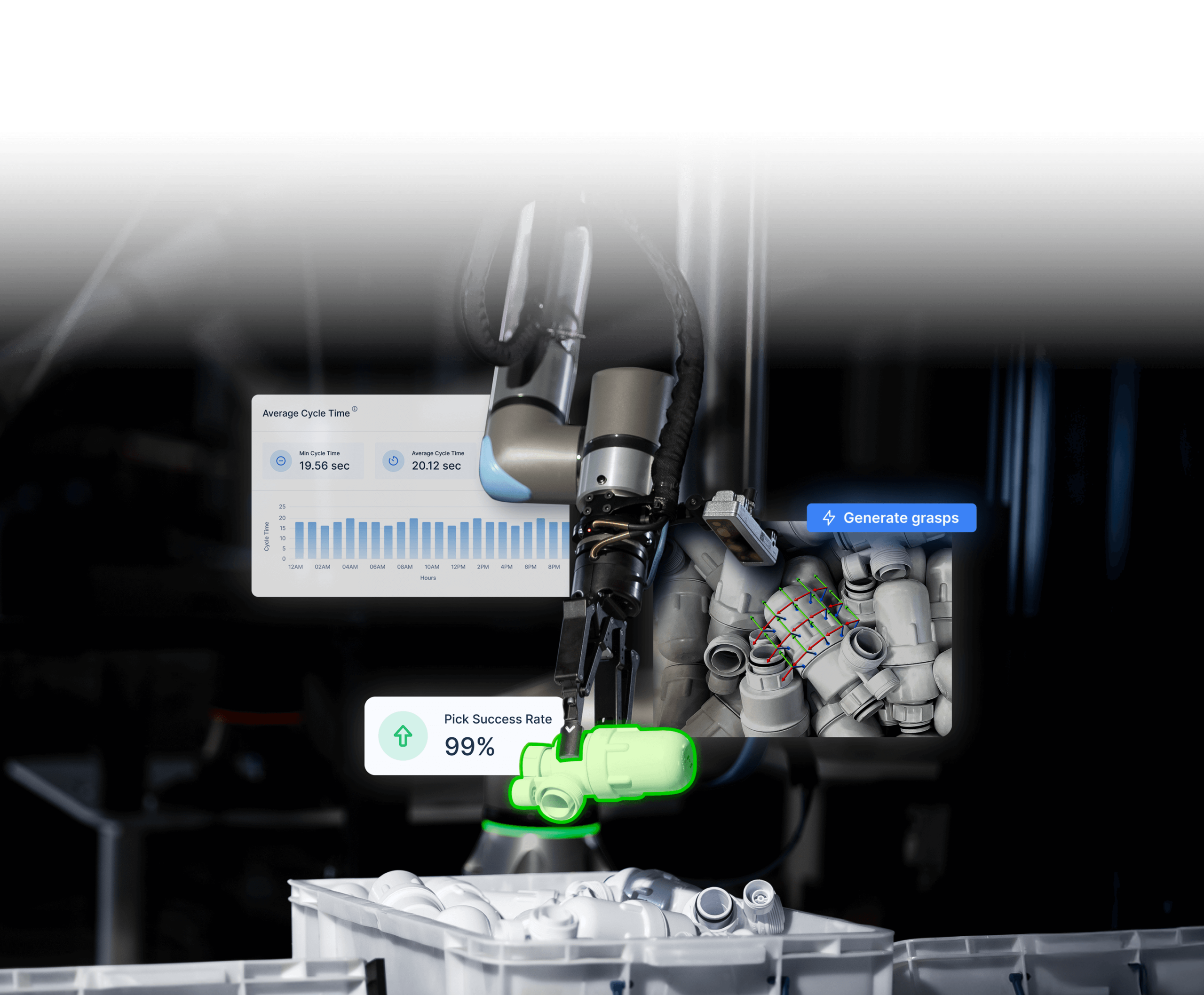
Vention introduced one part of that architecture in February with GRIIP, a modular pipeline covering scene digitalisation, object segmentation, pose estimation, grasp selection, and collision-free motion planning. It combines foundation models from external technology providers with Vention’s own models.
The company also plans to release a public GRIIP software development kit, allowing engineering teams to adapt the pipeline for their own manufacturing requirements rather than using it solely as a fixed Vention application.
That flexibility will be useful only if manufacturers can validate the resulting systems. A model that chooses a sensible grasp during a demonstration still has to deal with damaged parts, unexpected obstacles, poor lighting, sensor contamination, fixture wear, and the occasional condition absent from its training data.
Failure recovery becomes critical. Traditional automation engineers spend considerable effort defining what a machine should do when a sensor does not trigger, a component is missing, or a sequence falls outside its expected state.
AI-enabled robotics requires the same discipline even where the initial movement was generated dynamically. A system that completes 99% of tasks autonomously can still perform worse than conventional automation if the remaining 1% produces unpredictable stops requiring specialist intervention.
Vention’s advantage is its access to industrial deployments. The company says more than 28,000 machines have been deployed worldwide across a community of more than 6,000 factories, including users among 90 of the Fortune 500.
That installed base can provide feedback from production environments rather than relying entirely on synthetic or academic datasets. Vention says its researchers are using client problems and industrial manipulation data to shape benchmarks and post-train robotics models.
The quality of those examples matters more than the sheer volume. Useful industrial datasets need to include edge cases, failed grasps, awkward geometry, process variation, and recovery behaviour if models are expected to operate beyond ideal conditions.
The company is already working with industrial and electronics manufacturers, including a large automotive OEM, on complex unstructured tasks in final assembly. Vention has not named the vehicle manufacturer or supplied enough detail to assess the individual production applications, so those projects should be regarded as active development rather than evidence that general-purpose robotic manipulation has already been solved.
Physical AI is nevertheless becoming commercially material for Vention. The company reports that revenue associated with the segment has increased 400% over the past year, making it its fastest-growing business area.
That is a company-reported growth rate from an undisclosed starting base, so it provides evidence of commercial momentum rather than a useful measure of the total market. The more important test is whether deployment costs fall as the models and software mature.
A technically capable system can still lose to manual labour or conventional automation if every application requires months of specialised AI engineering. To broaden adoption, vision, manipulation, commissioning, and recovery behaviour need to become repeatable enough that integrators can deploy them as engineering tools rather than research projects.
The Montreal lab is designed around that transition. Its value will be determined less by the number of models developed than by whether manufacturers can measure the results using familiar factory metrics — cycle time, uptime, yield, changeover effort, intervention rate, and return on investment.