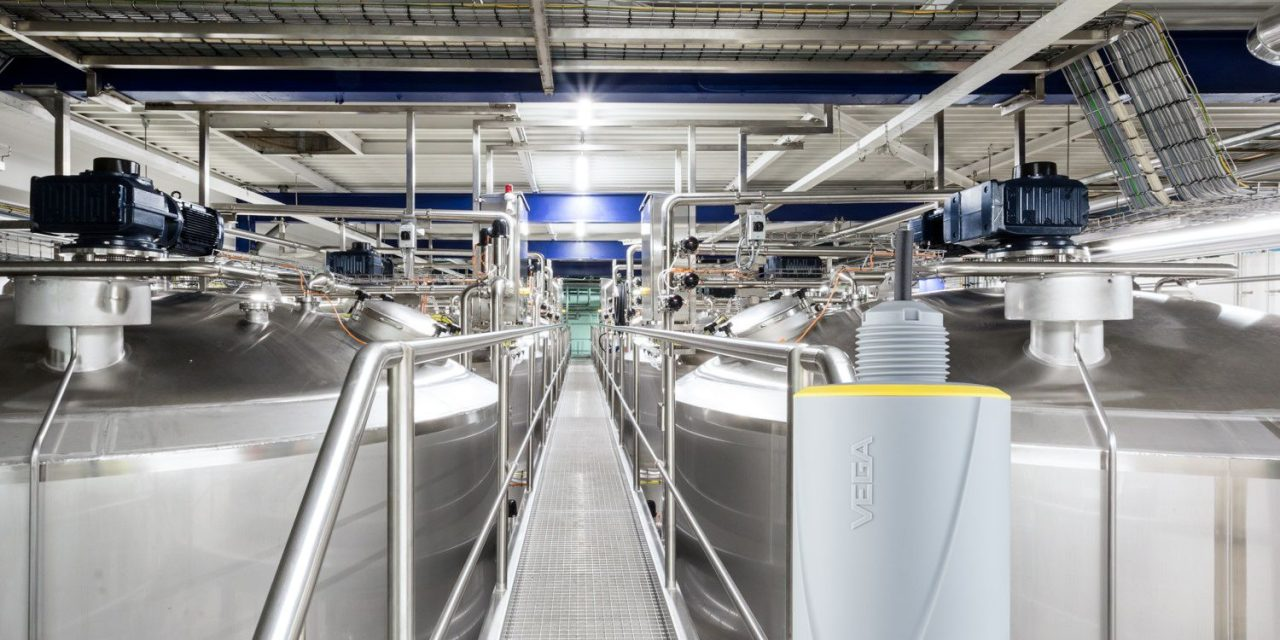
VEGA radar level sensors are being used at Döhler’s Oosterhout site in the Netherlands to modernise stock measurement across a large beverage ingredients storage operation.
The plant operates 105 tanks for liquid raw materials including fruit concentrates, not from concentrate products, and other ingredients used in beverage production. Tank capacities range from 50 to 1,000 cubic metres, creating a substantial stock management challenge when measurements depend on manual inspection.
The deployment replaces manual level checks with stationary radar level measurement, giving the site real-time visibility of tank contents. That changes how stock levels, tanker movements, production planning, and overfill prevention can be managed across the facility.
Manual tank measurement remains common in parts of process manufacturing, particularly where legacy systems, varied tank geometries, or difficult product conditions have slowed automation. The cost is often hidden in routine activity: operators spend time checking levels, stock data becomes less current, tanker scheduling becomes less efficient, and production planning has to account for uncertainty.
Radar measurement gives process plants a route to continuous, non-contact level data. In liquid ingredients operations, that can be useful where hygiene, product variability, vapour, foam, temperature, or access constraints make other approaches less attractive. The value comes not only from the sensor reading, but from how that reading feeds planning and control decisions.
At Döhler, the operational gains include reduced manual effort, better tanker planning, lower overfill risk, and more consistent production standards. Real-time stock data can also help avoid unnecessary tanker trips, supporting more efficient use of logistics capacity and raw materials.
The project fits a wider automation pattern in which mature sensing technologies are being applied to persistent production bottlenecks. Compact drive hardware for basic automation duties such as pumps, fans, and conveyors shows how incremental upgrades can affect energy use, uptime, and process reliability when integrated properly.
Visibility is often the first step toward more advanced control in process plants. Production planners cannot optimise a system that is measured only periodically or inconsistently. Tank level data feeds into materials planning, batch preparation, tanker scheduling, inventory reconciliation, production sequencing, and maintenance decisions.
When that data is manual, delayed, or inconsistent, uncertainty moves through the whole planning system. Operators may hold more stock than needed, delay batches, schedule tankers conservatively, or discover mismatches late in the process. Continuous measurement helps bring storage activity closer to production control.
The food and beverage sector adds further requirements around ingredient quality, hygiene, traceability, cleaning, product changeovers, and waste reduction. A storage tank is part of the production system rather than a passive container. Poor level visibility can create unnecessary handling, delayed batches, stock imbalance, or avoidable product loss.
Radar sensors can also suit brownfield upgrades because plants can improve measurement capability without redesigning an entire process line. Mounting, configuration, communications, and integration into existing systems still need careful engineering, but the disruption can be lower than a larger plant replacement project.
The sustainability element is practical. Reducing overfills, avoiding unnecessary tanker journeys, improving utilisation of stored product, and maintaining more accurate stock control all reduce waste. In high-volume ingredients handling, small improvements in planning can build into material savings over time.
The Döhler deployment shows how process automation often advances through focused improvements rather than sweeping plant transformation. In a facility with 105 tanks, replacing manual checks with continuous radar measurement turns storage from a periodic inspection task into an active part of production control.