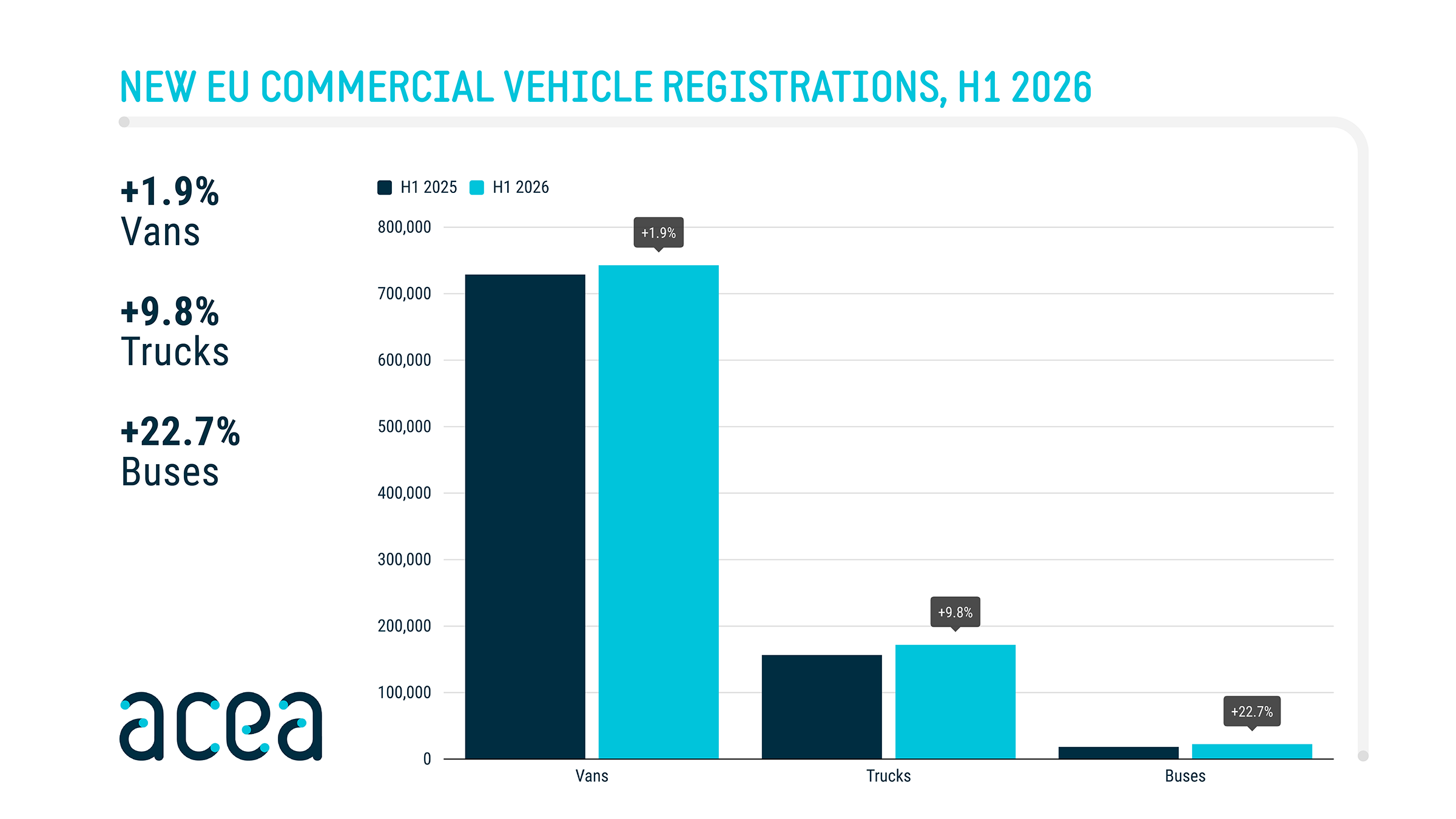
The European Automobile Manufacturers’ Association has reported higher registrations across vans, trucks, and buses during the first half of 2026, strengthening demand signals for commercial vehicle manufacturers and component suppliers.
New van registrations across the European Union increased by 1.9% to 742,759 units. Truck registrations rose by 9.8% to 171,933, while bus and coach registrations climbed by 22.7% to 22,590 vehicles.
National markets moved in different directions, with Spanish van registrations increasing by 7.9% while Germany declined by 4.6%, Italy by 4.7%, and France by 2.1%.
Across the major truck markets, Poland recorded growth of 25.9%, Spain increased by 13.2%, and Germany by 7.1%, while France remained broadly flat. Heavy truck registrations rose by 11.1%, compared with 2.8% growth across medium trucks.
Bus demand expanded particularly quickly in Italy, where registrations rose by 51.6%. Germany and France each recorded growth of 21.6%, Poland increased by 78%, and Spain declined by 8.5%.
Powertrain data shows electrification proceeding at markedly different rates across the three vehicle classes. Electric van registrations increased by 41.6% and reached a 13.2% market share, while hybrid vans grew by 31.7% to account for 3.3%.
Although electric vans gained share, diesel still represented 79.1% of registrations, with volume declining by 1.8% to 587,272 vehicles. Battery models are expanding without yet displacing the conventional powertrain at fleet scale.
Truck electrification remains at an earlier stage, with diesel accounting for 92.1% of registrations even as electric demand grew by 47.7%. Battery trucks secured a 4.8% share, and Germany, the Netherlands, and France accounted for almost three quarters of those registrations.
Developing an electric commercial vehicle and creating an operating environment in which fleets can use it economically remain separate challenges. Trucks require depot charging, high capacity grid connections, suitable route planning, predictable dwell times, and sufficient payload after batteries are installed.
Manufacturing decisions are consequently tied to infrastructure investment beyond the factory. Vehicle producers can establish battery assembly, electric axle, power electronics, thermal management, and final assembly capacity, yet demand will remain constrained where operators cannot secure charging power or make the duty cycle work.
Bus electrification has advanced faster because vehicles often return to a defined depot, operate scheduled routes, and are procured through public or long term contracts. Those characteristics make charging easier to plan and give manufacturers clearer visibility over replacement programmes.
Because vans serve a more varied market, urban delivery fleets can benefit from predictable routes and overnight charging while smaller businesses may lack dedicated depots, off street parking, or the capital required for vehicles and charging equipment.
The production shift extends across batteries, electric motors, inverters, gear systems, thermal management, braking, lightweight materials, and charging equipment. Conventional engine, exhaust, and fuel system suppliers face a prolonged transition because diesel remains the volume technology even as investment moves towards electrified platforms.
Manufacturers are adapting plants for several powertrains, as shown by Mercedes-Benz VLE production in Vitoria, where the factory has been reconfigured around a new electric architecture while retaining production flexibility.
As factories support several powertrains on shared lines, battery packs, engines, transmissions, cooling circuits, software, and safety procedures increase complexity across assembly and supply. Sequence accuracy must be preserved without tying expensive equipment to a single demand forecast.
Higher registrations should support production schedules during the second half, although geographical variation will affect product mix and allocation. Commercial vehicle plants commonly serve several countries, and stronger orders in one market can offset weakness elsewhere only where specifications and delivery requirements align.
Interest rates, construction activity, freight volumes, municipal budgets, and business confidence will continue to affect replacement decisions. Vans and trucks are productive assets, allowing operators to defer purchases when workloads or finance costs remain uncertain.
Component suppliers will need forecasts that distinguish platform investment from actual production volume, since rapid percentage growth can still represent a relatively small market for electric trucks.
First half growth gives manufacturers a firmer base, especially in trucks and buses. The industrial direction remains electrified, but the registration data points to a long mixed powertrain market rather than a rapid and uniform departure from diesel.