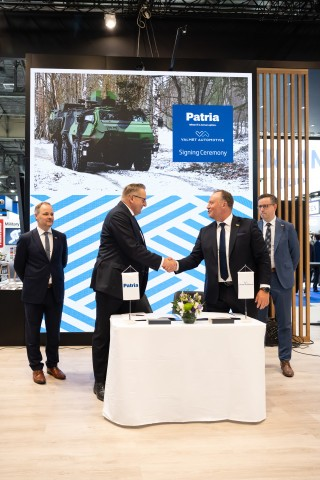
Valmet Automotive and Patria have signed a multi-year agreement to expand production of Patria 6×6 armoured vehicles at Valmet Automotive’s Uusikaupunki plant in Finland.
The agreement will increase annual production capacity to hundreds of vehicles. It follows a cooperation agreement signed in December 2025, which covered technology transfer and manufacture of the first vehicles. The new agreement continues that cooperation and moves the arrangement towards larger volume production, although the companies have not disclosed the commercial value.
Valmet Automotive’s manufacturing capability gives Patria a route to scale output at a time when European demand for protected mobility is rising. The Patria 6×6 is part of a broader shift in land systems procurement, with countries seeking common platforms, fleet support, and faster industrial delivery against a more demanding security background.
The agreement demonstrates how automotive manufacturing expertise can be redirected into defence production when the product requires robust assembly, vehicle integration, supply chain coordination, and quality discipline. Contract manufacturing skills developed in automotive do not transfer automatically to armoured vehicles, but they provide a strong base for production engineering, process control, workforce planning, and ramp-up management.
The Uusikaupunki plant gives the project an established industrial setting. Armoured vehicle production involves different materials, protection systems, mission equipment, testing requirements, and customer acceptance processes from civilian vehicles. Even so, line balance, supplier control, documentation, rework reduction, operator training, configuration management, and end of line validation remain central.
Defence production is increasingly being treated as part of wider industrial policy. Advanced engineering, materials, electronics, automation, and national readiness are now closely linked in procurement and supply chain planning. Defence programmes cannot be delivered only by prime contractors; they depend on production partners, machine shops, electronics suppliers, materials specialists, system integrators, and test capacity distributed across the industrial base.
European vehicle production demand has changed quickly. Support for Ukraine, national rearmament programmes, NATO planning assumptions, and renewed attention to territorial defence have increased demand for equipment that can be delivered in useful quantities. Production capacity, rather than concept design, can become the limiting factor.
Armoured vehicles also sit at an intersection between automotive manufacturing and defence engineering. They need mobility, maintainability, manufacturability, and fleet support, alongside ballistic protection, payload flexibility, communications integration, and survivability. Any production expansion has to preserve that balance. Faster output is valuable only if vehicles meet operational and quality standards.
Valmet Automotive’s role may also help Patria manage industrial flexibility. Established automotive manufacturers are used to complex supply networks, model changes, and production schedules shaped by customer demand. Defence orders can also require rapid scaling and configuration variation between national customers, but with tighter security, documentation, and acceptance requirements.
The agreement strengthens Finland’s defence industrial position and gives Europe another example of automotive capacity being used for strategic manufacturing. It also underlines how defence production is becoming less separated from wider manufacturing capability. Plants, people, suppliers, and production systems originally built around commercial markets can become part of defence readiness when the industrial requirements are understood and controlled.
Capacity measured in hundreds of vehicles a year is meaningful only if supply chains, labour, testing, customer acceptance, and programme management remain aligned. As European defence demand continues to rise, the ability to convert manufacturing infrastructure into reliable military vehicle output will carry increasing strategic value.