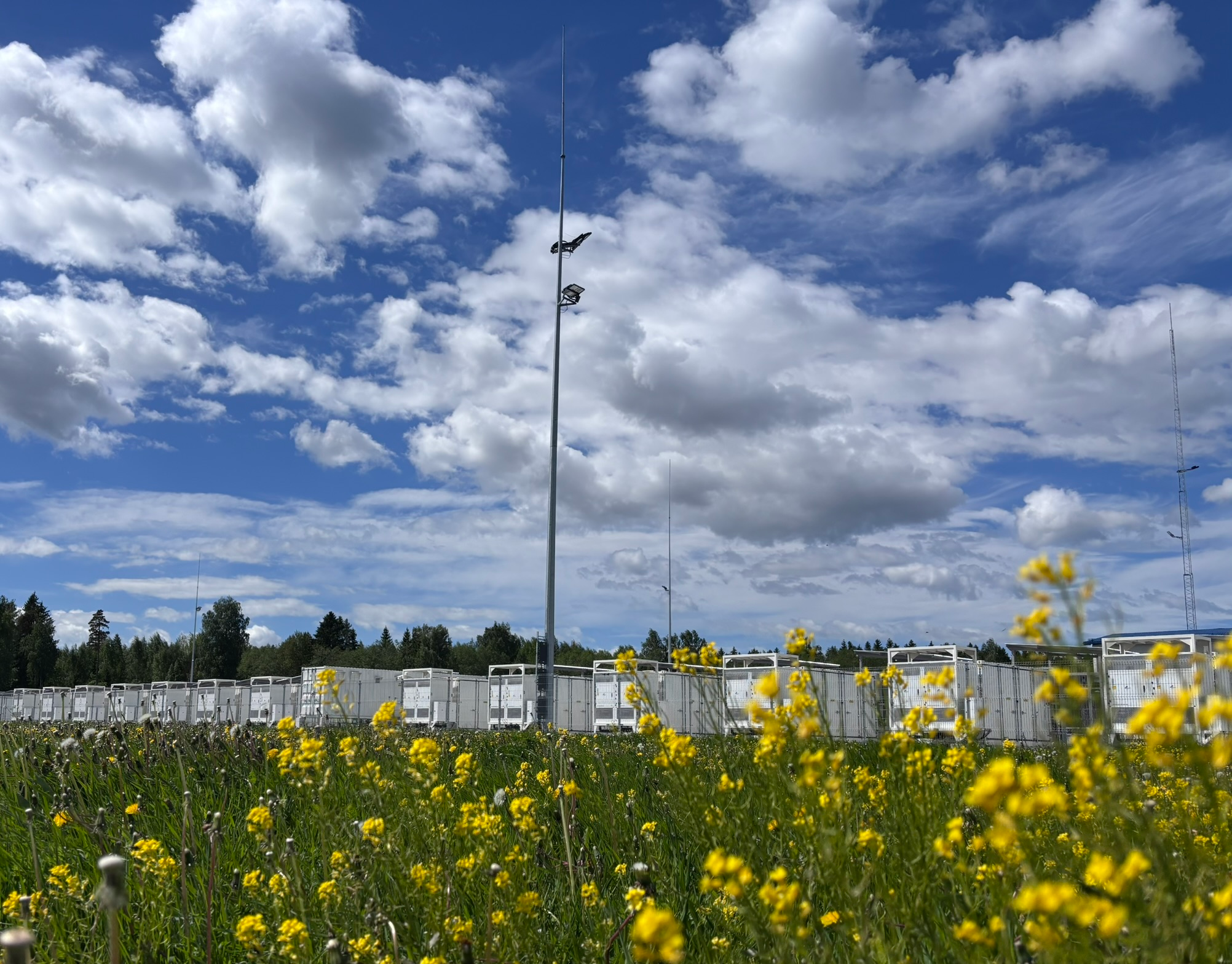
Taaleri Energia has invested in the 192MW/420MWh Raudsepa battery energy storage project in Estonia, with construction scheduled to begin this month ahead of full commercial operation in November 2027.
The SolarWind III Fund, a SolarWind III Fund co-investor, and KJK Fund III will jointly own the project, which is located around 50 kilometres south of Tartu. Renewable energy developer Evecon developed Raudsepa with French independent power producer Corsica Sole.
Estonian contractor Smartecon will construct and install the project on a turnkey basis. The system will use battery storage equipment from LG Energy Solution and European made inverters supplied by Power Electronics, connecting a substantial block of controllable capacity to the Estonian electricity system.
At 192MW, Raudsepa is designed to move large amounts of power onto or off the network quickly. Its 420MWh energy capacity gives a nominal duration of a little over two hours at maximum discharge, placing it in the part of the market used for short duration balancing as well as shifting electricity between different periods of the day.
The owners intend to operate the battery across several markets rather than depend on one fixed revenue stream. Taaleri said the optimisation strategy will combine electricity arbitrage with ancillary services, allowing the project to respond to wholesale price differences while also supplying technical balancing functions to the grid.
Ville Rimali, investment director for energy storage at Taaleri Energia, said: “With high power price volatility and the phase-out of oil-fired generation, Estonia represents a compelling battery storage investment opportunity.”
Combining several services is increasingly important for utility scale batteries. Arbitrage income depends on spreads between lower and higher priced periods, while ancillary markets reward capabilities such as rapid response and balancing that help system operators maintain frequency and stability.
No single service is guaranteed to provide a stable commercial model over an asset’s entire life. As more batteries enter balancing markets, competition can reduce returns, making optimisation across several revenue sources more important. The ability to move between those markets also depends on technical factors including state of charge, power response, cycling strategy, connection constraints, and battery degradation.
Raudsepa will therefore operate as both electrical infrastructure and a continuously dispatched commercial asset. Its control system will have to determine when capacity is most valuable for grid services, when energy should be charged or discharged against wholesale prices, and how much headroom needs to be retained for contracted obligations.
The choice of suppliers divides responsibility across several parts of the project. LG Energy Solution will provide the battery equipment, Power Electronics the inverter technology, and Smartecon the turnkey construction and installation package. Those interfaces have to be engineered around grid compliance, protection, control, communications, thermal management, and the performance guarantees associated with the finished plant.
Construction beginning in September gives the project roughly 14 months before the stated November 2027 operating target. During that period the work will move from civil preparation and electrical infrastructure through delivery and installation of battery systems, inverters, transformers, cabling, control equipment, commissioning, and grid testing.
The project is Taaleri SolarWind III’s first battery investment in Estonia and Taaleri Energia’s fifth investment in the Baltic countries. The fund manager has been expanding beyond wind and solar into storage as electricity systems require more flexible capacity alongside variable generation.
Batteries do not create additional energy, but they can shift output across time and respond much faster than many conventional generating assets. That makes them useful where wind and solar output does not match demand, or where system operators need rapid changes in power to keep the network balanced.
The Baltic electricity system is also undergoing a broader change as Estonia, Latvia, and Lithuania deepen their integration with continental European markets and reduce dependence on legacy eastern infrastructure. More controllable capacity gives system operators and market participants another tool as generation, interconnection, and demand patterns continue to change.
KJK Capital said Raudsepa is expected to be the largest battery project in the Nordic and Baltic region when it enters operation. That status is provisional because other projects could be commissioned before November 2027, but the claim illustrates the scale of the asset relative to the current regional market.
Installed megawatts alone will not determine performance. Availability, degradation, market prices, grid constraints, cycling strategy, and the changing value of ancillary services will decide how much of the project’s theoretical flexibility can be converted into revenue over time.
With ownership, contractors, and major equipment suppliers identified, Raudsepa has moved beyond the speculative end of the storage pipeline. The next material milestones are physical construction, grid connection, commissioning, and evidence that a 192MW battery can maintain its expected mix of trading and system service revenues once it joins an increasingly crowded European storage market.