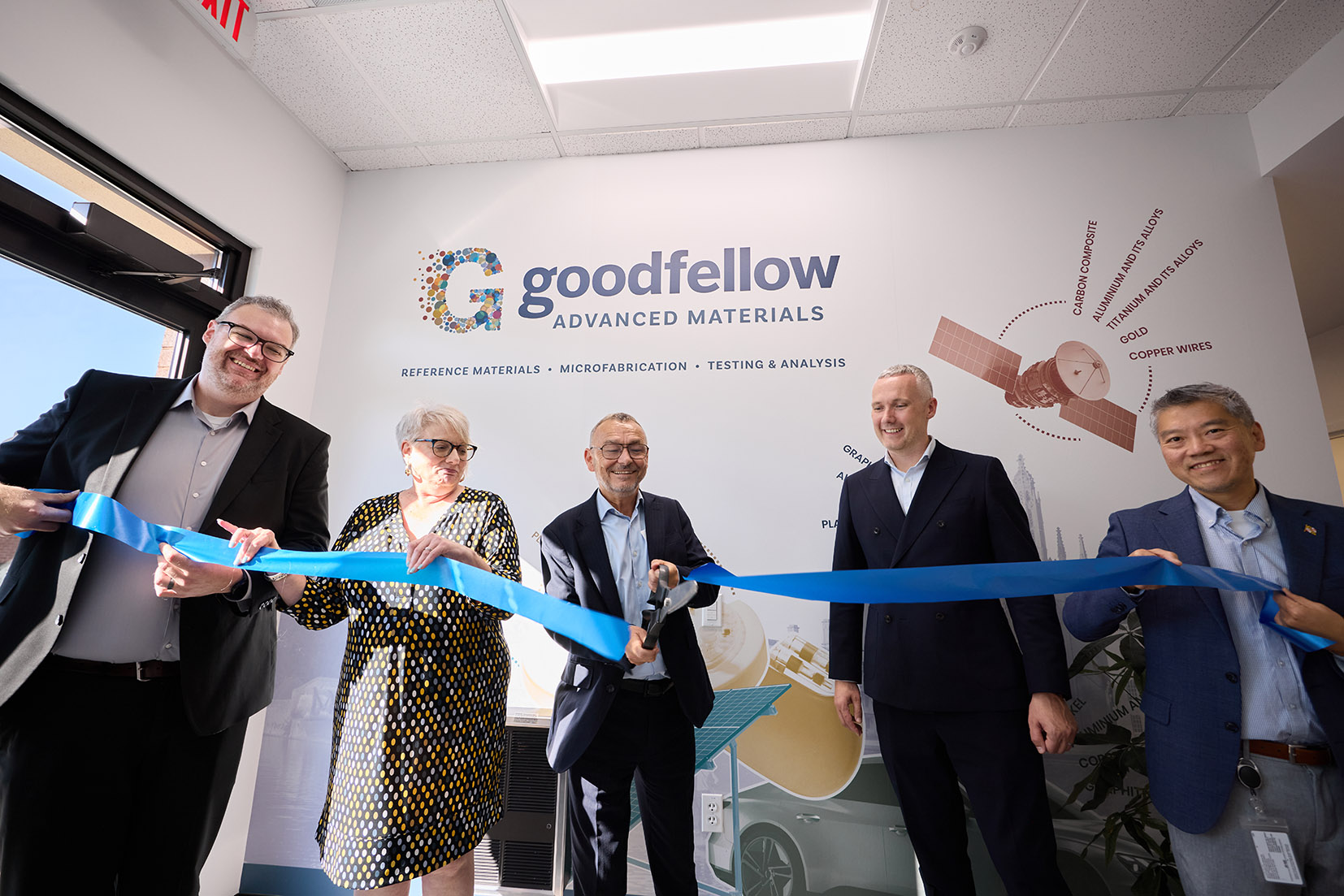
Goodfellow has invested more than £1.5 million in an expanded precision engineering centre in Columbia, Maryland, adding laser micromachining capacity as the UK advanced materials supplier increases its production presence in the United States.
The 15,000 sq ft facility is intended to shorten lead times for US customers and support more complex and higher volume programmes than the company could handle through a smaller local footprint. Up to 20 additional jobs are planned, taking Goodfellow’s US workforce to around 60.
The centre has been equipped with advanced laser systems for micromachining and microfabrication, allowing materials and components to be processed at very small dimensions and tight tolerances. Goodfellow’s wider capability includes specialist work on metals, ceramics, polymers and composites, combining materials supply with downstream processing for customers moving from development into production.
The company says it has already secured a multimillion dollar deal with a major AI processor manufacturer using capability associated with the expansion. The customer has not been identified, but the order gives the new equipment an immediate production workload rather than leaving the site dependent entirely on future business development.
Simon Kenney, chief executive officer of Goodfellow, said: “This facility represents a significant investment in our global manufacturing footprint. It’s a statement of our confidence in the Goodfellow brand, our capabilities and in the future of precision engineering.”
The US operation is particularly relevant to customers whose requirements extend beyond buying stock material. Semiconductor, medical, aerospace and other advanced manufacturing programmes can require machining at scales or in materials that are difficult to process using conventional cutting methods, while development projects may need repeated iterations before dimensions and material specifications are fixed.
Laser processing can remove some mechanical constraints because the tool does not physically contact the workpiece. The production challenge moves instead towards control of beam parameters, positioning, heat input, repeatability, inspection and material behaviour. Those variables determine whether a process that works for a prototype can be repeated economically across a larger batch.
Goodfellow’s proposition combines that manufacturing capability with an unusually broad materials catalogue. The company supplies more than 170,000 metals, alloys, ceramics, polymers, compounds and composites to customers across aerospace, medical, electronics, energy and advanced technology markets.
That combination can be useful when a product is still moving between research and manufacturing. Development teams may initially need a small quantity of material with specific properties, then require machining, test pieces, prototypes and eventually repeat production. Keeping more of that work within one supplier can reduce the number of process handovers, although customers will still judge the finished parts against their own qualification and quality requirements.
The Columbia expansion also brings more manufacturing closer to North American customers. Goodfellow remains headquartered in Huntingdon in the UK and says exports account for around 80% of annual sales, so the investment extends its international production network rather than replacing its British operations.
Local manufacturing can nevertheless alter project lead times. Prototype components and development batches often move repeatedly between design, inspection, testing and manufacturing teams. Reducing international transport for each iteration can shorten development cycles, while a domestic production base also gives US customers another option where programme requirements favour local sourcing.
Goodfellow already describes the Columbia operation as a microfabrication facility supporting high technology applications with local expertise and production. The latest investment increases the scale of that capability and gives the business more room to support programmes that move beyond one off samples or specialist research quantities.
The company is targeting markets where material performance and manufacturing precision are closely linked. AI hardware, aerospace systems, medical products, electrification and energy technologies all use materials that can be expensive, difficult to machine or sensitive to processing conditions, increasing the value of equipment and process knowledge capable of working at small feature sizes.
Higher volume work will place different demands on the centre from research orders. Equipment utilisation, inspection throughput, scrap rates, production scheduling and operator skills become more important once a process moves from occasional specialist jobs into repeat manufacturing. The 20 planned jobs will therefore matter to capacity as much as the new laser systems themselves.
The unidentified AI processor contract provides an early indication that the site is already moving in that direction. A multimillion dollar programme can anchor utilisation, but the longer term value of the investment will depend on how many additional customers move from material supply or development work into recurring precision manufacturing.
Goodfellow has put capital, equipment and floor space behind that objective. The next measures will be recruitment, utilisation of the new laser capacity, repeat production performance and whether the Columbia centre can convert the company’s established materials business into a larger share of downstream manufacturing work in the US.