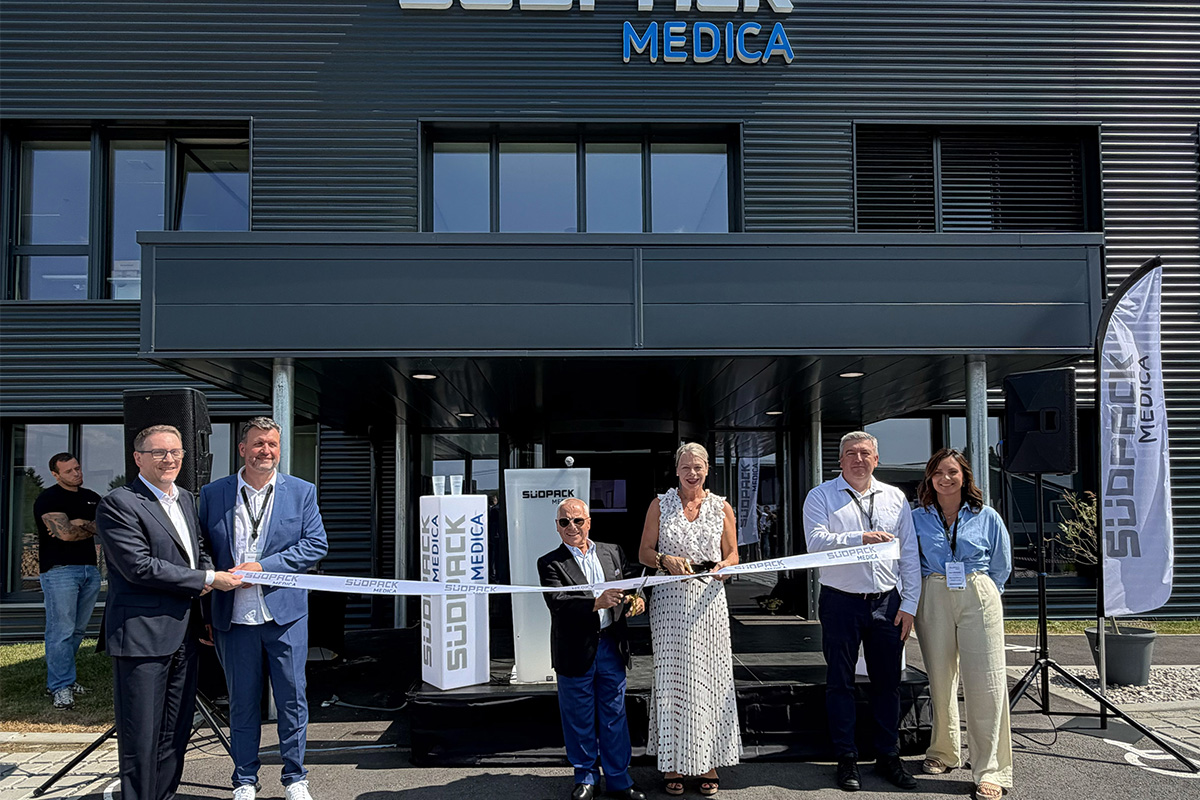
SÜDPACK has completed a major expansion of its Coulmer plant in Normandy, almost doubling the site’s ISO Class 7 and ISO Class 8 cleanroom manufacturing areas.
The enlarged operation will produce primary pharmaceutical packaging and sterile barrier systems for medical devices and diagnostics. Construction began in September 2023, and the completed project represents one of the company’s largest individual capital investments.
Coulmer is certified to ISO 13485 for medical devices and diagnostics and ISO 15378 for primary pharmaceutical packaging materials produced under good manufacturing practice requirements. Those standards cover the management systems, documentation, and production controls required to supply regulated life science customers.
Manufacturing centres on the MedGuard range, which includes pouches and packaging systems for implants, surgical kits, wound care products, and surgical textiles. The plant also produces header bags for larger medical devices that are commonly sterilised using ethylene oxide.
By increasing capacity across the complete cleanroom process chain, from film manufacture through to finished pouches, SÜDPACK can reduce transfers between controlled environments and maintain closer oversight of particulate cleanliness, material handling, and process consistency.
Medical packaging must protect a product during transport and storage while maintaining a sterile barrier until use. It also needs to open in a controlled manner, withstand the selected sterilisation method, and preserve identification and traceability throughout the product’s shelf life.
Poor seals, punctures, delamination, contamination, material degradation, or incompatibility with sterilisation can compromise the packaged device even when the device itself has been manufactured correctly. Production therefore depends on controlled film properties, validated sealing windows, inspection, environmental monitoring, and disciplined change management.
Alongside greater output, the additional capacity gives SÜDPACK more space to industrialise alternative structures intended to meet future recyclability and material-efficiency requirements. The facility will continue producing established packaging formats while development work progresses on replacement materials.
Regulation and material transition converge
Coulmer is developing mono-material polyethylene concepts intended to replace conventional polyamide and polyethylene laminates in suitable applications. The work is partly driven by the EU Packaging and Packaging Waste Regulation, which is increasing pressure on producers to reduce difficult material combinations and improve recyclability.
Replacing a multilayer structure is technically demanding because polyamide may provide puncture resistance, mechanical strength, and dimensional stability, while polyethylene contributes sealing and moisture performance. A mono-material alternative must reproduce enough of those functions without weakening machinability, barrier integrity, or sterilisation compatibility.
Medical and pharmaceutical packaging also operates under long approval cycles, so manufacturers cannot substitute a film solely because a more recyclable structure has become available. The replacement may require performance testing, ageing studies, seal validation, transport simulation, sterilisation assessment, and revised regulatory documentation.
Transition will consequently be slower than in less regulated packaging markets, with producers needing enough conventional capacity to maintain current supply while future structures are developed and qualified. The Coulmer expansion supports both tasks within the same controlled manufacturing operation.
Regional supply has gained greater attention since recent disruptions exposed the effect of shortages in apparently low-value components. A missing pouch or film can prevent a high-value medical device from being released, even when every part of the device itself is complete.
Packaging suppliers are also being asked to provide stronger process data covering batch traceability, environmental conditions, seal performance, raw material control, and deviation management. As the package forms part of a regulated product submission, its manufacturing history must withstand scrutiny alongside the device or medicine it contains.
Keeping more of the process chain at Coulmer may shorten lead times and clarify technical responsibility, although it also concentrates greater production dependence within the site. Cleanroom utilities, equipment reliability, maintenance, employee training, and contingency planning will determine how effectively the additional space becomes usable output.
The Normandy investment strengthens European supply of specialist flexible packaging while pharmaceutical and medical technology companies review the geographical concentration of critical suppliers. Local manufacture cannot eliminate dependence on polymer feedstocks and specialist additives, but it can reduce transport, communication, and scheduling risk.
Ramping the enlarged operation will require equipment, employees, environmental systems, inspection, and documentation to remain within approved limits as volumes rise. In regulated packaging, floor area becomes productive capacity only after the entire controlled process has been qualified.
SÜDPACK now has a larger industrial base from which to serve current products and prepare for material transition. The plant’s performance will be measured through reliable supply, validated quality, and the successful introduction of recyclable structures without weakening the sterile barrier on which the packaged product depends.