
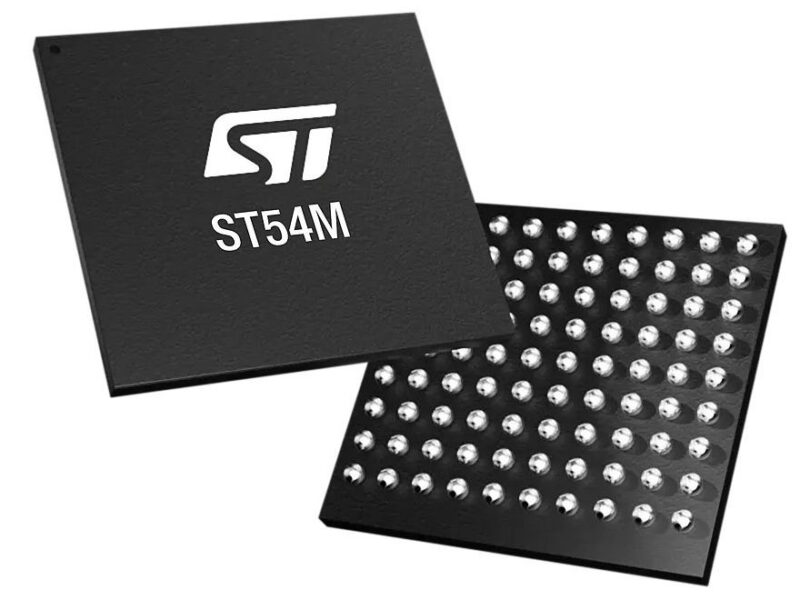
STMicroelectronics has introduced the ST54M secure mobile chip, integrating NFC, an embedded secure element, eSIM functionality, and a hardware accelerator for post quantum cryptography.
The single-die device is designed to help manufacturers prepare for future quantum-ready security requirements while supporting connected services such as contactless payment, transit ticketing, access control, digital identity, driving licences, connectivity services, and digital car keys. ST is targeting Common Criteria 2022 EUCC and EMVCo certifications in July 2026.
The device supports post quantum cryptography algorithms including ML-KEM and ML-DSA. These algorithms are part of the wider transition away from classical public-key cryptography that could become vulnerable to sufficiently powerful quantum computers. The ST54M hardware engine is also designed to help protect against side-channel and fault-injection attacks, both of which are practical concerns for secure silicon used in identity and transaction systems.
Although the product is aimed primarily at mobile and personal electronics, secure semiconductor architectures increasingly influence industrial electronics. Industrial systems rely on trusted identities, secure provisioning, remote access, digital credentials, secure firmware, equipment authentication, and long-life connected devices. Cryptographic decisions made in high-volume consumer and mobile silicon often shape the tools, certification expectations, and component availability that later affect industrial designs.
Post quantum readiness is especially relevant where products remain in service for long periods. Industrial equipment, vehicles, access systems, connected meters, medical devices, and infrastructure controllers may operate for many years after deployment. Designs secure at launch may need to withstand future attack capabilities, including the risk that encrypted data captured today could be decrypted later.
The ST54M also reflects continuing integration of multiple secure functions into compact semiconductor platforms. Combining NFC, embedded secure element, eSIM, and post quantum acceleration on one die can reduce footprint and simplify integration for manufacturers building devices that require connectivity, identity, and payment or access capability. That level of integration can reduce bill of materials complexity, although it places greater responsibility on the chip supplier’s security architecture and certification path.
The development sits alongside wider changes in European electronics capability. Automotive radar silicon is moving towards centralised vehicle sensing architectures, while European chip policy is trying to connect advanced manufacturing, design, packaging, and industrial demand. Secure silicon belongs to that same strategic layer because hardware trust is becoming fundamental to connected products.
Industrial electronics teams will need migration paths for cryptography, secure update mechanisms, hardware roots of trust, and component choices that can survive changing regulatory and customer requirements. Security specifications written today may have to support products still operating beyond 2030, when stronger quantum-ready requirements are expected to influence procurement and compliance decisions.
Certification will shape adoption. Buyers in regulated or risk-sensitive sectors often rely on component-level assurance when building secure systems, and claims around post quantum capability will need recognised validation. Hardware acceleration can reduce performance overhead and implementation burden, but market adoption will depend on evidence that security features have been independently assessed and can be used within compliant system architectures.
Classical cryptography, hybrid approaches, and post quantum algorithms will coexist across devices, networks, and infrastructure for years. Manufacturers will have to manage compatibility, memory constraints, performance, lifecycle updates, and certification across mixed estates. Hardware support reduces some of that burden, but only where system designs are prepared to use it.
The ST54M shows post quantum cryptography moving from standards work into component roadmaps. In industrial markets, where products last longer and updates are harder to guarantee, secure hardware choices made now will shape future resilience.
