Siemens and Dutch distribution network operator Enexis plan to expand the use of standardised, factory-assembled switchgear units to accelerate electricity grid reinforcement. Enexis aims to realise up to 800 new transfer stations over eight years and increase its annual delivery rate from approximately ten to around 100. The figures describe a programme target, not an announcement that 800 stations are already built or covered by individual completed orders.
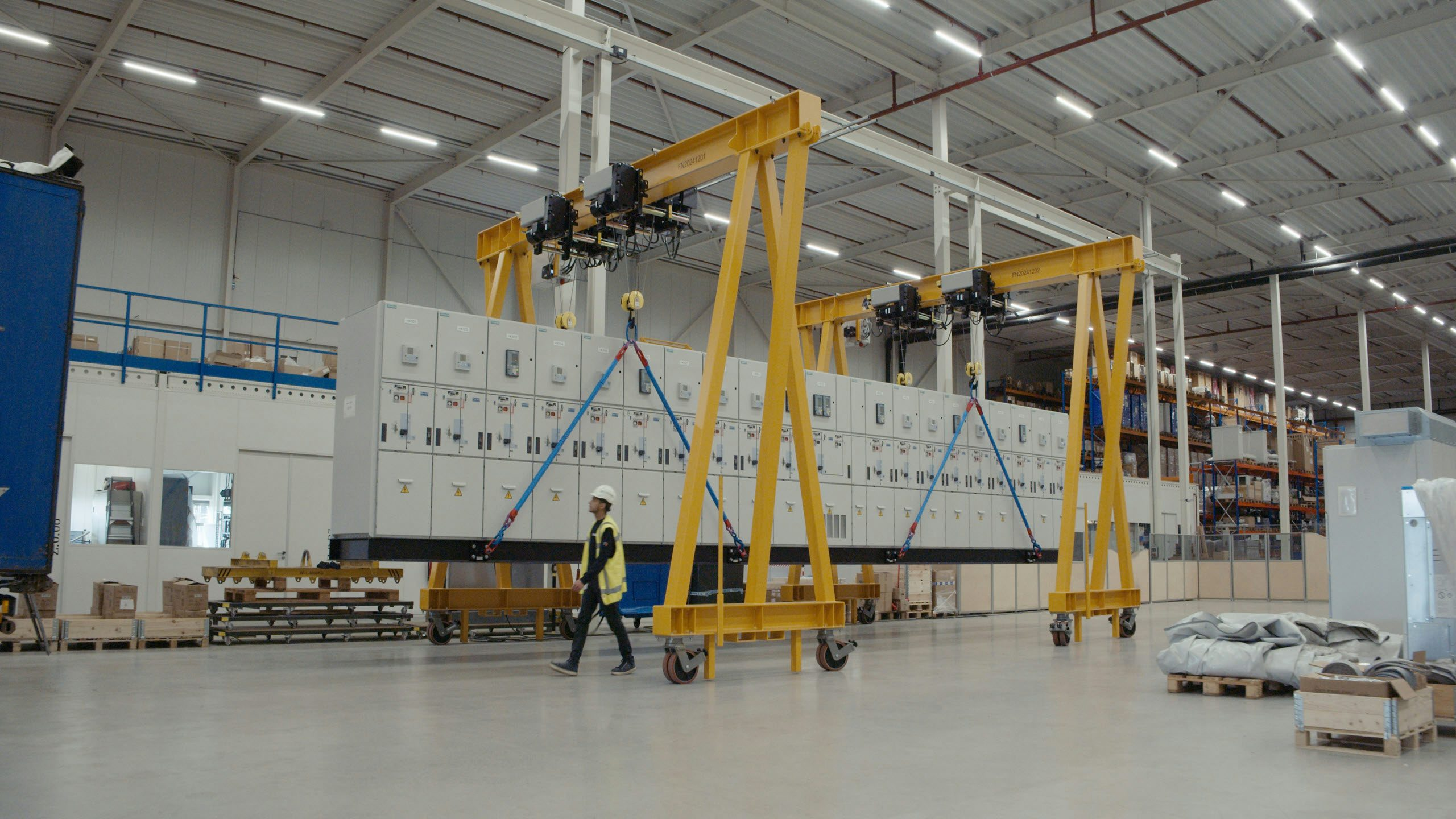
The approach uses Siemens NXPLUS C 24 blue gas-insulated switchgear (GIS), supplied in prefabricated and tested assemblies known as skids. Factory assembly reduces the amount of equipment preparation that has to take place at an individual construction site. Siemens says a skid can be installed and commissioned in a prefabricated station within one day, but cable routes, civil works, permits and final grid integration are separate activities. A one-day equipment installation must not be confused with the total duration of a substation project.
Enexis operates a substantial electricity distribution network serving approximately 2.9 million customers, alongside a separate gas network. The company reports about 139,000 kilometres of power lines and 46,000 kilometres of gas lines. Connection requests from households, businesses and renewable power projects are increasing the pressure on the electricity infrastructure. Limited spare network capacity can restrict when new generation or industrial demand is connected, regardless of the availability of equipment on the customer side.
Transfer stations connect different parts of a distribution network and provide controlled switching and protection for circuits. Their switchgear allows operators to isolate equipment, manage faults and carry out maintenance without indiscriminately de-energising a wider area. Repeatable equipment layouts can reduce engineering time for similar sites, although earthing, cable terminations, protection settings and the interface with upstream network capacity still require attention at each location.
The NXPLUS C 24 blue equipment is designed without fluorinated greenhouse gases as its insulating medium. Conventional gas-insulated switchgear has often relied on sulphur hexafluoride, a potent greenhouse gas whose handling and leakage require controls. Siemens instead uses its F-gas-free blue GIS technology, combining vacuum switching with an alternative insulating arrangement. That choice changes one environmental characteristic of the equipment; it does not remove electrical testing, switching safety or maintenance requirements.
A factory-built skid changes how quality assurance is organised. Equipment assemblies can undergo repeatable tests under controlled conditions before delivery, reducing the number of checks that depend on access and working conditions at the final site. Transport dimensions, lifting arrangements, mechanical connections and cable interfaces become part of the design standard. Those interfaces must be robust enough to accommodate the differences between sites while preserving the expected benefits of repeatable manufacture.
The first Siemens skid in this programme was installed in the Netherlands in October 2024, and on-demand deliveries began in 2025. The November 2026 announcement therefore concerns scaling an established deployment method. Sustaining approximately 100 new stations each year will depend on sufficient factory output and installation capacity, together with permissions, groundwork, cable connections and commissioning teams at the individual sites.
Standardisation also affects the sequencing of projects. When assemblies share electrical layouts and components, network planners can prepare more work in parallel while manufacturers maintain consistent production methods. For the operator, that can reduce redesign effort across similar stations and make it easier to forecast the procurement of replacement equipment. The approach does not eliminate the engineering challenge of coordinating upstream capacity and downstream load, both of which remain necessary for a new connection to become useful.
Enexis chief operations officer Han Slootweg described the continuing pressure for more network capacity. Siemens is one supplier in a wider delivery programme, while Enexis remains responsible for network reinforcement. Neither a fixed value for all 800 prospective stations nor a station-by-station commissioning timetable was disclosed. The partners’ announced annual production and deployment rates should be read as intended capacity, not audited annual performance.
The choice of equipment also reflects a changing specification environment for electrical networks. Distribution operators have to reconcile larger numbers of grid connections, equipment availability, environmental requirements and maintenance access. Prefabrication is one route to dealing with repeated installation tasks, but protection coordination, commissioning records and operational handover remain essential for every completed installation. These requirements become more important, rather than less, when the same design is deployed across a large fleet of assets.
Standardised switchgear can shorten work that would otherwise be repeated separately at each station, but the overall delivery rate will still be constrained by site preparation and connection works. Enexis’s target of up to 800 stations over eight years provides an explicit measure against which progress can be assessed. The two-year experience since the first installation gives the partners an existing design base; it does not establish that the full eight-year programme has already been secured.