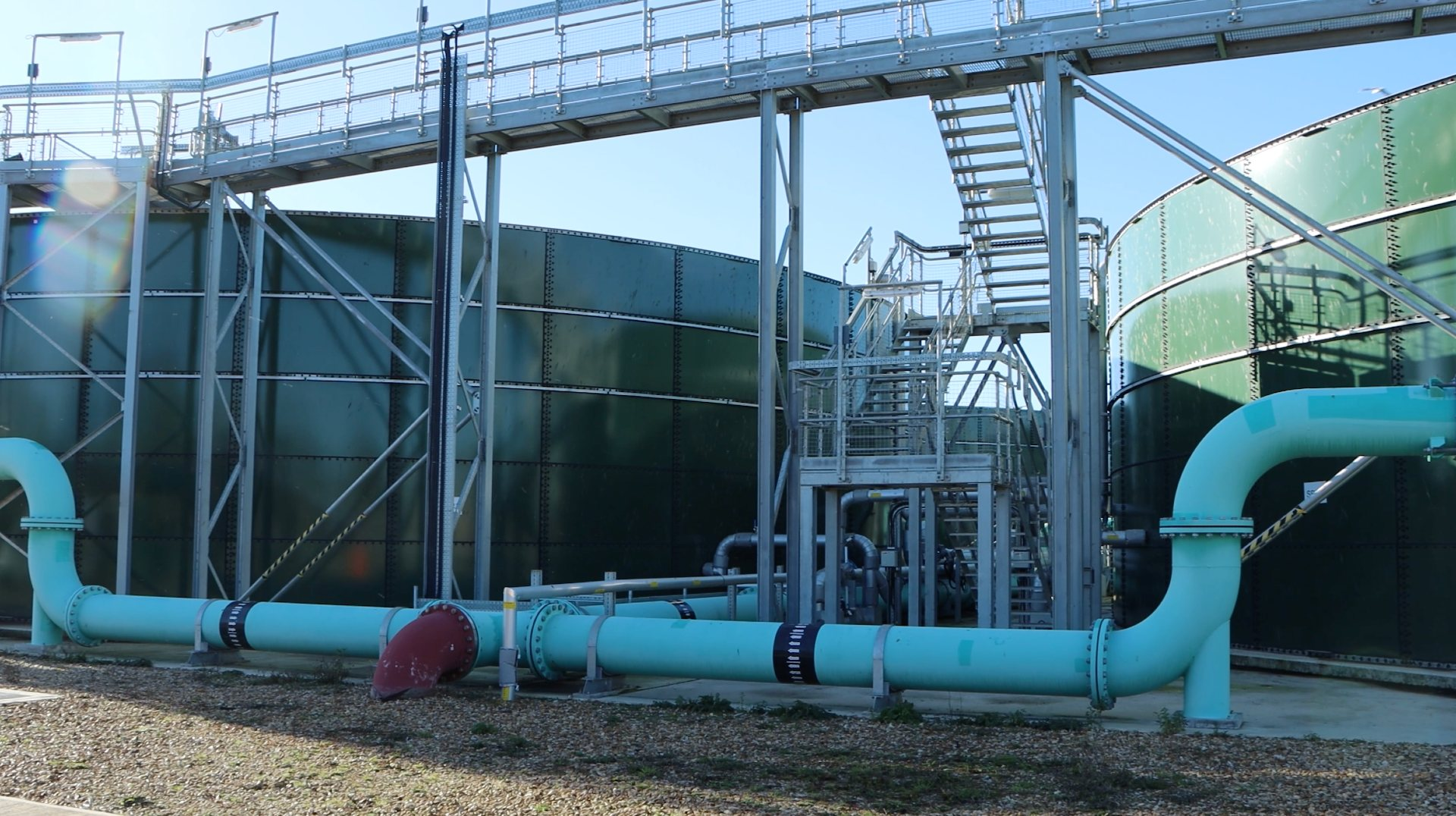
Anglian Water‘s @one Alliance is approaching completion of a £40 million upgrade at Broadholme Water Recycling Centre near Wellingborough. Four new sequencing batch reactors, phosphorus removal equipment and associated electrical and mechanical systems are designed to provide approximately 35 million litres a day of additional treatment capacity. The existing works has continued operating while construction and commissioning take place.
Broadholme serves communities including Wellingborough, Rushden, Irthlingborough and Kettering, with treated effluent ultimately returned to the River Nene. The works must accommodate population growth without compromising environmental permit obligations. Increasing the volume that can be passed to full treatment is therefore only one part of the investment; the quality and resilience of the process are also central to its design.
Four new 30-metre-diameter sequencing batch reactor (SBR) tanks supplied by Xylem Water Solutions form the centre of the expansion. An SBR carries out biological treatment and separation in time-controlled cycles, rather than sending wastewater continuously through distinct aeration and settlement tanks. Filling, aeration, settling and decanting must be coordinated so that the new reactors accept variable inlet flows while discharging treated water at the required quality. The operating sequence and control strategy are therefore as important as the physical tank volume.
The scheme is intended to increase full flow to treatment by 413 litres per second. Converted to a daily volume, that is approximately 35.7 million litres, consistent with the rounded project figure of 35 million litres a day. These are design-capacity figures, not measurements of additional wastewater already treated. Actual flows and the treatment achieved will depend on inlet conditions, the reactor operating cycles and completion of the remaining commissioning work.
Phosphorus removal is supported by two iron-salt dosing packages supplied by Lintott and a tertiary solids removal system from FLI. Iron salts promote the formation of phosphorus-containing solids that can be separated downstream. The latest project account identifies ferric reagent for the dosing packages, which will need to be coordinated with the biological treatment and filtration controls. The tertiary stage is specified for up to 1,350 litres per second across the new and existing process streams.
Accommodating the additional units on an operating site demanded extensive layout work. The treatment centre is constrained by existing plant, designated environmental areas and exposure to flood risk. Designers used three-dimensional models and virtual reality review to establish how new structures, pipe runs and access routes could fit without blocking existing operations. The approach also gave construction and operating teams a common model against which to check maintainability and installation sequences.
When a proposed gravity pipeline from the existing inlet works to the new process stream proved unviable, the alliance developed a pumped transfer arrangement using adapted infrastructure and bespoke controls. That alteration affected both construction and long-term operation: pumps must respond to changing inlet conditions without interrupting the existing works or overloading the new reactors. The new control arrangements will need testing during commissioning alongside the mechanical transfer equipment.
The upgrade extends beyond the treatment tanks. Supporting works include a new electrical supply, transformer, standby generation, motor control, blower equipment, more than 800 metres of pipework and improvements to sludge handling. Aeration equipment is integral to biological treatment because it provides oxygen for the microorganisms responsible for breaking down organic material. Standby power and coordinated controls are necessary to sustain critical functions during electrical disruption.
An earlier @one Alliance technical case study reported a £35 million project value, while the latest near-completion account gives £40 million. The newer figure represents an updated description of the same scheme, not a second investment or proof of the final outturn cost. The project formed part of the alliance’s AMP7 delivery programme, which required an operating treatment centre to be expanded within a constrained footprint close to protected habitats and flood-sensitive land.
Maintaining wastewater treatment during construction means that interfaces between the old and new process equipment have to be tested carefully. Pipe diversions, electrical changeovers, automated valves and instrumentation may be physically complete before the new assets can be relied upon in normal service. Commissioning must establish that flow transfer, reactor cycles, dosing and tertiary removal operate as intended across realistic conditions, including periods of elevated incoming flow.
Once commissioning is complete, the upgraded works is expected to support wastewater treatment for more than 230,000 people in North Northamptonshire and improve the quality of water returned to the River Nene. Those outcomes will depend on demonstrated flow capacity, stable reactor operation and compliance with discharge requirements. The alliance has reached the closing stages of construction, but the new plant has not yet been presented as fully operational.