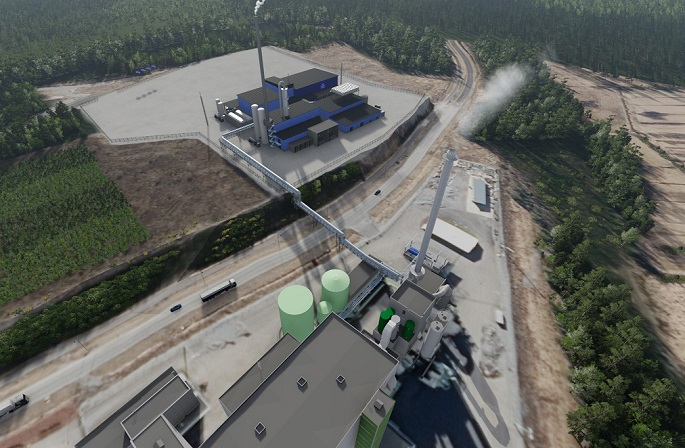
Nordic Ren-Gas has taken a final investment decision on an e-methane production plant in Tampere, Finland, committing a project worth more than €300 million to construction. The project combines hydrogen production, carbon dioxide recovery and heat integration within one industrial energy system. Building work is due to begin immediately, with completion scheduled for 2029, after the developer secured the financing needed to move beyond the development phase.
At full capacity, the plant is designed to produce approximately 190GWh of renewable e-methane a year for customers in the European market. It will use around 40,000 tonnes of biogenic carbon dioxide annually from a nearby waste-to-energy facility and renewable electricity to produce hydrogen through water electrolysis. The hydrogen and captured carbon dioxide will then form the feedstocks for methane synthesis. The resulting gas is intended primarily for heavy-duty road transport in Germany.
Renewable electricity will power electrolysers that split water to produce hydrogen, while the neighbouring waste-to-energy operation supplies captured biogenic carbon dioxide. In the methanation stage, these streams react to produce methane and water, with heat released by the reaction and associated processes. The integrated plant must then condition the gas for network use and recover usable heat. Its annual fuel output will depend on reliable delivery of electricity, carbon dioxide, water treatment and the linked conversion equipment, rather than the performance of the electrolyser alone.
E-methane has chemical properties that allow it to be used through established gas networks and in applications designed for methane, subject to the relevant specifications. Ren-Gas plans to transport its Finnish output through the European gas system to Germany, where heavy goods vehicles provide the principal end market. That pathway links production at an industrial location with fuel customers outside the host country, rather than requiring the developer to establish an entirely new transport network dedicated to a different gaseous fuel.
The European Investment Bank is providing a €60 million loan, backed by InvestEU, and describes itself as the project’s largest debt financier. Its contribution represents approximately one fifth of the total investment. Other lenders include Société Générale, Standard Chartered, Nordea and Finnvera. Equity is being provided by investors including Allianz, the Finnish state investment company Tesi, Japan Hydrogen Fund and Schroders Greencoat. The group of backers provides long-term capital for construction against future revenues expected from the facility.
The lender describes Tampere as the first EU e-methane project financed on a project-finance basis, under which repayment is principally supported by the cash flows expected from the asset. That structure places importance on contracted output, construction risk, operating reliability and the assumptions underpinning future fuel demand. It also separates the decision to build the facility from the production volumes that will only become measurable after commissioning and sustained operation.
The Tampere design includes recovery of up to 200GWh of heat each year for the city’s district heating network. Methanation releases heat, and thermal energy is also available from other parts of the production process. Recovering it requires heat exchangers and a temperature level that is useful to the receiving network. The annual 200GWh figure is a design target: actual transfer will depend on the plant’s operating hours, the temperature of available heat and how district heating demand changes through the seasons.
Around 40,000 tonnes of biogenic carbon dioxide is expected to be supplied annually from a nearby waste-to-energy facility. Capturing that stream creates a local feedstock connection between waste treatment and synthetic fuel production, but the quantity captured is not itself a measure of net emissions avoided. The resulting methane releases carbon dioxide when burned. Its climate performance also depends on the electricity supply, carbon capture and purification energy, methane leakage and the lifecycle accounting rules applied to the fuel.
The EIB says the annual energy content of the planned fuel production is comparable to around 19 million litres of diesel. That comparison is an energy-equivalence measure rather than a promise that an identical number of litres of diesel will be displaced. The eventual result depends on how much fuel reaches vehicles, the efficiency of the consuming engines and the arrangements under which operators purchase and use the gas.
Ren-Gas chief executive Saara Kujala described the investment decision as the result of work across the project’s technical, commercial and financial aspects. The company says the facility will draw on European technology providers and industrial partners while building a production chain between Finland and Germany. Its plan to use long-term offtake arrangements is particularly important because the capital investment is being committed before the plant generates any commercial output.
With financing in place, construction must bring together electricity procurement, electrolysis, carbon capture, methanation, gas export and heat supply within one operating schedule. A disruption in a single feedstock or process stage can constrain output elsewhere, and the district heating system must be able to accept recovered energy when it is available. Completion is planned for 2029; the projected 190GWh of fuel and up to 200GWh of heat annually remain design figures until the integrated plant is commissioned and achieves sustained production.