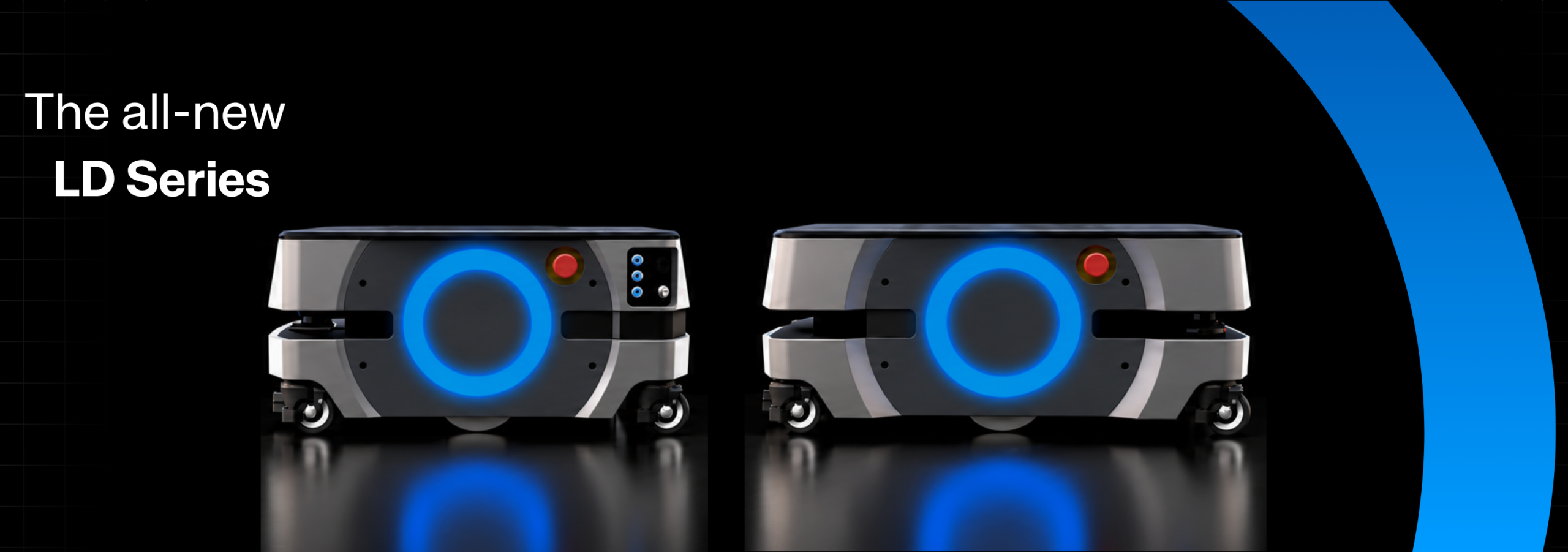
OMRON Robotics has opened orders in Europe and the Americas for two autonomous mobile robots designed to transport materials through busy industrial production environments without fixed guidance infrastructure. The LD-150 and LD-300 extend its LD range to payloads of 150kg and 300kg respectively, using compact chassis and shared fleet software to handle movement between manufacturing workstations. Shipments are scheduled to begin in January 2027, subject to individual market requirements.
The LD-150 has a body width of 500mm, while the LD-300 measures 580mm across. OMRON says both can navigate aisles as narrow as one metre, depending on the operating conditions and required clearances. Maximum travel speed is stated as 2.1 metres per second, with an ability to negotiate gradients of up to five degrees. These figures establish the operating envelope that must be assessed against each plant’s actual floor layout, traffic and load configuration.
Reconfiguring a production line can alter the distance and routes between workstations, stores and inspection equipment. Guided vehicles tied to magnetic tape, installed markers or predetermined tracks may need changes to that infrastructure when the layout moves. The LD models instead plan and adjust their routes dynamically using onboard navigation. This reduces the need for fixed guidance installations, but each route must still be evaluated for loading conditions, pedestrian access and interaction with forklifts and other equipment.
OMRON states that the LD-150 and LD-300 carry up to two and a half times the payload of the previous LD generation while retaining the same or a smaller footprint. The increased capacity potentially changes the number of journeys required to supply a workstation or transfer batches between process stages. Actual productivity gains will depend on the unit load, collection and delivery arrangements, waiting time at machines and whether routes are shared with people or manually operated handling equipment.
Wireless inductive charging is specified at 30 minutes or less, rather than the 18 minutes described in an earlier supplied version of the announcement. OMRON gives charge-to-runtime ratios of 1:14 for the LD-150 and 1:12 for the LD-300. Those are manufacturer specifications, not independently established duty cycle results for every installation. A loaded robot travelling repeatedly through a congested aisle can face different energy demand from one operating over shorter distances with fewer stops, and those differences affect how many robots and chargers a site needs.
The charging system is intended to support work across multiple shifts by allowing robots to replenish energy without manual cable connection. A practical deployment must allocate charging locations, ensure those locations do not obstruct material movement and coordinate charging periods with production demand. The benefit becomes greater where the fleet management system can schedule recharging without withdrawing too many robots from service at the same time.
Both machines use OMRON FLOW Core for fleet management and are intended to work alongside existing LD, MD, OL and HD mobile robot platforms. The software coordinates task assignment, route planning, traffic management, configuration and diagnostics across mixed fleets of up to 100 autonomous mobile robots. Managing a mixed fleet allows machines with different payload capabilities to share an operational environment, although the system still needs accurate information about each robot’s geometry, load and permitted operating zones.
OMRON also provides options for cart toppers, conveyors, lifts and mobile manipulators. These attachments are significant because a mobile robot must normally interface with an upstream or downstream process, rather than simply arrive at a marked position. A conveyor top module may transfer a tote automatically, for example, while a lift arrangement can bring a load into alignment with different workstation heights. Integration requirements vary with the attached equipment and the mechanical interfaces available at the factory.
For operation around workers and mobile equipment, OMRON lists safety scanner configurations and obstacle detection, alongside ISO 3691-4:2023 and EU Machinery Regulation requirements. It also specifies standard electrostatic discharge protection and ISO Class 5 cleanroom compatibility. These are relevant to electronics, automotive and medical device handling, where electrostatic events or contamination can affect products. Site commissioning must nevertheless assess stopping distances, hazards from shared traffic, payload stability and the effects of any fitted conveyor, lift or manipulator rather than relying solely on the base robot’s specification.
The opening of orders follows the public demonstration plans OMRON set out for Automate 2026 in June. It therefore marks a shift from presentation of the new platform to commercial ordering rather than the first public appearance of the products. The company says availability will initially cover Europe and the Americas before extending to other regions, and it does not provide a universal delivery date for every country.
At an automated workstation, the transport task succeeds only when a load can be transferred and the receiving process is ready. Charging availability, fleet congestion and communication with conveyors or production controls can therefore limit material throughput even when the robots have sufficient payload capacity. Shipments are scheduled from January 2027, and early installations will establish how the LD-150 and LD-300 perform when these interfaces, mixed traffic and shift patterns are combined in operating factories.