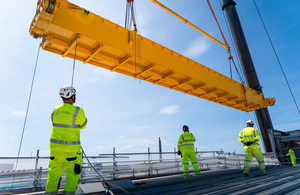
Sellafield Ltd has taken its SIXEP Continuity Plant to 75% completion after a sequence of heavy lifts installed major process and handling equipment inside the new radioactive effluent treatment facility. Fourteen pump-and-valve modules, each weighing 16 tonnes, have been positioned alongside a 55-tonne gantry crane spanning 21 metres as the project moves deeper into internal fit-out.
The principal buildings are complete and weathertight, shifting the workload from civil construction towards mechanical, electrical, control, and process installation. That transition brings a different set of delivery risks: modules have to arrive within tight dimensional tolerances, access routes must remain available for heavy lifts, and equipment installed by separate suppliers has to connect into a treatment system that will ultimately operate as one nuclear plant.
SIXEP Continuity Plant, usually shortened to SCP, is being built to replace the effluent-treatment role of Sellafield’s existing Site Ion Exchange Effluent Plant. SIXEP has operated since 1985, removing radioactive material from water generated by site operations before treated water is discharged to sea. The treatment capability supports work on high-hazard legacy facilities including the First Generation Magnox Storage Pond and Magnox Swarf Storage Silo.
The original SIXEP was designed for an operating life of around 25 years, yet Sellafield expects the treatment function to be required until approximately 2060 as decommissioning and hazard-reduction programmes continue. The existing plant also lacks a full backup for its treatment role and contains potential single-point failure mechanisms, increasing dependence on equipment commissioned more than four decades ago.
SCP is intended to remove that ageing bottleneck while maintaining continuity during the site’s long clean-up programme. Active commissioning remains targeted for 2029, after which effluent will be diverted from the existing plant into the replacement facility. Modifications to SIXEP itself form part of the transition, so the changeover has to be completed around operating nuclear infrastructure rather than as an isolated greenfield start-up.
Delivery is being handled through Sellafield’s Programme and Project Partners model. Sellafield Ltd works with KBR as integration partner, Amentum for design and engineering, Morgan Sindall Infrastructure for civil construction management, and Altrad for process construction management, supported by a wider industrial supply chain manufacturing specialist tanks, vessels, pumps, valves, pipework, and handling equipment.
Moving those components from fabrication into installed plant is a significant project threshold. Much of the remaining work depends on interfaces that were previously represented only in drawings, specifications, and factory acceptance records. A pump skid that does not align with pipework, a valve package that obstructs access, or a control interface that has not been fully resolved can create commissioning delays long after the concrete and steelwork appear complete.
The 16-tonne pump-and-valve modules shift part of the fabrication and assembly burden away from the final installation area by grouping equipment before it enters the building. That approach can reduce the number of individual lifts and connections carried out in constrained spaces, although it also concentrates dimensional and interface requirements into larger units that have to arrive ready for accurate positioning.
The upper-floor gantry crane will itself become part of the plant’s operating and maintenance infrastructure, providing handling capability once SCP is in service. Further process connections, electrical work, controls integration, testing, and commissioning preparation still have to follow before radioactive operations can begin.
The programme also illustrates the unusually long engineering horizon of nuclear decommissioning. A replacement facility entering service in 2029 is being built for a requirement extending into the 2060s, so maintainability, component replacement, spare parts, software support, and obsolescence management have to be considered while the plant is still under construction. Several generations of control hardware may come and go during the service life of the underlying process equipment.
That long operating window puts pressure on documentation and configuration control as much as on physical design. Equipment will be maintained by teams who were not involved in its installation, while future replacements will have to preserve safety functions and process performance against records created during the current project. Nuclear plant longevity makes incomplete asset information an engineering liability that can persist for decades.
Sellafield’s wider clean-up mission depends on dependable effluent treatment because hazard-reduction work elsewhere on the site cannot be separated from the liquid wastes it generates. SCP therefore sits in the critical path of activities far beyond its own building footprint. With construction now three-quarters complete, the project has passed many of its largest visible lifts, but the remaining quarter contains much of the systems integration and commissioning work that will determine whether the 2029 operating target is achieved.