Saab UK has delivered Giraffe 1X radar systems to the Royal Air Force under an urgent requirement for counter-uncrewed-aircraft capability. The systems have entered the RAF’s wider counter-drone architecture for detection, tracking, and engagement, with Saab drawing on global production capacity and its UK manufacturing and support operation to accelerate delivery.
The handover follows a period of expanding Giraffe 1X activity in Britain. In April, the Ministry of Defence placed an order worth approximately £24 million for the compact radar, with production assigned to Saab UK’s Centre of Radar Excellence at Fareham. In May, the company completed the 100th Giraffe 1X produced in the UK, alongside investment in an Integration and Verification facility intended to support radar production and testing at the site.
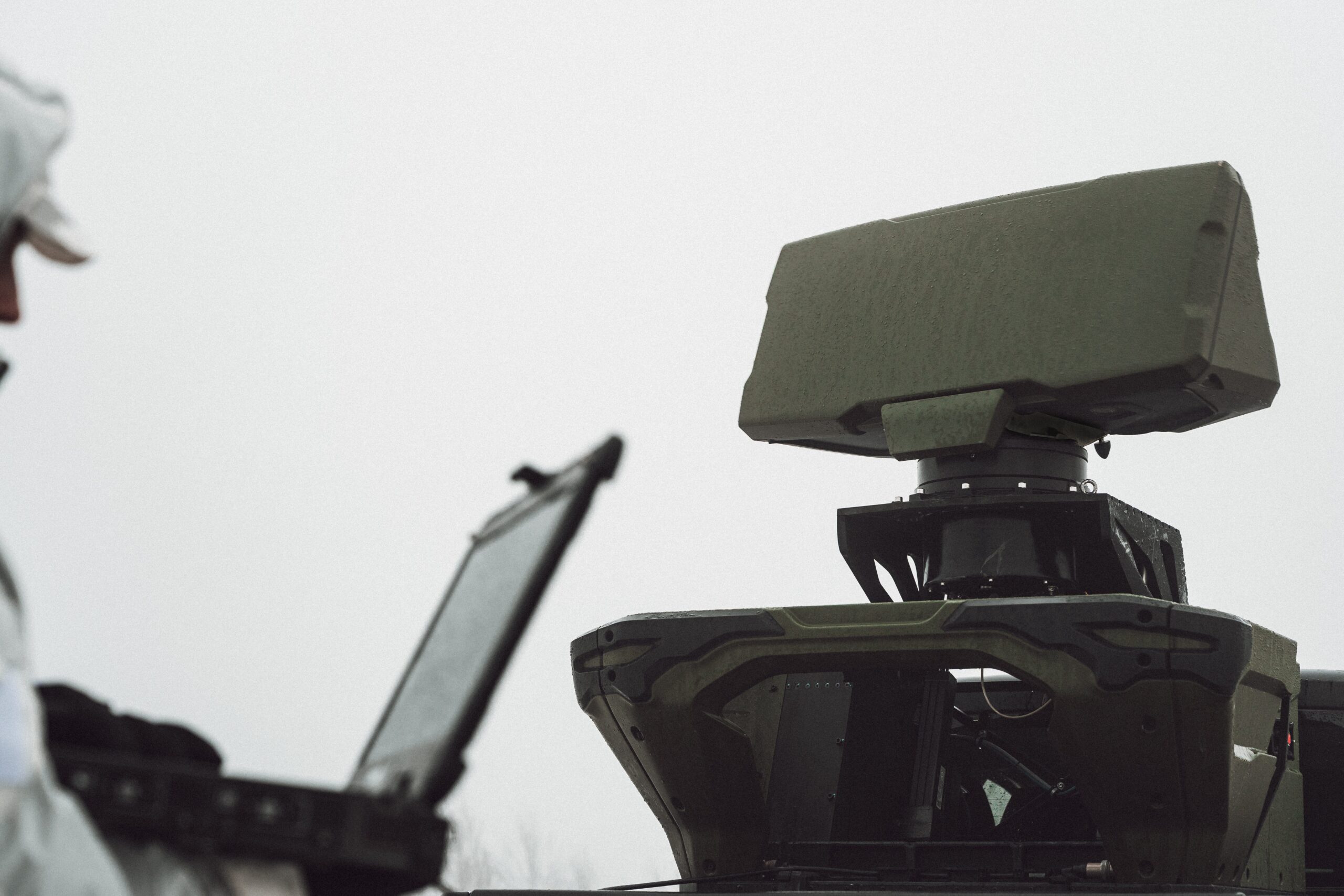
Giraffe 1X is a lightweight three-dimensional surveillance radar designed for roles including ground-based air defence, counter-UAS, force protection, weapon locating, and short-range surveillance. Saab says the complete system weighs less than 150kg, with a sensor topside of about 100kg, allowing it to be mounted on vehicles, deployed in fixed positions, or moved between configurations. The radar refreshes its full search volume every second, an important characteristic when tracking small, rapidly changing aerial targets.
The RAF delivery is distinct from earlier UK development work around the same radar family. An August trial linked multiple Giraffe 1X systems with independent quantum timing sources to test whether distributed radar operation could remain coherent during representative GNSS denial and spoofing. That work dealt with timing resilience; the latest development is an operational delivery driven by counter-drone demand and supported by a manufacturing base Saab has been expanding in southern England.
Fareham has become the industrial centre of that UK radar activity. Saab opened the campus as a base for radar manufacture, integration, support, and engineering, and the site now produces Giraffe 1X while supporting in-service systems including Giraffe AMB. Producing the compact radar in Britain gives the company a domestic line for a system that is also being supplied internationally, including recent orders and deployments in Denmark and the United States.
Serial production matters when customers are buying against urgent requirements rather than conventional multi-year acquisition schedules. Radar hardware still has to pass manufacturing, integration, and verification processes, but a product already moving through an established line can be drawn from a wider production and test organisation more quickly than a bespoke system starting from development. Saab said the RAF requirement was met by mobilising global production capacity while using UK manufacturing and support capability to speed delivery.
The counter-UAS role also gives radar suppliers a difficult target set. Small drones can present low radar cross-sections, fly slowly, operate close to clutter, and appear in numbers that place pressure on detection and tracking systems. Giraffe 1X is designed to detect, track, and classify small uncrewed aircraft alongside conventional fixed-wing, rotary-wing, missile, and rocket targets, allowing the same sensor family to support several short-range surveillance and air-defence tasks.
For UK manufacturing, the programme sits at the intersection of sovereign production capability and an increasingly international product line. The April order explicitly tied manufacturing to Fareham, while the latest delivery shows that the site is supporting equipment required on operational timescales rather than only future milestones. Saab’s investment in integration and verification also keeps more of the production cycle alongside assembly, which matters when software configuration, test, and system acceptance form a substantial part of radar manufacture.
There is a supply chain consequence as well. A compact radar still depends on specialist RF electronics, computing, power systems, mechanical integration, and test equipment, while customer variants must remain under configuration control. Repeat production gives suppliers and engineering teams a steadier basis for capacity planning, but urgent orders can compress those schedules sharply. The ability to move resources across a global production network while retaining a UK integration base is therefore part of the capability being tested by the programme.
The RAF has now incorporated the systems into its wider counter-drone architecture, while Saab continues to manufacture Giraffe 1X for other customers. The significance for the industrial base will be measured less by one urgent delivery than by whether repeat orders keep Fareham’s production line, engineering teams, and verification capacity loaded. Counter-UAS requirements are changing quickly; maintaining production readiness while radar software and operational demands continue to evolve is the less visible engineering challenge behind the delivery.