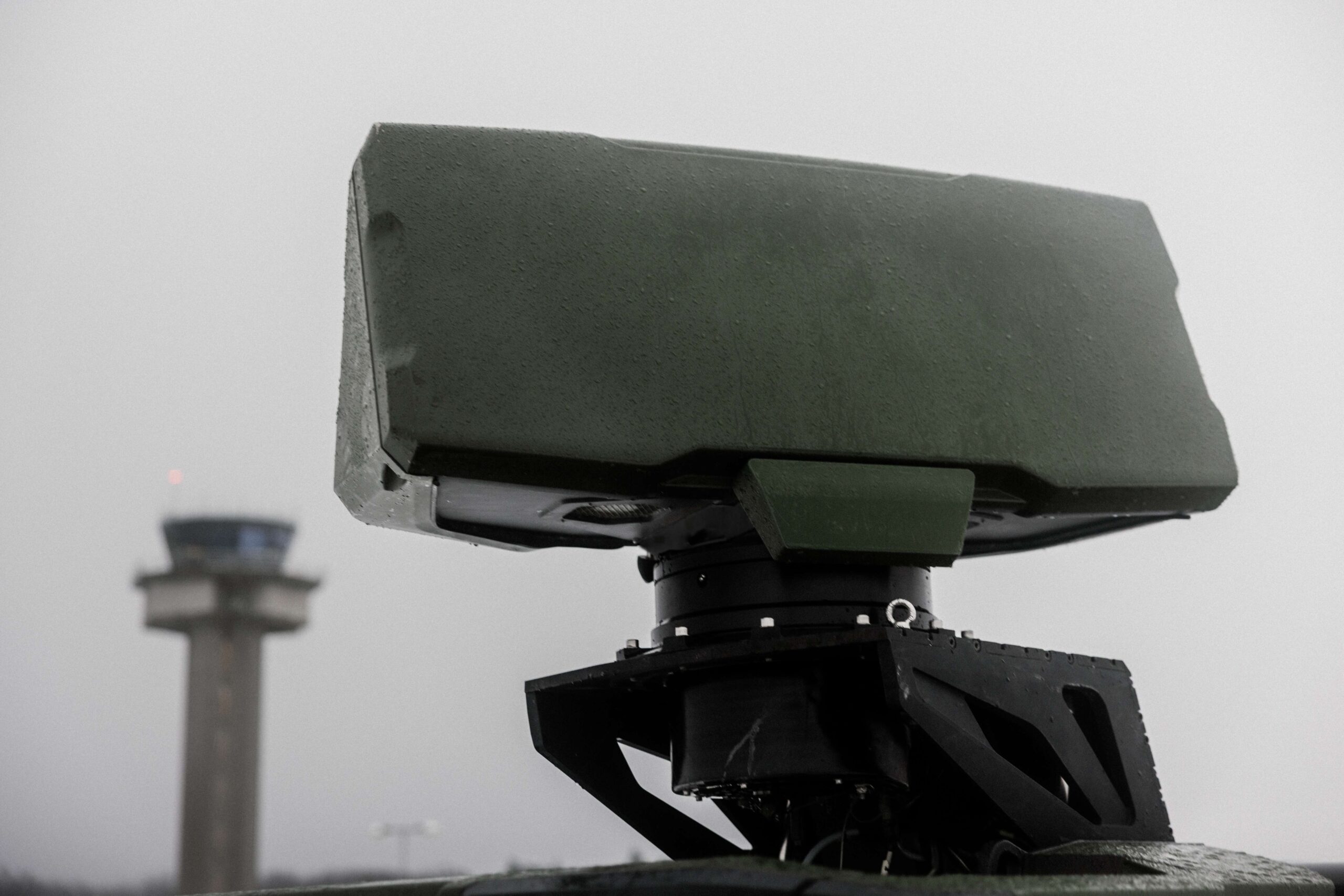
Saab has completed a UK trial in which distributed Giraffe 1X radars maintained a coherent air picture using independent quantum timing sources rather than satellite-derived timing.
The demonstration brought together Saab UK, Aquark Technologies, the Royal Navy’s Disruptive Capabilities and Technologies Office, and QinetiQ. Multiple Giraffe 1X radars operated at separate locations while Aquark’s AQlock systems provided independent timing references.
The radars tracked live targets before controlled timing errors were introduced to reproduce representative Global Navigation Satellite System denial and spoofing conditions. Saab says the network continued generating a coherent operational picture without GNSS timing and recovered rapidly when synchronisation was restored.
Distributed radar networks depend on accurate timing because measurements gathered at separate locations have to be aligned before their tracking data can be combined. A radar can continue detecting targets locally while the quality of the wider fused picture degrades if the sensors no longer share a sufficiently accurate time reference.
GNSS provides a convenient way of synchronising those systems, but it also introduces an external dependency. Jamming, spoofing, or other disruption can affect the timing service even where the radar hardware itself remains fully operational.
During the trial, deliberately introduced timing errors produced predictable degradation in the combined radar picture. The network then returned rapidly to synchronised operation after the timing relationship was restored. That behaviour provides engineers with information about how the system fails as well as whether it continues operating at all.
Aquark’s AQlock is a deployable atomic clock designed to provide GNSS-independent positioning, navigation, and timing capability. The company uses cold-atom technology and has focused its development on reducing the size and complexity normally associated with high-precision quantum timing equipment.
Integrating such a clock into an existing radar network changes the exercise from a laboratory timing demonstration into a systems test. The timing source has to interact with operational sensor hardware, communications, data fusion, and tracking software while preserving enough accuracy for separate radars to contribute to one picture.
Saab describes the exercise as what it believes to be the first demonstration of a distributed high-performance military radar network maintaining a coherent operational picture from independent quantum timing sources. That remains a company characterisation of a trial rather than evidence of a production deployment or fielded procurement programme.
No fleet-wide integration schedule or production order has been announced. The work instead establishes that the combination can operate under controlled representative disruption, leaving qualification, ruggedisation, support, procurement, and wider deployment as separate stages if customers choose to take the capability further.
The engineering principle extends beyond radar. Networked systems increasingly depend on common timing for sensor fusion, communications, sequencing, control, and event correlation. Where that timing comes from an external satellite service, loss of the service can become a system-level problem even when individual pieces of equipment remain intact.
Quantum timing is attracting attention partly because it offers another reference that does not require continuous access to GNSS. Practical use still depends on packaging, power consumption, environmental tolerance, reliability, cost, and integration into equipment designed around conventional timing architectures.
The Giraffe 1X trial puts several of those issues into an operationally recognisable environment. Separate sensors were tracking real targets, timing errors were deliberately introduced, and the resulting effect on the combined radar picture could be observed rather than inferred from a standalone clock measurement.
That does not make quantum timing an automatic replacement for satellite timing. Redundant systems typically retain several references rather than exchanging one dependency for another. It does show that a distributed radar network can maintain useful synchronisation through an independent timing architecture when satellite-based timing is unavailable or cannot be trusted.
The next meaningful step will be determined by integration and procurement rather than another claim of laboratory performance. Saab and Aquark have shown the system behaving under controlled timing disruption; turning that into deployable equipment will depend on whether the clock can meet military requirements repeatedly, economically, and without adding more complexity than the resilience is worth.