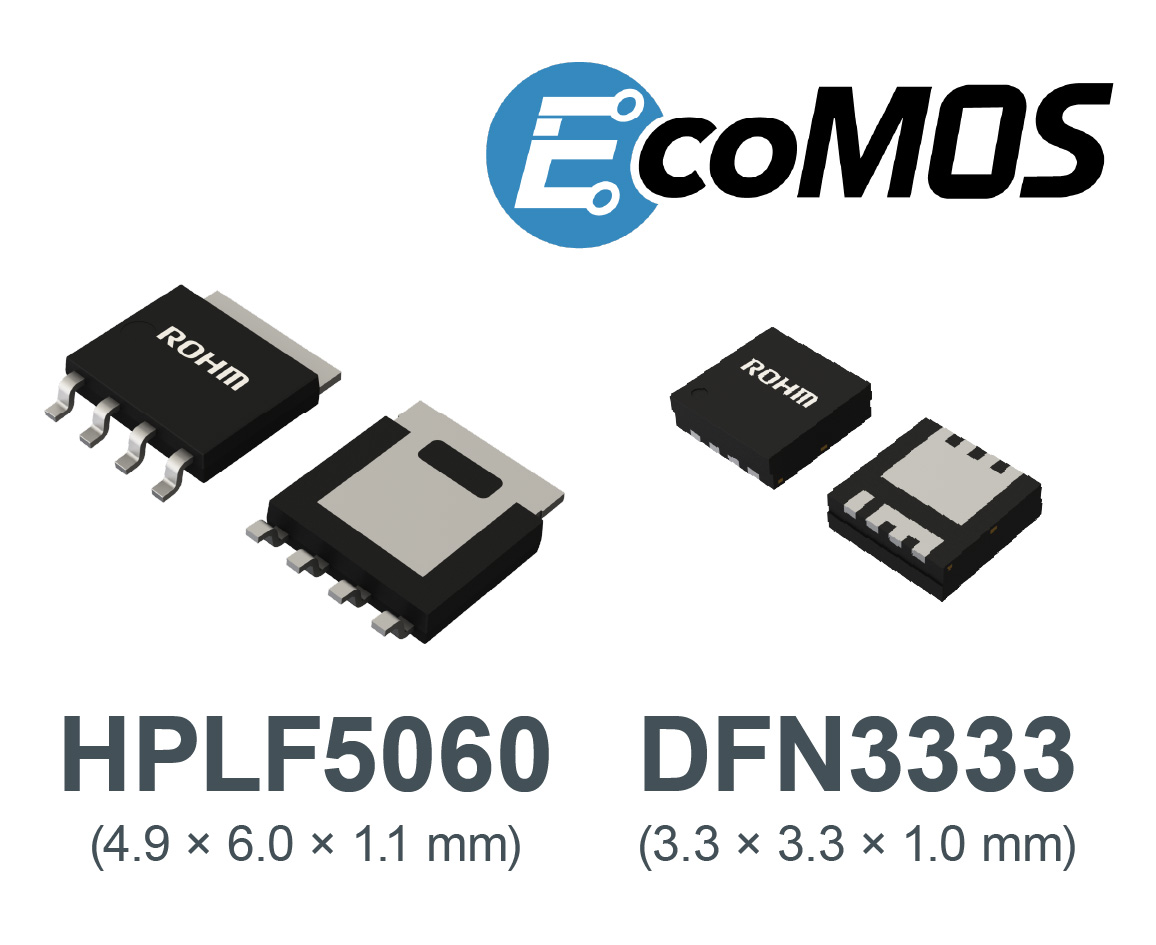
ROHM has launched the AG16xFNxx Series, a new line of 80V power MOSFETs designed for automotive 48V power supply systems.
The devices are intended for applications including main inverter control circuits, electric motors, and electric water pumps. ROHM is targeting the increasing power demand in high-end vehicles, where 48V systems are being adopted as a more efficient alternative to conventional 12V architectures.
The company says wider adoption of 48V systems is expected around 2030, creating demand for 80V power MOSFETs that can deliver lower losses than standard 100V devices. The new series uses HPLF5060 and DFN3333 packages, allowing downsizing compared with standard automotive MOSFET packages such as TO-252. The HPLF5060 package measures 4.9mm by 6.0mm, while the DFN3333 package measures 3.3mm by 3.3mm.
The HPLF5060 version uses gull-wing leads, while the DFN3333 version uses wettable flank technology to support printed circuit board mounting reliability. ROHM has also adopted copper clip junction technology to improve heat dissipation and allow the devices to handle high currents. The products comply with the AEC-Q101 automotive reliability standard.
Mass production began in April 2026 for the AG160FNS4FRA in the HPLF5060 package and the AG166FNH7FRA in the DFN3333 package. Online sales have started, with availability through distributors including DigiKey and Farnell. ROHM is also preparing further package expansion, including TOLG products for higher-power, high-reliability 80V MOSFET applications.
The launch reflects a larger shift in vehicle electrical architecture. Cars are carrying more electrically driven systems, from pumps, fans, heaters, active chassis functions, and driver assistance hardware to infotainment, sensors, and comfort systems. A 12V architecture can become inefficient as power demand rises, because higher currents increase losses and place heavier demands on wiring, connectors, protection devices, and thermal management.
48V architectures reduce current for a given power level and can support higher-power auxiliary systems without requiring full high voltage traction architecture for every function. That makes them attractive in mild hybrid systems, premium vehicles, and applications where electrified auxiliaries can improve efficiency, control, and packaging.
Power electronics packaging is central to that transition. A MOSFET’s on-resistance, thermal path, package size, board mounting reliability, and manufacturability all influence system design. Vehicle electronics engineers have to balance electrical performance against temperature, vibration, space, assembly method, and long-term reliability. A smaller package is useful only if it can handle current and heat under automotive conditions.
ROHM’s work in SiC packaging for top-side cooling, covered in a recent power semiconductor piece, shows the same pressure from a higher-voltage direction. Vehicle and infrastructure power stages are demanding more from semiconductor packaging because efficiency gains at device level can be lost if heat cannot be removed or if assembly constraints make the package difficult to use at scale.
The AG16xFNxx Series is aimed at a different voltage class, but the engineering direction is related. Automotive electronics are becoming denser, hotter, and more power hungry. Semiconductor suppliers are competing not only on silicon performance, but on packages that support automated assembly, inspection, heat dissipation, and qualification.
48V adoption will not happen uniformly across all vehicle segments, but the direction is clear where electrical load is rising. Components that reduce losses and save board space will be valuable as vehicle manufacturers try to improve efficiency without adding unnecessary weight or cost.