RobCo has passed a $1 billion valuation after a secondary share transaction that brings new investors into the German robotics company while allowing long standing employees to sell part of their holdings.
The Munich founded business said its valuation has doubled within nine months as it increases deployment of modular industrial robots and develops Alfie, an autonomous two-arm system intended to tackle manufacturing work that conventional programmed automation struggles to handle.
Existing investors including Sequoia, Lightspeed, Greenfield, Kindred, Lingotto and Promus Ventures participated alongside newcomers including Cherry Ventures and European Tech Collective. RobCo has not disclosed the size of the transaction or how much fresh capital, if any, enters the company.
Because part of the deal is a secondary sale, the billion-dollar valuation should be separated from a conventional funding round in which investor money flows directly onto the company balance sheet. The industrial measure remains the number of productive systems deployed, the tasks they can perform and the recurring revenue generated from operating them.
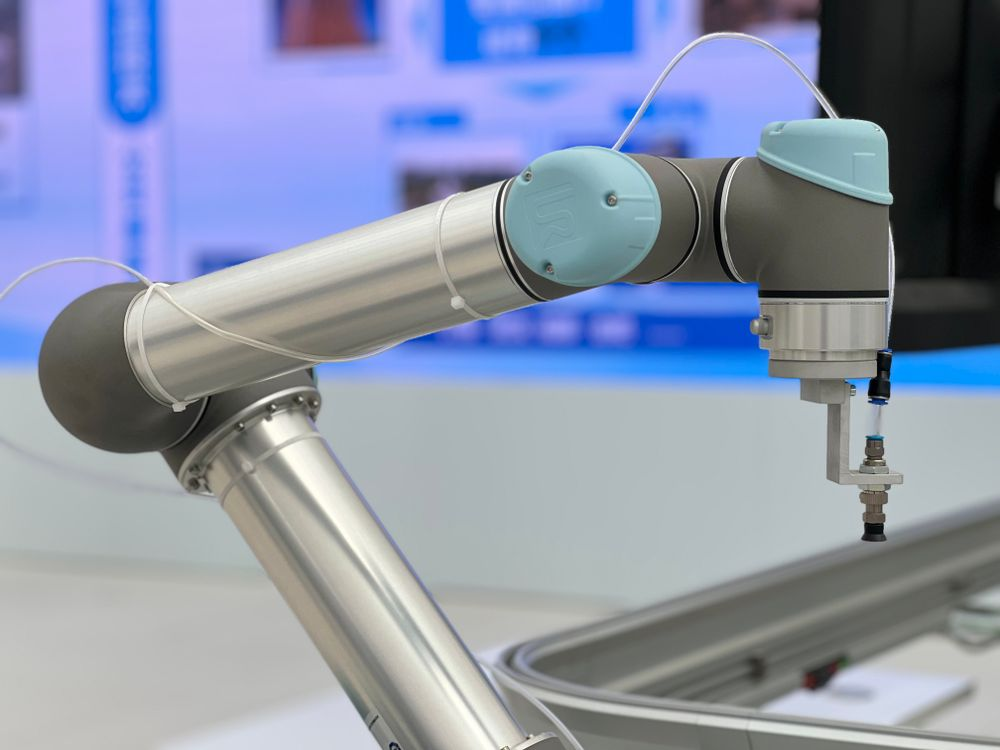
RobCo’s current commercial platform combines configurable robot hardware with machine vision, simulation, programming software and a Robotics as a Service model. Its modular architecture allows systems to be assembled with different numbers of axes, reach, payload and end effectors according to the task rather than forcing every application into one fixed robot configuration.
Modules can be combined into mechanisms ranging from relatively simple axes through to articulated systems with as many as eight degrees of freedom. Standard mechanical, power and data interfaces allow a configuration to be built around applications including machine tending, material handling, palletising, dispensing and welding.
RobCo Studio provides the software layer, creating a digital representation of the robot and production cell so movements can be simulated before commissioning. Graphical programming reduces the amount of conventional robot code required to define sequences and allows changes to be tested virtually before equipment moves on the factory floor.
Those systems still follow the established industrial automation model in one important respect: the work is defined in advance. Fixtures locate components consistently, machines present parts in known positions and validated programs tell the robot where to move through each production cycle.
Alfie is intended to absorb more of that variation inside the robotic system. RobCo describes the forthcoming machine as a bimanual platform combining perception, reasoning and execution so it can respond to less structured objects and tasks without every motion being specified manually beforehand.
That changes the engineering problem considerably. Conventional industrial robots became productive partly because factories removed uncertainty around them; an autonomous system has to tolerate more of that uncertainty without sacrificing cycle time, repeatability or safety.
Vision systems must identify what is present and estimate its position, planning software has to choose a valid motion, and the controller must keep forces and collisions within permitted limits. When the physical result differs from the predicted one, the machine also needs a recovery strategy rather than simply stopping and waiting for an engineer.
Two-arm manipulation increases both the possible task set and the coordination burden. Assembly or handling flexible objects can require both arms to move relative to one another while controlling contact forces and avoiding collisions with the workpiece, nearby machinery and the robot itself.
RobCo says Alfie will target high mix and less structured work that has resisted conventional automation. A commercial launch is scheduled for 4 March 2027 at the company’s first RobCoN event in Munich, leaving the production system itself to be assessed after the valuation milestone.
The installed base currently comes from RobCo’s existing modular robots. The company says more than 300 systems are operating in factories across Europe and the United States, giving it a source of field data from conventional automation while the more autonomous platform is developed.
Robotics as a Service changes the commercial relationship around those installations. RobCo retains ownership and charges a recurring fee rather than requiring the manufacturer to approve the full hardware and integration cost at the beginning of the project.
That can lower the barrier to trialling automation where product mix may change before equipment has fully depreciated. It also leaves more performance risk with the supplier because recurring revenue depends on the deployed system remaining productive rather than the project ending when installation is complete.
The United States has become RobCo’s fastest growing market, with customer operations across more than a dozen states, manufacturing and assembly in Austin, Texas, and a laboratory in San Francisco. Co-founder and chief executive Roman Hölzl has also relocated to the US.
The expansion follows a $100 million funding round earlier in 2026 intended to support enterprise deployments, American growth and the company’s physical AI programme. RobCo is therefore maintaining an existing robot fleet, building manufacturing capacity and developing a different class of autonomous system simultaneously.
Manual tasks that remain after conventional automation has been deployed are often the least structured ones. Components arrive with greater positional variation, product mixes change frequently or employees rely on judgement and physical manipulation that is difficult to encode into a fixed sequence.
Those applications are also where demonstrations can diverge most sharply from sustained production. An autonomous robot has to repeat acceptable performance through thousands of cycles, respond safely to changing inputs and recover from faults without demanding constant intervention from specialist engineers.
RobCo’s valuation has therefore moved ahead of the commercial launch of its most ambitious product. The company already has an installed modular platform and manufacturing operations, but Alfie will provide the harder test of whether greater robotic autonomy can survive routine factory variation at the reliability and cycle times industrial users require.