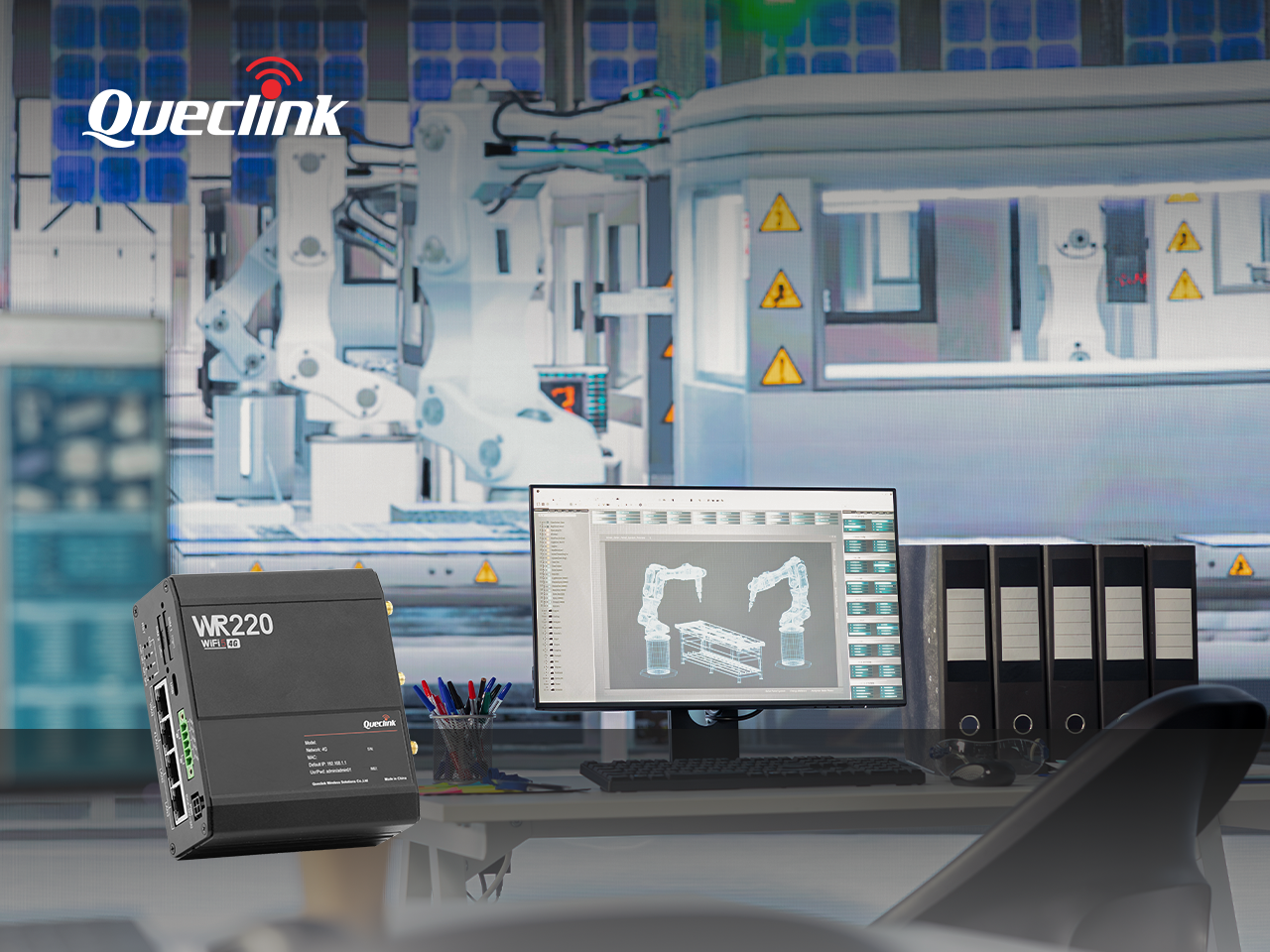
Queclink Wireless Solutions has launched the WR220 Series, an industrial 4G LTE router platform designed for smart manufacturing, factory automation, and distributed industrial connectivity.
The platform combines wireless connectivity, industrial interfaces, PoE powered operation, accessory integration, and remote management. It is designed to provide networking infrastructure for automated production systems, robotic equipment, sensors, edge devices, and ancillary factory systems.
The WR220 uses 4G LTE Cat 4 connectivity with dual SIM redundancy and intelligent failover mechanisms to maintain network availability. It is housed in a rugged aluminium enclosure, supports a wide operating temperature range, and is intended for demanding industrial deployments where conventional office networking equipment is unsuitable.
Remote management allows centralised monitoring, configuration, and diagnostics across distributed sites. The router also includes a built-in BLE gateway for direct connection with wireless sensors, beacons, and edge devices. Queclink has added PoE PD support to its router range for the first time, allowing the WR220 to receive power and data through a single Ethernet cable.
That PoE support is useful in space-constrained or difficult-to-wire locations. Factory retrofits often require connectivity in areas where dedicated power wiring is inconvenient, expensive, or disruptive. Reducing cabling requirements can shorten installation time and lower deployment cost across production cells, warehouses, utility rooms, remote cabinets, and temporary industrial installations.
Vernon Bonser, International Sales Director at Queclink Wireless Solutions, said the WR220 was developed to provide “a digital backbone for smart factory operations.”
Factories are connecting more robots, production systems, machine tools, mobile platforms, environmental sensors, energy meters, quality systems, and maintenance devices. That creates demand for networking equipment able to bridge legacy operational technology and modern cloud systems without making every deployment a bespoke integration project.
Many industrial sites are not starting from a clean digital architecture. They contain older equipment, multiple control generations, physical barriers to cabling, segregated networks, and assets spread across large or difficult environments. A router that combines cellular, Ethernet, BLE, and remote management capability can simplify that architecture where a separate gateway, access device, or additional cabling would otherwise be needed.
Wireless connectivity has to be treated differently in a production environment than in an office. A smart factory network must support machine visibility, remote maintenance, production diagnostics, and equipment monitoring, rather than simple internet access. Availability, security, diagnostics, and fleet management therefore become part of the equipment specification.
Dual SIM redundancy supports that requirement by giving distributed assets a fallback when one network is unavailable or degraded. Remote diagnostics can reduce site visits and speed fault finding, particularly where routers are deployed across multiple factories, depots, substations, warehouses, or remote industrial systems.
The BLE gateway capability gives the WR220 a role in sensor integration. Wireless sensors and beacons are increasingly used for condition monitoring, asset tracking, environmental measurement, and workflow visibility. Bringing those signals into a managed industrial router can simplify deployment, especially where a separate gateway would add cost and configuration work.
Industrial networking has moved from supporting infrastructure into the production architecture itself. Automation systems need reliable data paths, maintenance teams need remote access, energy managers need metering visibility, production managers need machine status, and quality teams need evidence. All of that depends on connectivity being available where machines and assets actually sit.
The WR220 is aimed at that practical layer of smart manufacturing. It does not replace plant control systems, but it can help connect assets that need to be monitored, managed, or integrated into wider digital operations. As factories add more connected equipment, rugged industrial routers are becoming part of the operating fabric rather than an IT accessory.