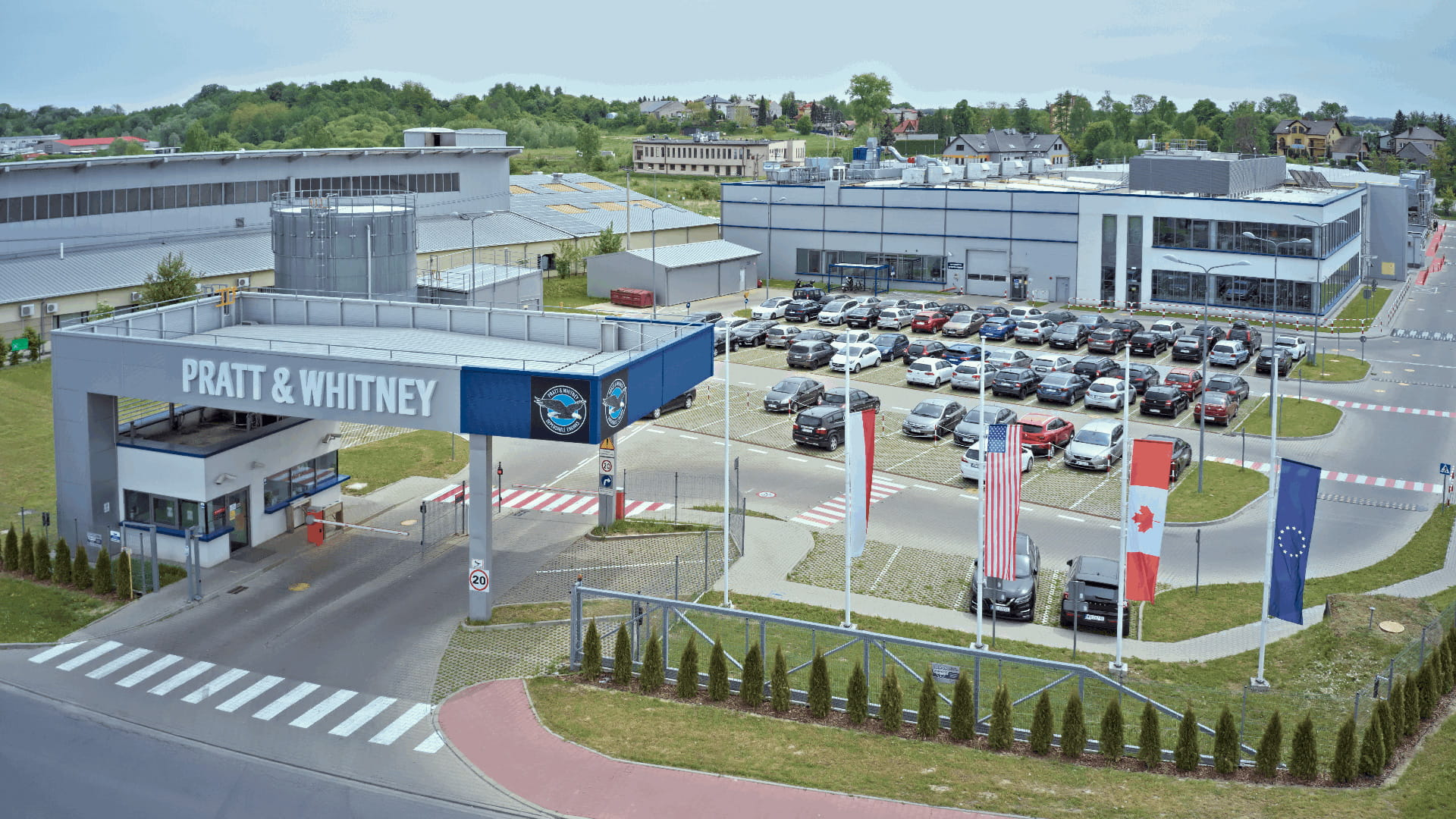
Pratt & Whitney is investing $25 million, equivalent to PLN 95 million, to expand its manufacturing facility in Niepołomice, Poland, adding capacity for complex tubular assemblies used in commercial and military aircraft engines. The expanded site is expected to become operational in 2028 and create more than 120 jobs.
The plant already manufactures precision components for the Pratt & Whitney GTF engine used on commercial passenger aircraft, the PW800 business-aviation engine, and the F135 powering all variants of the F-35. The expansion increases the site’s role within a Polish manufacturing network supporting several of the company’s principal propulsion programmes.
Complex tubular assemblies form part of the network of fluid and pneumatic systems required inside an aircraft engine. Their production can involve forming, joining, dimensional control, specialist materials, inspection, and detailed traceability, with components expected to perform reliably under demanding thermal, vibration, and pressure conditions.
The investment is supported by the Polish government through the Polish Investment Zone Programme and brings Pratt & Whitney’s announced Polish investment during 2026 to $125 million. The company has separately committed $100 million to facilities in Rzeszów, where additional capability is being installed for isothermally forged engine parts.
The Rzeszów programme includes heat treatment, sonic machining, and inspection for forged components used in the GTF, F135, and F100 engine families. Pratt & Whitney has said that investment is intended to increase capacity for critical rotating components, including compressor and turbine disks, with full operation also planned for 2028.
The two projects address different production constraints. Rzeszów is focused on the processing of highly stressed forged engine parts, while Niepołomice produces complex tube assemblies carrying fluids and gases through tightly packaged engine systems. Expanding both areas indicates that capacity planning is being spread across several stages of engine manufacture rather than concentrated on final assembly.
Poland is already a major production base for RTX. The group employs more than 9,500 people in the country across Pratt & Whitney, Collins Aerospace, and Raytheon, making it RTX’s largest employee and investment base outside the United States. Pratt & Whitney’s Polish operations span manufacturing, engineering, turboprop work, auxiliary power units, and components for both commercial and military engines.
Aerospace manufacturing networks depend heavily on process qualification and repeatability. Parts produced at different sites and by different suppliers have to arrive with the same material condition, dimensional accuracy, documentation, and inspection history expected by the engine programme. Increasing nominal capacity is therefore only useful when machinery, workforce training, supplier control, and quality systems can expand without weakening those standards.
The requirement has become more pressing as aircraft manufacturers seek higher delivery rates. Propulsion supply chains have faced constraints across castings, forgings, electronics, specialised materials, and labour, and a shortage in one comparatively small component family can restrict completed-engine output regardless of capacity elsewhere in the programme.
Investment in specialised component processes gives engine manufacturers more headroom before those bottlenecks reach assembly. It can also reduce dependence on facilities already operating close to their practical limits, although additional capacity takes time to qualify and does not contribute materially until the equipment and workforce are producing conforming parts at the required rate.
For Poland, the industrial value lies in the complexity of the work. Precision aerospace components require capital equipment, metrology, manufacturing engineering, documented process control, and trained operators rather than simply low-cost assembly labour. Once those capabilities are embedded and qualified, they become harder to relocate quickly and can attract further work from adjacent programmes.
The Niepołomice project also combines commercial and defence demand within the same manufacturing site. GTF and PW800 production links the plant to civil aircraft markets, while F135 components connect it to the continuing F-35 programme. That programme mix gives the factory several demand streams, although each retains its own engineering and quality requirements.
Both announced Polish investments are scheduled to reach operation in 2028. The next two years will therefore be dominated by equipment installation, recruitment, training, qualification, and production ramp-up rather than immediate increases in delivered engine components.
At $25 million, Niepołomice is a modest investment compared with the cost of developing an aircraft engine, but engine output is ultimately determined by whether thousands of individual components arrive in the right quantity and condition. Pratt & Whitney is adding more Polish capacity at precisely those less visible stages where a missing tube, disk, or inspected part can still stop a much more expensive engine from leaving the factory.