
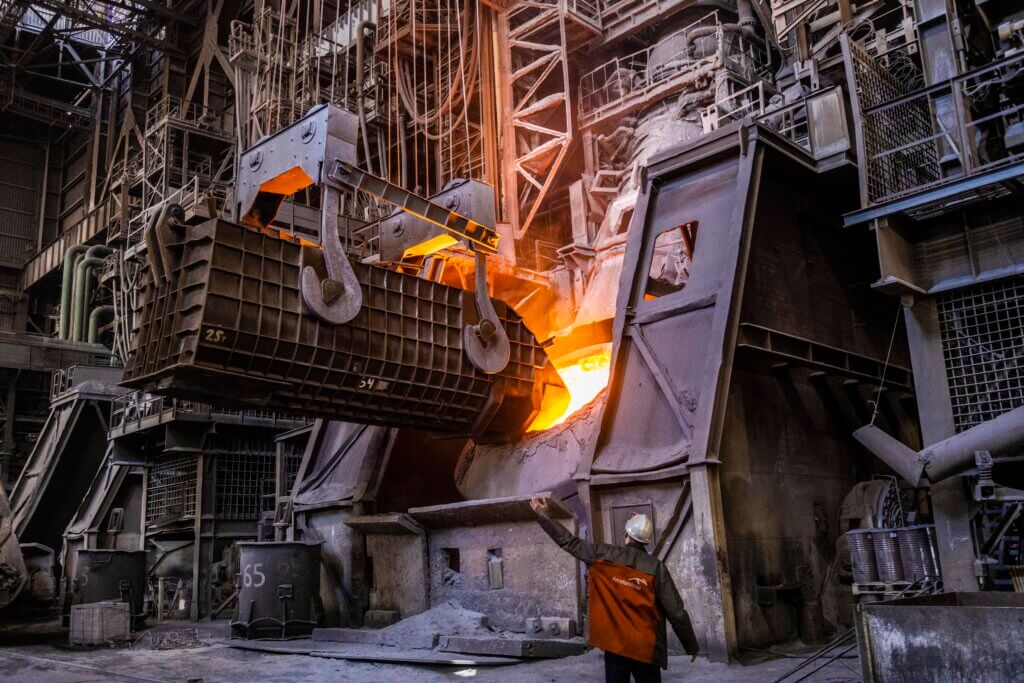
ArcelorMittal Kryvyi Rih has partially halted production after a missile strike damaged key energy and blast-furnace facilities at its integrated steelworks in central Ukraine. Two people were killed and 14 were injured in the attack, according to Ukrainian officials and contemporaneous reporting, while the company said specialists were assessing the damage and options for restoring operations.
The plant was operating when it was struck. ArcelorMittal Kryvyi Rih said damage to power-generation and blast-furnace production facilities had interrupted part of the works, creating an immediate constraint on processes that depend on continuously available electricity, utilities, raw-material handling, and hot-metal production. No timetable for full restoration has been published.
An integrated steelworks is particularly vulnerable to disruption at those points because the production chain is physically and thermally connected. Ironmaking feeds steel conversion, which feeds casting and rolling, while large energy systems, gas networks, cooling circuits, oxygen, compressed air, and material-handling equipment support several stages at once. Damage to one utility or primary process area can therefore reduce output far beyond the equipment directly hit.
Blast furnaces are also continuous thermal processes rather than machines that can be stopped and restarted at will. Operators have to maintain stable temperatures, burden movement, pressure, cooling, and gas handling while protecting refractory linings and auxiliary equipment. A forced interruption can require careful stabilisation before inspections and repair work begin, and the condition of the furnace after an incident can determine how quickly downstream production can resume.
ArcelorMittal Kryvyi Rih operates a full production chain extending from iron-ore extraction through sintering, blast-furnace ironmaking, steel production, and rolling. Its finished products include billet, rebar, wire rod, sections, angles, round bar, and square products. On its published design basis, the site is capable of producing more than six million tonnes of steel and more than five million tonnes of rolled products annually.
Actual output has been far below nominal capacity during the war. Electricity availability, logistics, workforce constraints, damage risk, and weak commercial conditions have all restricted utilisation, while repeated pressure on the Ukrainian power system has made energy security an operating issue rather than a background cost. The latest strike therefore affects a works that was already being managed under abnormal production conditions.
Energy disruptions have caused operational problems at the site before. ArcelorMittal Kryvyi Rih has previously reported the financial and technical effects of unstable electricity supply, including the need to import a significant share of its power and periods when metallurgical production had to be reduced. Lower utilisation can increase unit costs because fixed infrastructure, maintenance, utilities, coke-making, and primary ironmaking still have to be supported across fewer tonnes of saleable product.
The latest damage compounds those pressures because restoring power alone may not restore production. Engineers first have to establish the condition of the affected blast-furnace and energy systems, determine whether auxiliary equipment, controls, cabling, pipework, or structures have been damaged, and decide which processes can be brought back safely without placing additional strain on the rest of the works.
Downstream operations depend on the answer. Converter steelmaking requires a stable supply of hot metal, while rolling mills depend on semi-finished steel from upstream. Existing inventories can sometimes support limited production after an interruption, but an integrated site cannot sustain normal output for long if primary ironmaking remains constrained.
The human impact takes precedence over those production calculations. Two people were killed and 14 injured in the strike, and emergency response and medical treatment followed while damage assessment began. The company has limited the operational detail released publicly, a reasonable constraint while rescue, safety, and wartime-security considerations remain active.
That also means production-loss estimates would be premature. Public reporting does not yet establish which individual assets require repair or replacement, how much redundant power and utility capacity remains, whether any blast furnace can continue at reduced output, or how quickly downstream units can be resequenced. Without those details, a tonnage estimate or restart date would be speculation.
The site remains one of Ukraine’s most important industrial assets because mining, ironmaking, steelmaking, and rolling are concentrated in one complex. That integration gives the works substantial productive capability when the chain is intact, but it also exposes the operation to disruptions that move rapidly from energy and primary production into every subsequent stage.
ArcelorMittal Kryvyi Rih now has to establish the physical condition of its power and blast-furnace assets before any credible recovery schedule can be set. For a steelworks already operating with limited headroom, the latest attack removes another layer of resilience from a production system that has spent more than four years adapting to war.
