Metso has expanded its Lokotrack mobile crushing range with two machines aimed at different aggregate-processing duties, introducing a diesel-electric impact crusher for demolition recycling alongside a cone crusher with integrated screening for hard-rock production.
The 70-tonne LT400RS joins the Lokotrack EC range and is designed to process concrete, asphalt, demolition waste, and other recyclable material. The LT200HPX is configured for secondary and tertiary hard-rock crushing, with customers able to specify pre-screening, product screening, or both.
The different layouts reflect the feed conditions each machine is expected to handle. Quarry rock generally arrives from a controlled geological source, while demolition material can contain reinforcing steel, timber, asphalt, and lighter contaminants alongside concrete of varying strength and particle size.
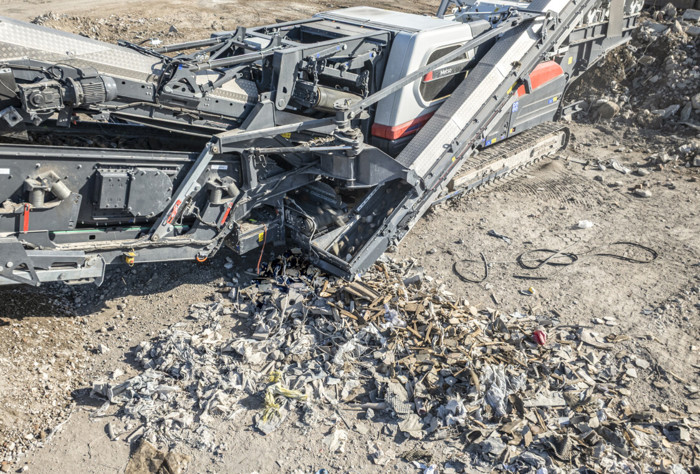
Metso has therefore built the LT400RS around crushing, screening, and separation in one tracked package. The machine uses a Nordberg NP1213MR impact crusher with a 250kW electric drive, supported by a 430kW diesel genset.
A two-deck screen separates product sizes, while a wind sifter and adjustable electromagnet remove lightweight contaminants and ferrous material. The screen can produce up to three end products, depending on the selected process configuration.
Separation is central to the recycling application because breaking demolition waste into smaller pieces does not automatically create a saleable aggregate. Steel and lightweight contamination need to be removed, and the remaining mineral material has to be graded consistently enough for its intended reuse.
The LT400RS uses diesel-electric power transmission, with the process functions driven electrically. It can run from the onboard diesel genset or connect to an external electricity supply as standard when suitable site power is available.
That gives contractors a choice between self-contained mobility and grid operation. External electricity can reduce local fuel consumption, exhaust emissions, and noise, although the overall carbon result still depends on the source of the electricity and the operating profile of the machine.
The crusher also uses Metso’s ICX automation system, which provides a larger operator interface, troubleshooting support, and production recipes for different applications. Stored recipes allow repeated process settings to be recalled when the machine moves between feed materials or product requirements.
Remote IC capability allows the crushing process to be controlled from an excavator cab, while digital services include Production Performance and AI-powered Predictive Maintenance. Those tools are intended to improve visibility of output and machine condition rather than alter the mechanical reality that crushers operate in an abrasive, high-impact environment.
Wear therefore remains part of the process. The operational advantage comes from identifying deterioration early enough to schedule intervention, avoiding both premature part replacement and failures that stop production without warning.
The LT200HPX addresses a different duty. It uses Metso’s HP200e cone crusher and can be configured with a two-deck pre-screen, a 5.6m² two-deck product screen, or both on the same track-mounted unit.
Pre-screening removes fine material before it reaches the crusher. Bypassing particles that are already below the required feed size can increase available capacity, reduce wear, and improve stability because the crushing chamber is not processing material that does not need further reduction.
The product screen performs the downstream task, classifying crushed material onboard and returning oversize where a closed-circuit arrangement is required. Metso says the combined pre-screen and product-screen configuration can deliver up to 40% higher capacity than the LT200HPS, depending on application conditions.
The LT200HPX uses a direct V-belt crusher drive rather than the diesel-electric architecture of the LT400RS. Metso claims fuel consumption can be up to 30% lower than the LT200HPS with the product-screen configuration, illustrating that the company is using different powertrain approaches according to application rather than forcing one architecture across the range.
Transport and maintenance have also influenced the design. Folding walkways, lowering functions, service platforms, and configurable screens are intended to reduce the work required when the machine moves between sites or needs access for routine service.
Jarmo Vuorenpää, vice president of Track Solutions at Metso, said the machines are intended to help customers “improve productivity, lower their cost per tonne and maintain high uptime”.
Cost per tonne is a more useful measure for crushing equipment than headline engine power because output depends on the interaction between feed quality, crusher setting, screening, recirculation, wear, energy consumption, and machine availability.
Metso is presenting both models at Steinexpo in Germany from 2 to 5 September, putting the new machines in front of quarrying, recycling, and construction-material operators shortly after launch.
The engineering test will differ between the two products. The LT400RS has to demonstrate that it can turn difficult demolition feed into consistently separated recycled aggregate without sacrificing throughput, while the LT200HPX must show that integrated screening adds flexibility without creating an unwieldy mobile plant.
Both developments point towards a broader change in mobile crushing. The crusher itself remains the centre of the process, but power options, screening, contaminant separation, automation, remote control, and condition data increasingly determine whether the machine produces useful tonnes rather than simply smaller rocks.