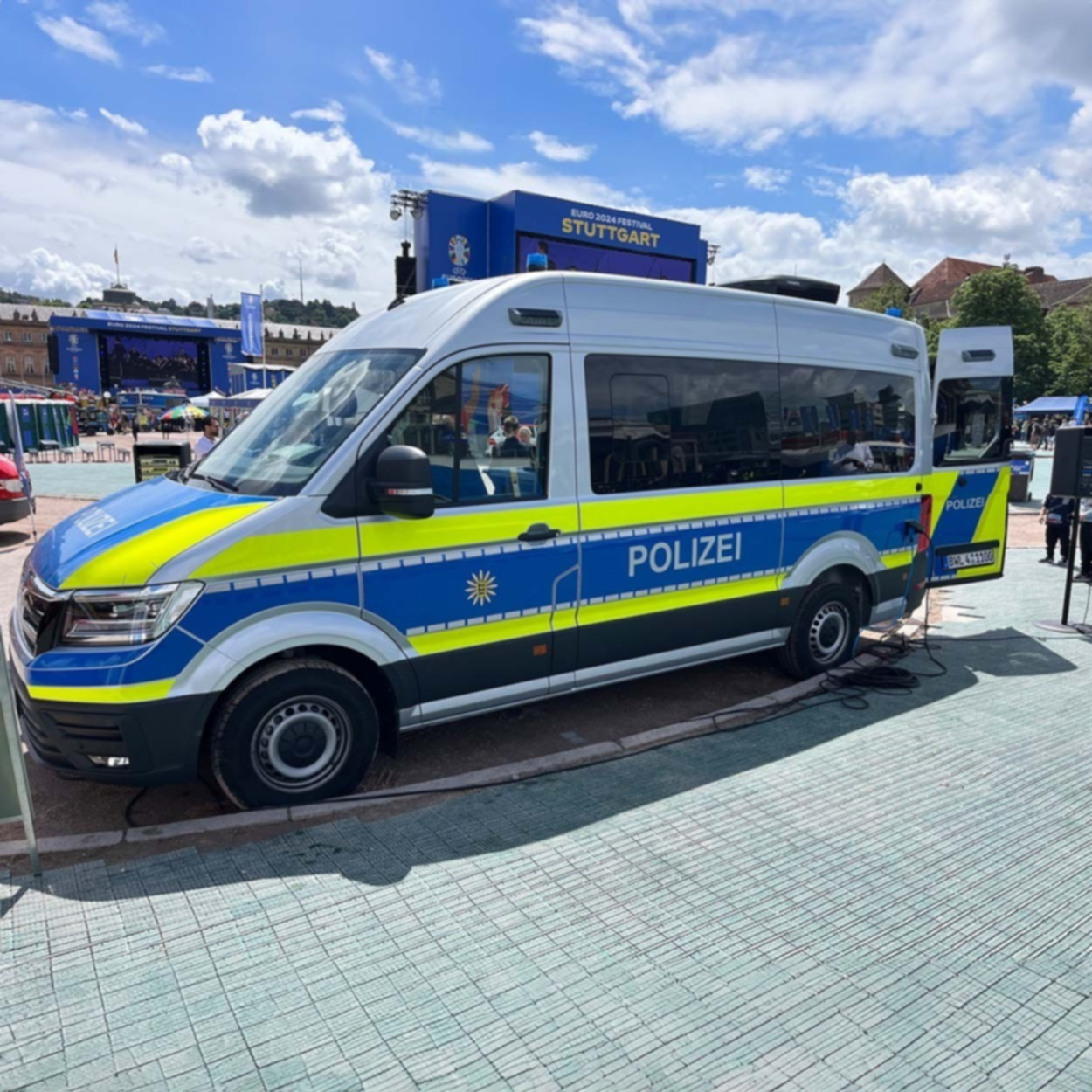
MAN Truck & Bus has secured a four-year German government framework covering the supply of up to 1,000 TGE passenger vans for federal and state police operations. The agreement allows for as many as 250 vehicles a year, with first deliveries scheduled during 2026 and specialist conversion work assigned to MOSOLF Special Vehicles in Kippenheim.
The contract was tendered by the Procurement Office of Germany’s Federal Ministry of the Interior and is one of the largest individual orders in the history of the MAN TGE. Vehicles will be supplied to the German Federal Police and the riot-police forces of the federal states rather than being concentrated within a single regional fleet.
The base model is the MAN TGE 3.180 Kombi passenger transporter, specified with a 130kW engine producing 177hp and maximum torque of 410Nm between 1,500 and 2,000rpm. Standard production vehicles will then be transferred to MOSOLF, where they will be equipped for official law-enforcement duties.
That second manufacturing stage is central to the programme. Specialist fleet vehicles combine the economics of a series-produced automotive platform with lower-volume integration work that can include communications, electrical equipment, internal fittings, power distribution, safety systems, and other customer-specific hardware.
The arrangement avoids designing an entire vehicle from first principles for police use while still allowing operational requirements to be built around a proven commercial platform. It also divides responsibility between two very different production environments: MAN manufactures the common vehicle at automotive scale, while MOSOLF adapts individual units or batches to a much narrower specification.
The converted TGEs are intended for passenger transport during public-order and security duties, including major sporting events and demonstrations. They will also support Federal Police work involving border protection, security at federal facilities, and railway policing, creating a varied operating profile rather than one dedicated task.
Those applications place importance on availability and maintainability. Police fleets can face periods of concentrated demand, and vehicles may be dispersed across a wide geographic area. The usefulness of a standard commercial platform therefore extends beyond purchase price because routine mechanical maintenance can be supported through the manufacturer’s wider workshop and parts network.
Specialist equipment creates another service layer. Added electrical loads have to remain within the capability of the base vehicle’s power system, installed hardware has to tolerate vibration and repeated use, and additional equipment affects payload and internal space. Converters also have to avoid compromising crash structures, occupant protection, diagnostics, or access needed for maintenance.
Modern vehicle electronics make that integration more complicated than simply bolting equipment into the rear compartment. Communications hardware, lighting, power systems, and other additions may interact with electrical architectures whose operation is increasingly controlled through software and networked modules. Poorly integrated modifications can create diagnostic faults or service problems long after the initial conversion is complete.
The four-year framework gives MAN and MOSOLF a clearer production horizon than a sequence of unrelated purchases, although the maximum volume of 1,000 vehicles represents the ceiling available under the agreement rather than a guarantee that every unit will be ordered. Call-offs will determine the actual production profile.
That still gives the suppliers an opportunity to standardise more of the conversion work than would be possible on isolated small batches. Repeated layouts, wiring arrangements, component mounting, documentation, and acceptance procedures can reduce engineering effort per vehicle while making future servicing more consistent across the fleet.
Framework volume also changes supply-chain planning. MAN has to ensure base vehicles are available when required, while MOSOLF has to coordinate specialist components whose suppliers may work at much lower volumes than mainstream automotive manufacturers. Equipment specific to law enforcement can have longer procurement cycles or narrower substitution options than conventional van hardware.
The conversion operation consequently sits between mass manufacturing and project engineering. Too much customisation can undermine the efficiencies created by the common base platform, but excessive standardisation can leave operational users with equipment poorly matched to their duties. A programme potentially extending to 250 vehicles a year provides enough repetition to make that balance commercially significant.
Serviceability has similar implications over the fleet life. Base-vehicle parts can move through established MAN channels, while specialist systems require their own technical documentation and replacement strategy. If a particular communications or electrical component becomes obsolete during the four-year delivery programme, later vehicles may have to adopt a new configuration without making earlier units unnecessarily difficult to support.
That issue will continue after production ends. Public-sector fleets can remain in service for years, meaning the programme has to be maintainable long after individual conversion components have disappeared from current product catalogues. Clear configuration records and commonality across batches can therefore reduce operating cost as much as the original manufacturing efficiency.
First deliveries later this year will move the framework from procurement into production and conversion. The ultimate volume will depend on orders placed against the agreement, but the potential scale makes it more than a conventional specialist-vehicle contract. It establishes a multi-year production interface between MAN’s series-built TGE and MOSOLF’s lower-volume engineering operation, with up to 1,000 finished police vehicles emerging from the combination.