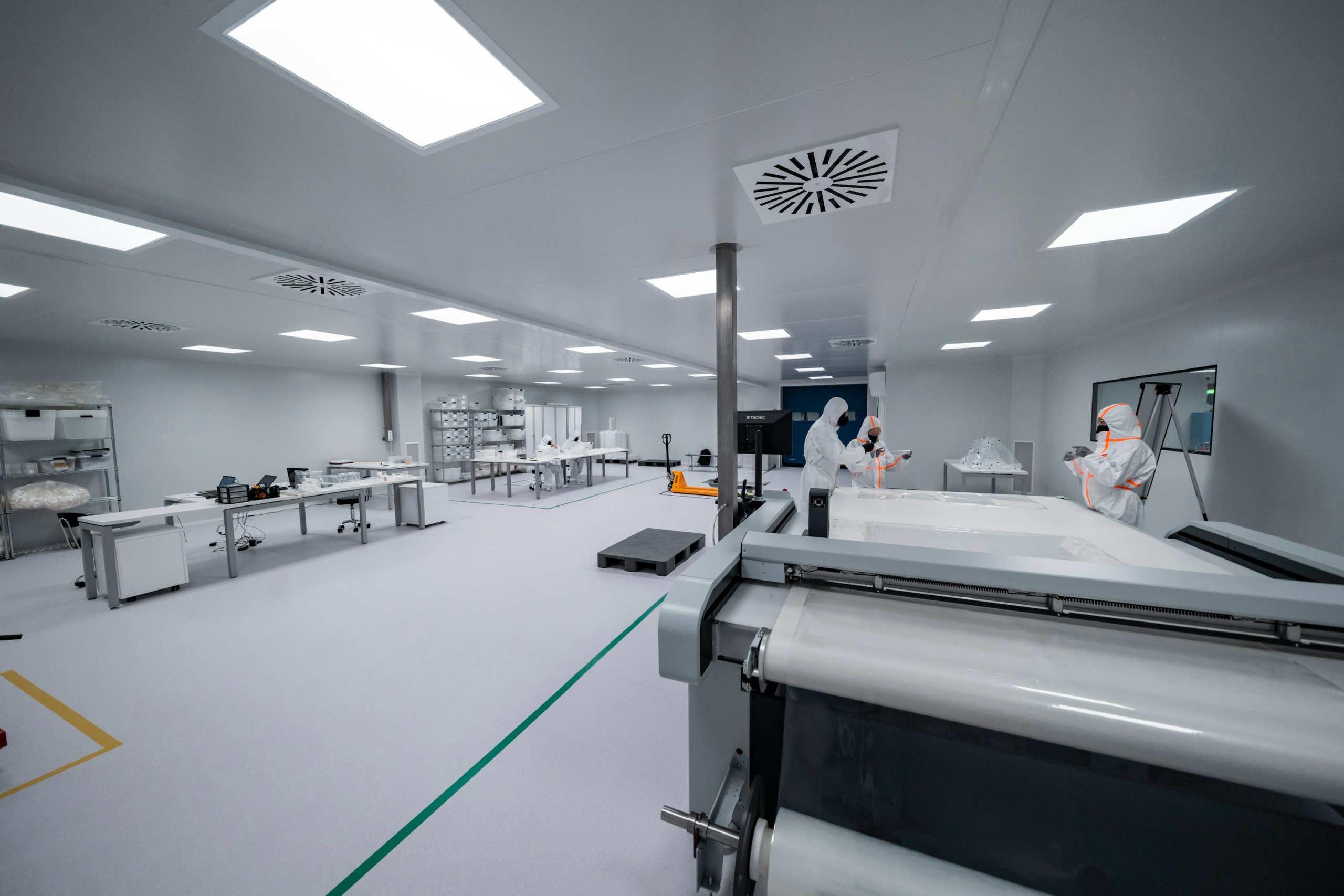
Kemira has started pilot production of iron phosphate at its Helsingborg site in Sweden, moving its battery-material programme beyond laboratory development and into larger-volume manufacturing for customer testing, product qualification, and process validation.
Iron phosphate is used as a precursor in the manufacture of lithium iron phosphate cathode material, placing the new plant in the middle of the battery supply chain rather than at cell assembly. Kemira will use the pilot operation to establish whether its chemistry and manufacturing route can meet customer requirements before committing to commercial-scale production.
The move from laboratory work to pilot manufacture is an important engineering stage for any chemical process. A formulation that performs consistently in small batches has to be reproduced using larger vessels, different mixing conditions, longer transfer routes, filtration equipment, drying systems, material handling, and industrial controls.
Each of those changes can affect the resulting product. Reaction conditions, impurity levels, particle characteristics, moisture, filtration performance, and residence times can shift as volume increases, making pilot production necessary before a company can specify equipment and operating parameters for a full-scale plant with confidence.
The Helsingborg facility also gives Kemira enough output to supply material for customer trials. Qualification matters because precursor characteristics influence downstream cathode-active-material processing and, ultimately, battery performance, so prospective buyers need evidence that repeated batches remain within the required physical and chemical specifications.
Lithium iron phosphate has expanded rapidly across electric vehicles and stationary energy storage. Compared with nickel-containing lithium-ion chemistries, LFP provides a different balance of cost, durability, thermal stability, raw-material requirements, and energy density, making it increasingly attractive where maximising energy stored per unit of mass is not the only design priority.
Growth has been particularly strong in stationary energy storage, where long cycle life, cost, and safety can outweigh the weight advantages of other chemistries. Grid-scale systems, renewable-energy installations, industrial power projects, and data-centre infrastructure are all adding demand alongside electric vehicles.
The European supply chain remains much less developed than the final demand for the chemistry. Battery-cell factories require cathode materials and precursor chemicals in addition to lithium, graphite, separators, electrolytes, and other inputs, meaning regional cell production alone does not create a complete regional manufacturing chain.
Iron-phosphate production therefore sits within a broader effort to establish more battery-material capacity in Europe. The industrial requirement stretches from raw-material refining and chemical conversion to active materials, electrodes, cells, modules, and complete battery systems, with each stage requiring its own equipment and qualification processes.
Kemira enters that market from an established chemicals-manufacturing base rather than as a battery producer. Its existing operations include inorganic and iron-based chemistry, process development, water-intensive industrial systems, and experience scaling chemical production from laboratory work into large industrial plants.
Those capabilities are relevant to precursor manufacture because commercial production depends on far more than achieving the required chemical reaction. Feedstock handling, plant corrosion, filtration, drying, utilities, wastewater treatment, quality control, automation, maintenance, and process safety all affect whether a chemistry can be produced economically and consistently.
The Helsingborg pilot is intended to generate data across those areas. It can establish achievable throughput, product consistency, energy and water requirements, waste streams, equipment behaviour, and production economics while providing material to downstream customers for evaluation.
Customer qualification will determine much of what happens next. If cathode-material producers validate the material successfully, Kemira will have stronger evidence for designing a commercial-scale plant around actual product specifications and likely demand rather than relying only on laboratory assumptions.
Market conditions will influence that decision alongside technical performance. Battery-material pricing and regional investment plans have moved rapidly in recent years, and a new precursor plant has to compete with established large-scale suppliers as well as other projects being developed closer to European cell production.
The pilot approach reduces some of that risk by separating process development from the largest capital commitment. Kemira can refine the production route and gauge customer interest before specifying the capacity, equipment, and plant layout required for a permanent commercial operation.
For the wider European battery industry, the project illustrates the importance of midstream materials capacity that sits between mining and highly visible gigafactory investments. Cell plants cannot operate independently of the chemical and materials producers feeding them, and qualification cycles make those relationships difficult to establish at short notice.
Helsingborg now gives Kemira a physical platform for that qualification work. The next measurable milestone will be successful downstream validation rather than simply a higher pilot output figure; if that stage is completed and a commercial investment follows, the project would move from process development into permanent European production of an LFP precursor material.