KASTO has integrated automated storage, demagnetisation, sawing, robotic sorting, and warehouse management at SEW-EURODRIVE’s Smart Factory Hall North in Graben-Neudorf, Germany.
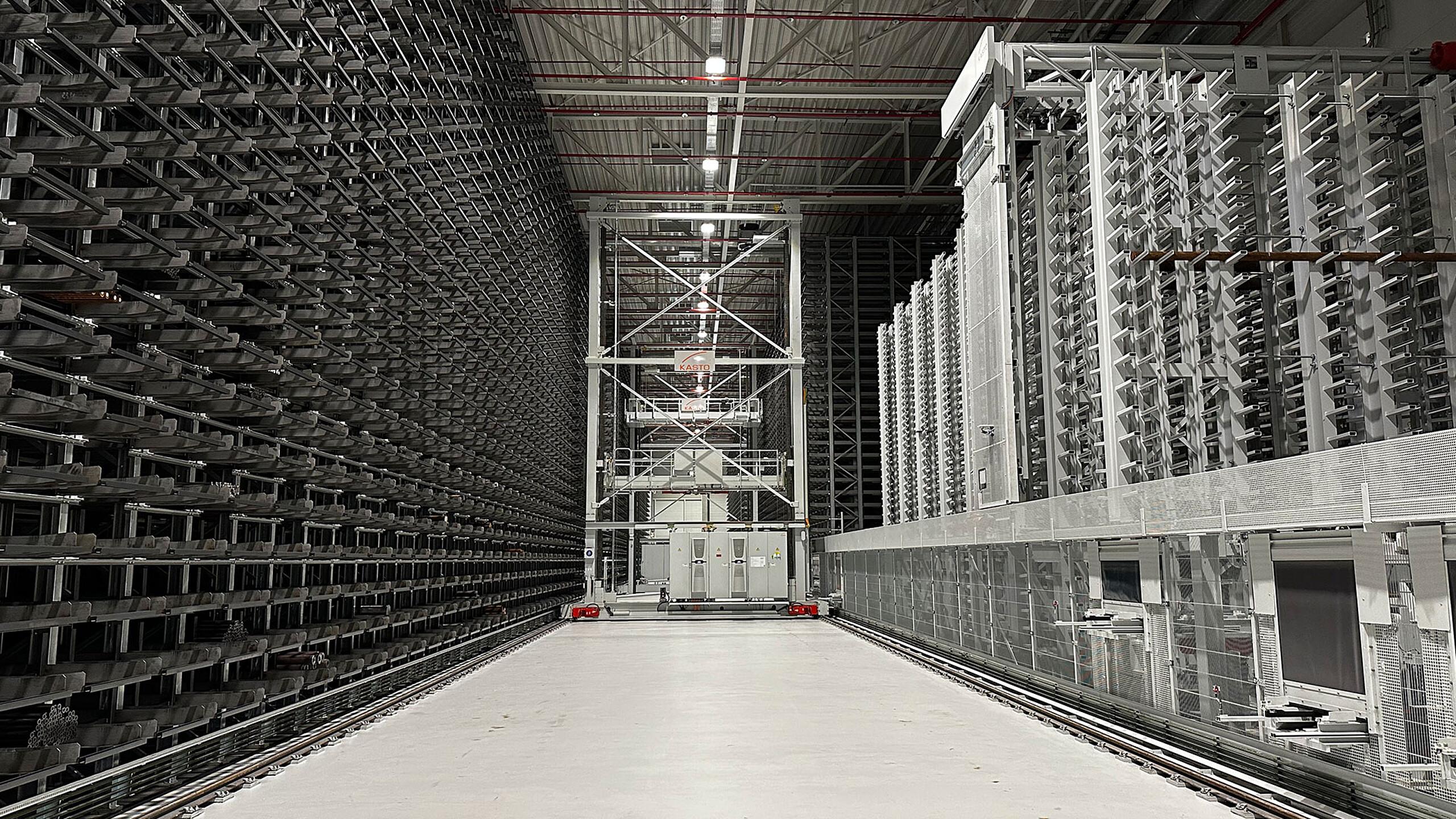
Built around a 4,000m² warehouse, the material system combines 5,140 cassette storage locations with a 450-position bar store serving eight automatic circular saws and a high performance bandsaw. Each main cassette can hold up to three tonnes of bar, tube, and profile stock.
Incoming bundles measuring three or six metres are unloaded onto a buffer conveyor and identified through barcode data. Where transport and friction have magnetised the steel, complete cassettes pass through an alternating magnetic field before an overhead crane places the material into storage.
Individual bars are then retrieved automatically and transferred to the required saw. Eight KASTOvariospeed circular machines process material up to 180mm in diameter, while larger cross-sections and difficult alloys can be handled by the hydraulic KASTOtec bandsaw.
After cutting, a robotic system selects grippers, containers, and stacking patterns before automated guided vehicles move completed orders into production. KASTOlogic warehouse software coordinates inventory, travel paths, saw allocation, material handling, and order data through an interface with SEW-EURODRIVE’s SAP system.
Only three to four employees are required to operate the complete installation, according to the companies. The system supports batch sizes from one to large series while maintaining central control over stock, cutting, sorting, and onward delivery.
Warehouse data becomes production data
Automated storage is often justified through higher density, but its larger effect comes from controlling the identity and position of each piece of material. When inventory data remains accurate, stock can be released directly against a work order without a separate manual search and verification stage.
That control begins at receipt. Incorrect grade, dimensions, batch information, or barcode data can be propagated efficiently through an automated system, allowing the wrong material to reach several orders before the error becomes visible. Incoming identification and data discipline consequently remain essential despite the reduction in manual handling.
Integrating storage with sawing removes another boundary from the process. Conventional operations may retrieve material in bulk, create a queue beside the saws, cut according to local priorities, and place finished pieces into another holding area, increasing work in progress and obscuring order status.
Direct software coordination allows material release to reflect diameter, grade, saw capability, due date, downstream demand, and machine availability. Remaining sections can return to stock with updated dimensions, reducing waste where alloy steel, titanium, Inconel, or other difficult materials carry high purchase costs.
Demagnetisation provides an example of process detail that can become significant later in production. Steel magnetised during transport or handling may interfere with machining, cleaning, measurement, or subsequent assembly, so treating complete bundles before storage removes the condition before it reaches individual work orders.
Robotic sorting prevents automated cutting from creating a manual bottleneck at the output. Cut pieces vary in length, mass, geometry, and destination, requiring dependable identification and handling if orders are to remain separated without excessive labour.
Bentley’s automated paint operation at Crewe applies a comparable production principle, coordinating physical movement and process data across varied vehicle bodies rather than treating automation as a collection of independent robot cells.
The KASTO installation still depends on skilled operators and maintenance personnel. Employees supervise flow, manage exceptions, protect data quality, and respond when equipment or software diverges from the planned sequence, while maintenance teams support cranes, conveyors, saws, robots, sensors, safety systems, and interfaces.
Connecting so many functions also concentrates operational risk. A fault in the central store can restrict every saw, while an unavailable output station or software interface can prevent completed orders from reaching production even when the cutting equipment remains serviceable.
Condition monitoring, spare parts, backups, and recovery procedures must therefore cover the complete system rather than individual machines. Remote support can shorten diagnosis, although access controls, software updates, and cyber security need to reflect the fact that a digital failure can stop physical material flow.
The installation is designed for varied series production rather than a single repetitive product. Flexible automation must accommodate changing order mixes and batch sizes without losing the utilisation associated with standardised high volume lines.
SEW-EURODRIVE’s system turns the warehouse into the first controlled stage of manufacturing, with each movement linked to a production requirement. Its long term performance will depend on inventory accuracy, mechanical availability, software stability, and the ability to recover from exceptions without allowing one connected fault to stop the entire flow.