Bentley Motors has formally opened its new paint shop at Crewe, completing a major stage of the luxury car manufacturer’s programme to modernise production at its long-established Cheshire site.
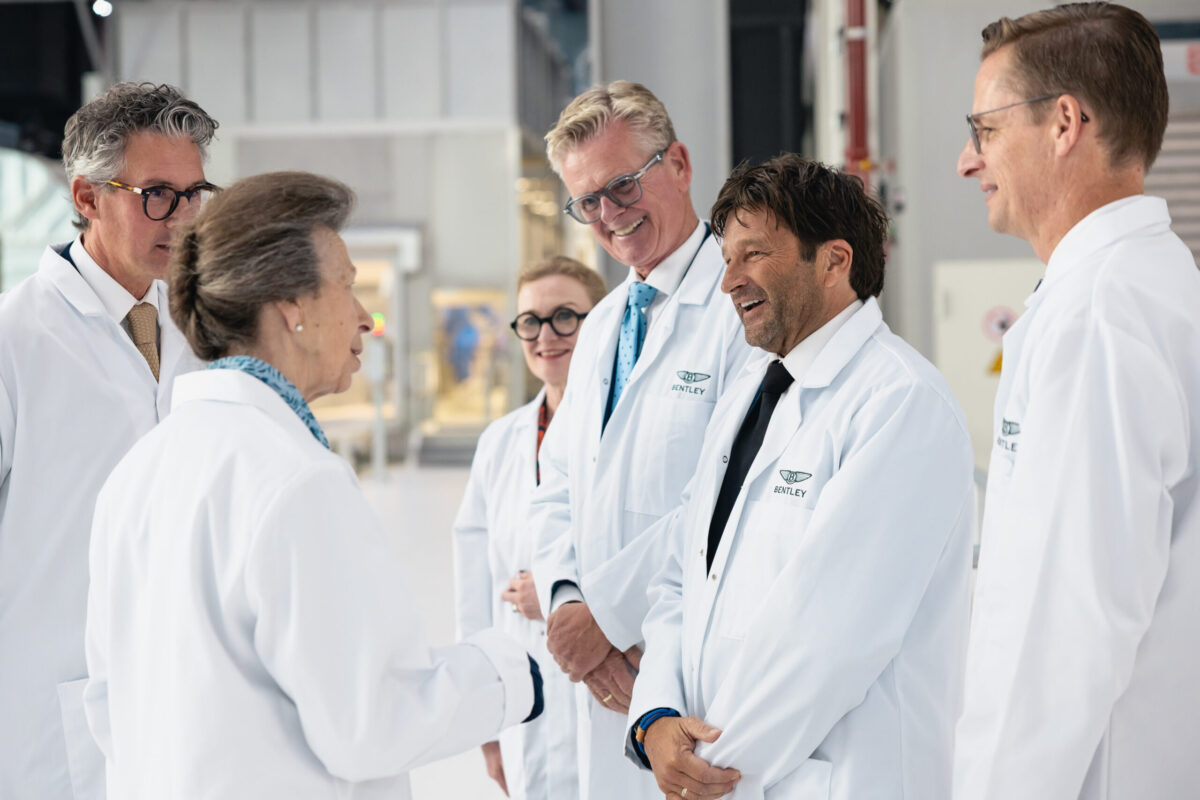
The 12,500m² facility was opened by the Princess Royal and represents one of the largest physical investments within Bentley’s Dream Factory programme. Built across several levels, it is the tallest structure on the Crewe campus and has been designed to handle both the current model range and future vehicle programmes.
Ten automated guided vehicles move bodies between preparation, coating, inspection, and finishing operations, replacing much of the fixed conveyor infrastructure used in a conventional automotive paint shop. Bentley says no other automotive facility currently uses AGVs to transport vehicle bodies throughout the complete paint process.
Because each body can be identified and routed independently, the production system can accommodate differing colours, finishes, inspection requirements, and model configurations without every vehicle following an identical sequence. Process stages can also be bypassed or revisited when a body requires additional preparation or rectification.
The facility entered production earlier in the summer, while the formal opening marks its full incorporation into Bentley’s long-term manufacturing plan. The forthcoming Torcal model line is expected to use the paint shop from the start of production, alongside the Continental GT, Continental GTC, and Flying Spur.
Paint application remains among the most energy and process-intensive stages of vehicle manufacture. Bodies must be cleaned, prepared, coated, cured, inspected, and refinished under tightly controlled conditions, with temperature, humidity, air quality, contamination, and application thickness affecting the final surface.
Premium vehicle production places additional pressure on the process because customer specifications vary considerably. Standard colours may be mixed with bespoke commissions, specialist finishes, contrasting body sections, or additional coats, creating production requirements that are closer to batch manufacturing than conventional high-volume assembly.
Bentley has introduced a water-based primer system in place of a more solvent-intensive process. The company expects the change to reduce waste by up to 45% and cut volatile organic compound emissions by as much as 98%, depending on the production mix and operating conditions.
Flexible routing replaces fixed production logic
Removing the dependence on a continuous conveyor changes how the paint process can be organised. Individual bodies can dwell for different periods, enter separate work areas, or move around maintenance activity without stopping every vehicle upstream and downstream.
That flexibility also reduces the amount of mechanical infrastructure occupying the building. Fixed conveyors usually determine the geometry and sequence of a production line for decades, whereas mobile transport allows individual cells, inspection areas, and buffer zones to be modified as requirements change.
Automated transport does not remove skilled manual work from the operation. Surface assessment, defect rectification, colour evaluation, polishing, and final finishing still depend on trained operators, supported by controlled application equipment and digital inspection.
Concentrating manual activity around inspection and finishing allows the automation to handle repetitive body movement while employees address the variation associated with low-volume luxury production. Maintenance teams will also require broader electrical, mechanical, software, and network skills as the reliability of material flow becomes dependent on AGV controls and plant communications.
Thermal management has been incorporated into the building because paint curing, air handling, and extraction consume substantial amounts of energy. Warmth generated by production processes will be recovered and reused, reducing the requirement for additional heating during much of the year.
Bentley expects recovered heat to meet the building’s requirements for around two-thirds of an average year. Performance will vary according to external temperature, production schedules, and the balance between generated process heat and building demand.
The investment also demonstrates the practical difficulty of modernising an established automotive site. New equipment must be installed without interrupting current production, while buildings and utilities developed for earlier manufacturing generations must support increased electrical loads, higher data volumes, stricter environmental controls, and automated transport.
Crewe remains responsible for body, paint, assembly, engineering, finishing, and bespoke operations, employing around 3,000 people. Continued investment provides greater certainty for the site, although the composition of factory work is changing as production systems become more connected and software controlled.
Paint quality remains an immediate measure of manufacturing performance for a luxury brand. Customers may never see the AGVs, heat recovery equipment, air treatment systems, or process data behind the finish, yet surface defects, colour variation, and delayed delivery are readily apparent.
The new operation therefore combines environmental improvement with a conventional factory requirement: achieving repeatable quality while processing a high degree of variation. Its mobile architecture gives Bentley greater scope to adjust routes and equipment as new models enter production and the company changes the balance of its powertrain portfolio.
As vehicle manufacturing moves through electrification and lower-volume model diversification, rigid lines are becoming harder to justify for every process. Bentley’s Crewe paint shop applies flexible automation to one of the most technically controlled parts of vehicle production, where small process changes can have an immediate effect on both manufacturing cost and finished quality.