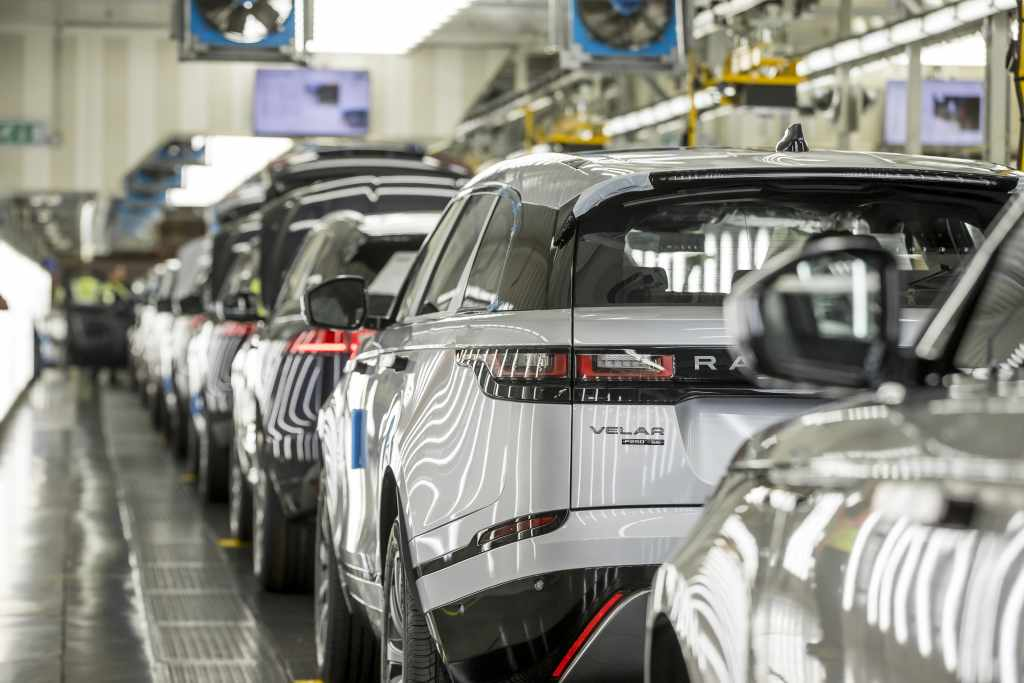
JLR is preparing to cut around 4,000 jobs worldwide through voluntary redundancies over the next two years as it reduces fixed costs and simplifies the business around a still-heavy investment programme. The proposed reduction is close to 10% of the company’s global workforce and is expected to fall mainly across salaried and management roles rather than production-line positions.
The restructuring sits inside a wider programme targeting £1.7 billion of savings and a reduction in JLR’s cash break-even volume towards 300,000 vehicles a year. The company employs about 43,000 people globally, including roughly 34,000 in Britain, but has not published a site-by-site breakdown of the proposed job losses. Business Secretary Jonathan Reynolds has spoken with chief executive PB Balaji and is expected to meet the company and trade unions as the consultation develops.
The cost programme does not amount to a retreat from product and manufacturing investment. JLR says it will continue spending £15 billion to £18 billion over five years on electrification, digital technologies, advanced manufacturing, and customer experience, while launching five new products over the next 12 months. The challenge is to fund that programme from a business carrying fewer fixed costs and operating in a market where tariffs, Chinese competition, and uneven electric-vehicle demand have all become harder to absorb.
Recent financial performance explains the urgency. Revenue for the year to 31 March 2026 fell 20.9% to £22.9 billion, with adjusted EBIT at 0.7% for the full year. JLR said the result reflected incremental US tariffs, difficult conditions in China, the planned wind-down of outgoing Jaguar models, and production stoppages after the 2025 cyber incident.
The cyber disruption exposed how quickly a corporate systems failure could become a manufacturing problem. JLR halted production across much of its network before beginning a phased restart in October 2025, initially bringing back engine and battery operations in the West Midlands alongside stamping and selected Solihull activities. A supplier-financing arrangement was introduced at the same time to bring forward payments to qualifying suppliers while production and cash flow were being restored.
That episode sits directly beside JLR’s current factory transition. Solihull, Halewood, and the Electric Propulsion Manufacturing Centre remain central to the company’s electrification plans, while the group is retaining greater propulsion flexibility so Range Rover and Defender programmes can respond to different market conditions rather than relying on one global transition timetable.
Battery supply adds another constraint. AESC has delayed the next stage of its Sunderland gigafactory expansion after JLR supply talks stalled, leaving a planned line waiting for firmer customer demand. That does not stop JLR’s electrification programme, but it illustrates the difficulty of aligning vehicle launches, battery qualification, factory investment, and supplier capacity when demand forecasts continue to move.
Flexible propulsion strategies can reduce exposure to a single market outcome, yet they also preserve complexity. Internal-combustion, hybrid, and battery-electric programmes require overlapping engineering, validation, software, sourcing, and manufacturing work, raising the amount of fixed capability a carmaker has to carry before each model reaches volume production. JLR’s savings plan is therefore aimed at the organisation around the factories as much as the factories themselves.
The wider automotive market offers little room for an easy recovery. European manufacturers are cutting capacity and headcount as they contend with Chinese competition, higher trade barriers, and slower-than-expected electric-vehicle adoption in several markets. Luxury manufacturers have some protection through pricing and brand strength, but they are not insulated from weaker volumes or from the cost of maintaining several powertrain technologies at once.
JLR enters that environment with product investment still moving ahead but with a much lower tolerance for under-utilised capacity and organisational duplication. The company wants its operating structure to support stronger margins at lower annual vehicle volumes, while keeping enough engineering and manufacturing depth to launch the next Range Rover and Jaguar programmes on schedule.
The redundancy programme will now move through consultation, and the geographical distribution of the cuts remains one of the largest unanswered questions. JLR must take £1.7 billion out of its cost base without removing the people, supplier capability, or production readiness needed to convert billions of pounds of continuing investment into saleable vehicles.