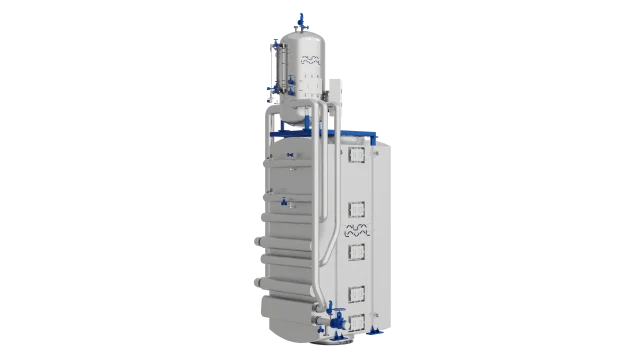
Alfa Laval has launched Hukka-5, a new exhaust-gas steam boiler for cruise ships and passenger ferries that uses an inverted downward natural-circulation arrangement to recover waste heat within restricted machinery and funnel space. The boiler was introduced at SMM 2026 and is available immediately for project orders.
Exhaust-gas boilers use heat that would otherwise leave a vessel through its engine exhaust to generate steam or hot water for onboard services. Depending on vessel configuration, that recovered energy can support heating and other auxiliary loads, reducing the amount of fuel or electrical power that would otherwise be required to produce the same thermal output.
Hukka-5 is designed around natural circulation, meaning water movement through the boiler is driven by density differences rather than dedicated circulation pumps. Alfa Laval has inverted the conventional arrangement so that circulation runs downwards, creating counter-current flow between the water circuit and exhaust gas.
The company says that geometry allows greater heat recovery while keeping the exhaust-gas boiler footprint compact. Space is particularly constrained on cruise vessels, where propulsion, hotel services, emissions equipment, safety systems, ventilation, and passenger accommodation all compete for volume, making a larger heat exchanger difficult to accommodate simply by expanding the casing.
The design also aims to reduce instability in the evaporative circuits when exhaust temperature changes. Four-stroke engines on cruise ships and ferries frequently operate across changing loads, particularly on routes involving regular port calls, so exhaust conditions can vary substantially during a voyage.
Alternative fuels add another variable. Alfa Laval says the Hukka range can be applied with engines and gas turbines running on different fuels, including methanol and hydrogen. The boiler does not determine the emissions profile of the fuel itself, but the ability to recover useful energy from the exhaust remains relevant regardless of what created the heat.
The natural-circulation approach removes pumps and rotating components from the water circuit. Alfa Laval also says water remains within the heating-surface tubes when circulation stops, helping to limit heat loss and reducing some risks associated with forced-circulation arrangements during sudden engine-load changes.
Hukka-5 uses finned water tubes as standard and can be fitted with integrated Aalborg OMA soot blowers for applications where flue-gas fouling is significant. Deposits on heat-transfer surfaces reduce thermal performance over time and can increase pressure loss, meaning the effective efficiency of a waste-heat system depends on maintaining the equipment rather than simply meeting its clean-design specification.
The boiler uses a dual gas-path exhaust arrangement and can be configured with multi-stage heat recovery. An optional condensing cold-end can extract further energy where the operating conditions and installation permit it, while the modular design allows the heat-recovery package to be tailored around the vessel rather than imposing one fixed arrangement.
A vertical steam drum is standard, removing restrictions associated with a particular ship orientation and assisting layout design. Alfa Laval also offers integration of electric steam generation without adding another pressure vessel or requiring the steam circuit to depend on a fired auxiliary boiler.
That option is aimed particularly at port stays. When propulsion engines are stopped, their exhaust no longer provides a useful heat source, but cruise and passenger vessels may continue to require substantial steam services. Where shore power is available, electrical heating can provide that steam without operating an auxiliary fired boiler purely to maintain the thermal system.
The result is less a single efficiency device than an attempt to integrate several operating modes into the same steam plant. During sailing, waste heat provides the primary opportunity; during port stays, electricity can take over. Actual savings will depend on engine loading, steam demand, shore-power availability, fuel type, fouling, and the way the equipment is integrated with the rest of the vessel.
Alfa Laval has substantial experience in the sector, reporting more than 1,300 waste-heat-recovery boiler installations on cruise ships and passenger ferries since 2000, as well as hundreds of land-based installations in more than 100 countries. The company estimates that the installed systems collectively avoid more than 10 million tonnes of carbon dioxide emissions annually.
That emissions figure is a manufacturer calculation rather than an independent assessment of every installation, although the underlying energy balance is straightforward: useful exhaust heat recovered onboard reduces the energy that must be generated elsewhere. The commercial value depends on whether the recovered energy exceeds the additional capital and maintenance cost across the vessel’s operating profile.
Hukka-5 therefore enters service with a clear engineering task rather than a particularly mysterious one. Cruise ships already produce large amounts of recoverable heat, machinery space was already scarce before another generation of environmental equipment began competing for it, and fuel remains expensive. Alfa Laval has redesigned the circulation path to extract more value from the exhaust without asking the shipbuilder for much more room.
The next test comes away from the exhibition hall. The inverted design now has to demonstrate that it can deliver the promised heat recovery, stable circulation, cleanability, and operating availability on vessels that change engine load rather more frequently than a product brochure does.