
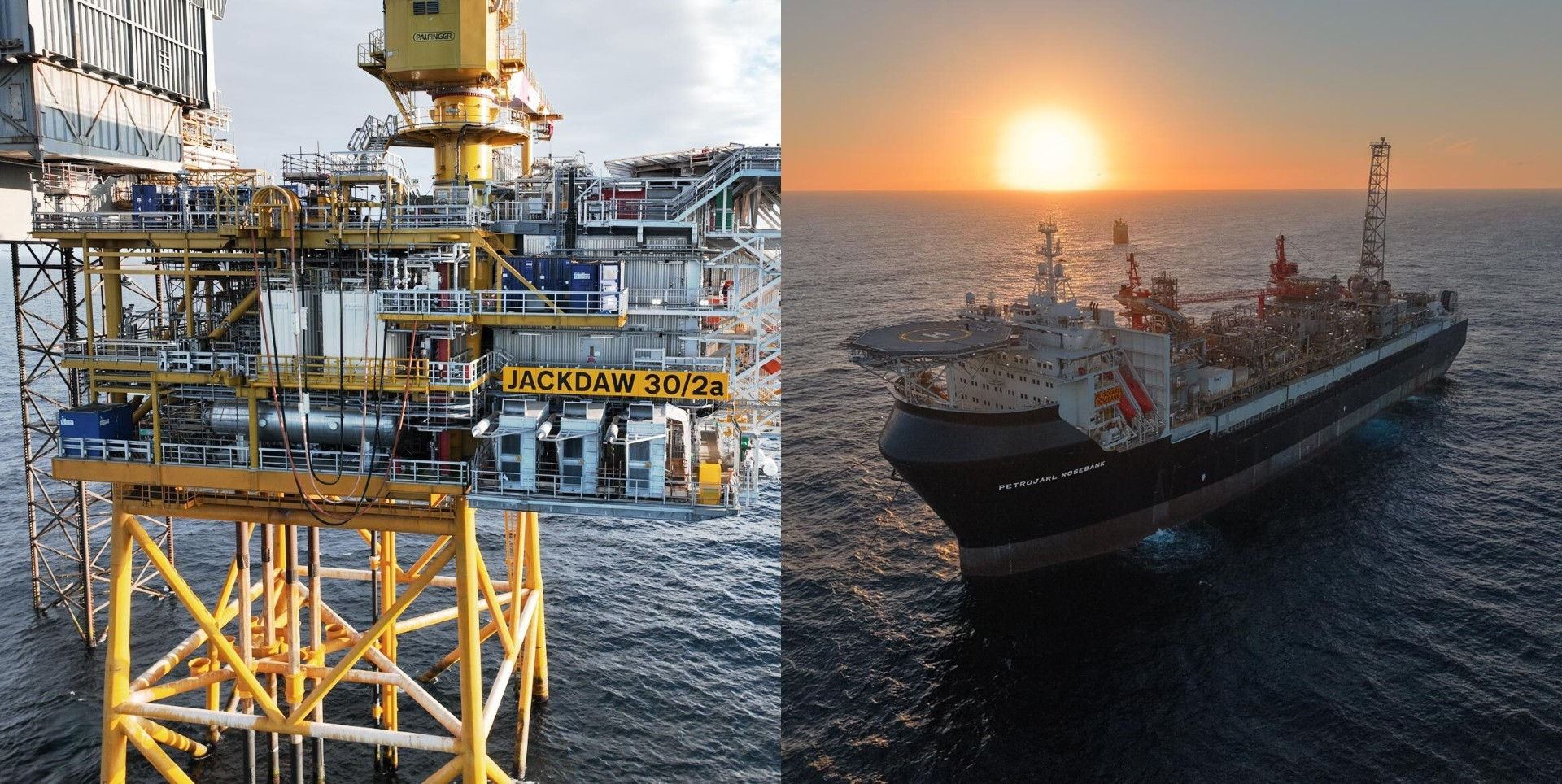
The North Sea Transition Authority has granted consent for gas production at the Jackdaw field in the central North Sea, allowing operator Adura to complete development work and prepare for first output. The approval, issued on 21 October after agreement from the Energy Secretary, moves a project already substantially constructed beyond a prolonged environmental assessment process.
The government expects Jackdaw to begin supplying gas by the end of October, although actual production will depend on the remaining operational work and commissioning. The field is around 250km east of Aberdeen, close to the UK-Norway median line, and its infrastructure connects to the existing Shearwater processing hub rather than relying on a new standalone export route.
Adura operates Jackdaw following the combination of Shell and Equinor’s UK offshore businesses. The development comprises a wellhead platform designed to operate without permanent attendance, with four wells and an approximately 31km pipeline connection to Shearwater. The field lies in water about 78 metres deep, while the offshore structure’s jacket was installed in 2023 and topside in 2025. Its export pipeline was laid in 2024, and the wells have progressed through drilling.
Jackdaw is designed as a subsea tieback to an existing host. Once operational, gas and associated condensate will travel from the wells through the approximately 31km connection to Shearwater for processing and onward transport. Using established facilities avoids constructing a second offshore processing complex, but the field still depends on commissioning the well systems, export pipeline, control interfaces and receiving capacity at the host installation.
At peak output, Jackdaw could raise UK domestic gas production by around 6%, the government estimates. That percentage measures production from UK fields, not the proportion of total UK gas demand met by the project. Ministers put the field’s potential operating life at up to 11 years and its cumulative gas production at an energy equivalent of approximately 40 million barrels of oil. Neither figure is an achieved production result.
According to figures provided by the developer and cited by government, the field could create 27 direct jobs and safeguard 273 existing roles, while contributing an estimated £2.9bn to the UK economy over its lifetime. These are projections rather than jobs or economic value already realised. Adura has said the development could produce enough gas at peak rates to provide the heating energy equivalent for about 1.4 million homes.
The consent process was revisited after the Supreme Court’s 2024 Finch judgment, which required assessment of the emissions associated with the eventual combustion of extracted hydrocarbons. Adura provided further environmental information, and the project underwent public notification and consultation before the Energy Secretary agreed to the regulator granting consent. The decision documents address downstream emissions as well as the infrastructure and environmental effects of extracting and transporting gas.
In her assessment, Energy Secretary Miatta Fahnbulleh concluded that Jackdaw would not prevent the UK from meeting statutory carbon budgets or its 2050 net zero obligation. That is the government’s determination under the consenting regime, not a finding that burning the gas is emissions free. Ministers argue that production from existing UK resources can displace some imports while gas remains in use; environmental campaigners challenge the climate rationale for bringing additional reserves into production.
Jackdaw already held a petroleum licence, which reserves exploration and production rights but does not itself authorise a particular development to begin production. The North Sea Transition Authority’s 21 October consent provides that separate development approval after the Secretary of State’s agreement under the offshore environmental impact assessment regime. The decision leaves the government’s stated policy against issuing new exploration licences for unlicensed fields unchanged.
The government also established an Energy Wealth Fund within the National Wealth Fund, with an initial £2bn allocation intended for renewable and low carbon energy infrastructure. Ministers plan to channel future North Sea oil and gas tax revenues through the fund. The allocation is a distinct fiscal measure rather than funding earmarked from Jackdaw production, and no specific industrial project has been identified as a recipient of the field’s revenue.
Government measures announced alongside consent extend to other mature North Sea assets. Regulators have been asked to consider urgent cases for production in already explored areas near licensed fields ahead of new Transitional Energy Certificate legislation. A separate consultation addresses guidance on decommissioning complex infrastructure, where platform removal, well plugging and pipeline management compete for specialist vessels, fabrication and engineering resources.
Adura can now proceed with the remaining development and commissioning work. Before gas reaches the Shearwater hub, the wells, pipeline and connected systems must be made ready for service and meet the operator’s operational requirements. First gas is anticipated within weeks, but the start date, sustained output and reliability of the new connection will become measurable only once production begins.


