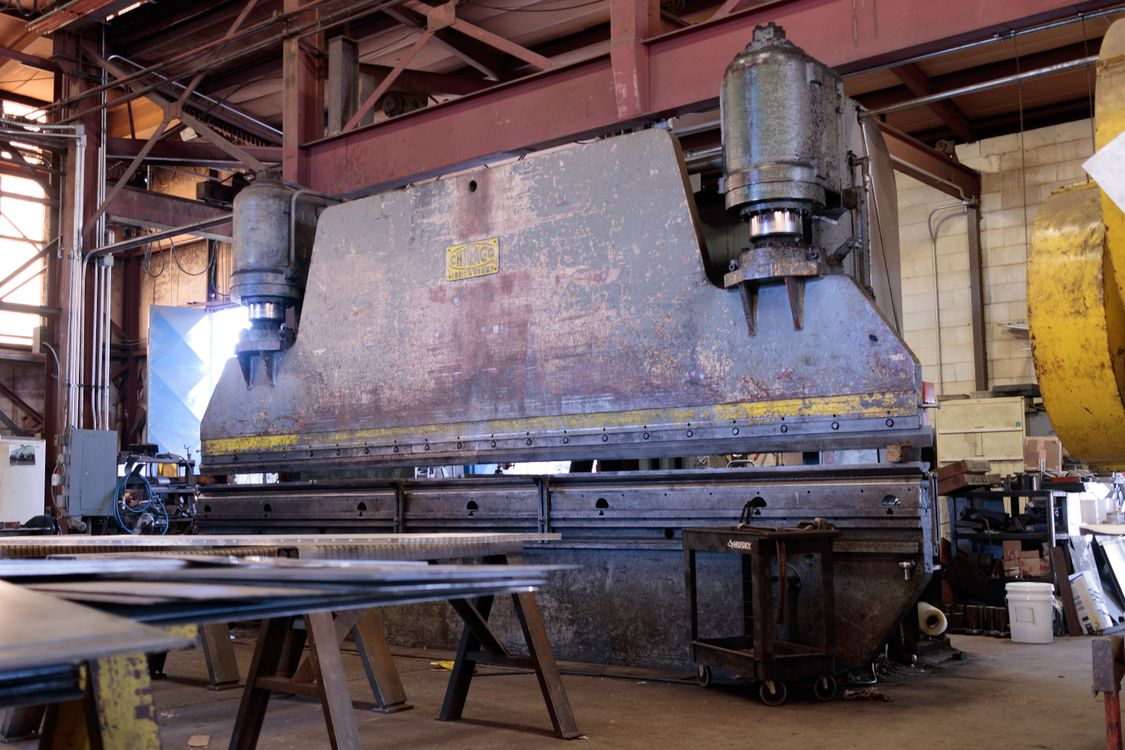
Yamazaki Mazak has brought the OPTONICS XB series of hybrid press brakes to the European market, adding sheet metal bending equipment to its established fabrication portfolio. The line comprises nominal forming capacities of 130, 170 and 250 tonnes, with 3,200 mm or 4,100 mm maximum bending lengths according to model. Mazak is presenting the range during EuroBLECH in Hannover, held from 20 to 23 October.
Each XB machine uses separate servo-controlled hydraulic pump drives for the Y1 and Y2 axes, which position the two ends of the bending ram. Controlling the axes independently helps maintain the programmed position and alignment as forming loads change along a workpiece. Rather than operating a conventional hydraulic pump continuously at a fixed duty, the arrangement is designed to deliver pressure and flow in response to machine movements, reducing the power demanded during parts of the cycle when high forming force is unnecessary.
Mazak claims energy use can be up to 60% lower and cycle times up to 25% shorter than those of conventional hydraulic press brakes. These are manufacturer comparisons, not independently established savings for individual factories. The result will depend on machine size, frequency and length of bends, tool setup, material and the share of each cycle spent approaching, forming and returning. Shops considering the equipment will need measurements against their own production mix rather than applying the maximum percentages to annual electricity bills or output forecasts.
The initial European offering comprises the XB130-32, XB170-32 and XB250-41, each available with different tool-clamping configurations. The two smaller models offer nominal forming forces of 1,300 and 1,700 kN and a maximum bending length of 3,200 mm. The XB250-41 is rated at 2,500 kN with a 4,100 mm bending length. Selecting a press involves matching both the total forming force and the load distribution along the tool to the metal grade, sheet thickness and bend geometry.
In a typical bending operation, the workpiece is supported on a die while a descending punch imposes force along a defined line. The material undergoes elastic and plastic deformation, and its final angle depends on the punch travel, material properties, die opening and compensation for springback. When the bend extends along a long sheet, even small differences in ram position or tool deflection can cause variation in the angle from one end of the component to the other.
Mazak specifies CNC crowning and position measurement to compensate for tool and frame deflection across the bending length. Crowning changes the effective position of the lower tool support, while the controller coordinates ram movement for a programmed forming sequence. The systems cannot remove variations caused by unsuitable tooling, inconsistent material properties or incorrect bend allowance; these must still be handled through setup, trial bends and inspection of finished parts.
The SmoothBEND NC control includes a dual touchscreen interface for bending programmes and graphical operator information. Mazak also offers optional Smart System offline programming for three-dimensional unfolding and bend sequence preparation. Preparing a programme while a machine is working on another job can reduce changeover interruption, although forming tools must still be selected, placed and checked at the press before the new batch begins.
Servo pump control changes the operating profile of the hydraulic system without removing hydraulic maintenance altogether. Oil condition, seals, valves and pressure systems still need inspection, while the electronic drives and associated feedback devices add electrical maintenance tasks. Faster approaches or returns offer limited benefit where part loading, tooling changes or inspection dominate the cycle, so improvements in shop throughput depend on more than ram movement speeds.
Fabricators frequently cut blanks on laser machines before moving them to the press brake, where bend order, tool clearance and springback determine whether the required geometry can be formed. Mazak’s wider offering places cutting and forming equipment within the same service portfolio, but no automatic connection between a customer’s existing laser nesting software and XB bend programmes should be assumed. The compatibility of individual programming systems remains a matter for installation and commissioning.
The XB range is available with alternative tool clamping arrangements and support through Mazak’s European service operation. Published specifications give forming forces of 1,300, 1,700 and 2,500 kN across the three capacities. Users must consider the available tool space, bending length and actual force needed along the component, since the nominal machine tonnage alone does not determine whether a part can be made within tolerance.
The European introduction establishes the available machine capacities, hybrid drive architecture and CNC features. The energy and cycle-time comparisons remain Mazak’s claims, with actual results depending on the fabricated parts and the site’s operating practices. EuroBLECH gives customers an opportunity to inspect the equipment, but the manufacturer has not reported confirmed European installations or independently measured production savings from this launch.