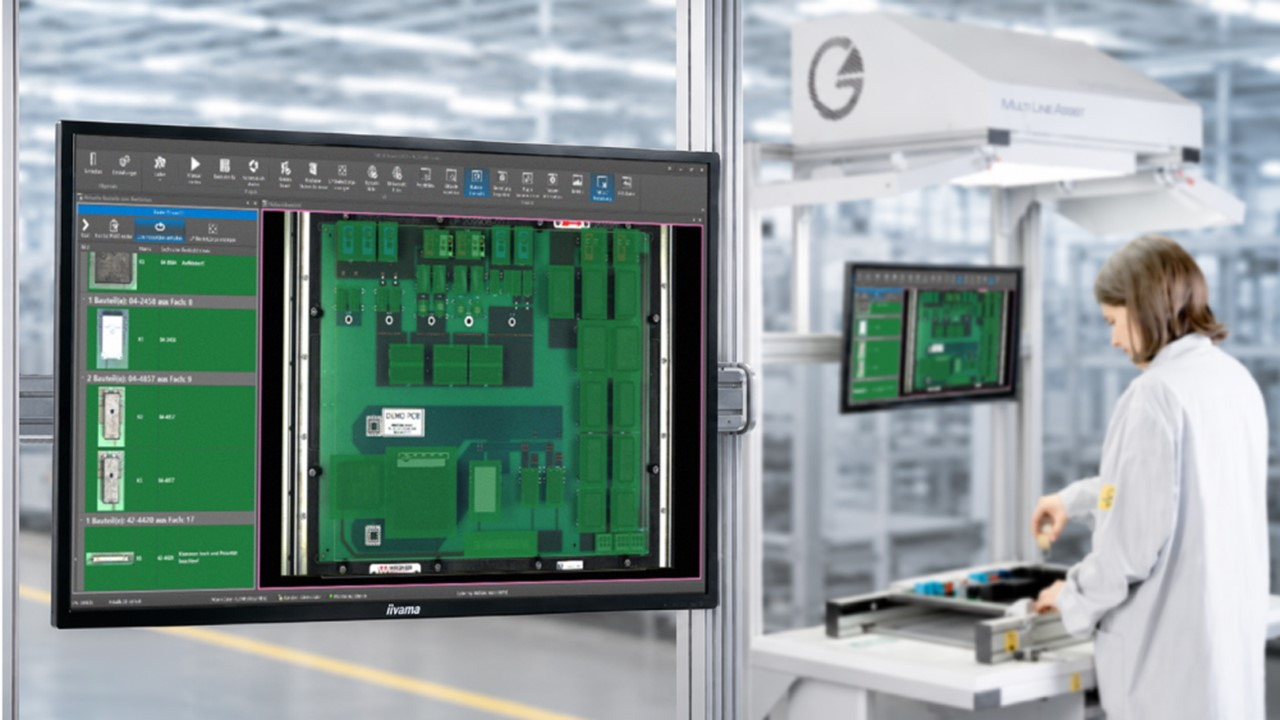
GÖPEL electronic has further developed its Multi Line Assist operator assistance system for guided through-hole technology assembly.
The system supports manual and semi-automated THT production by guiding operators through component placement, providing component assistance, projecting instructions into the work area, and combining assembly support with automatic inspection and final testing.
Multi Line Assist can be used at individual workstations or integrated into automated production lines. It combines a user guidance system, component assistant, and AOI module to check placement and assembly quality, while also supporting data transfer to manufacturing execution systems.
Through-hole technology remains important in electronics manufacturing, particularly for components that require mechanical robustness, higher current handling, field serviceability, or stronger board retention. Surface mount technology dominates many production environments, but industrial, power, transport, defence, and control products still rely on through-hole components for selected functions.
That production work often retains a manual step, especially in mixed assembly and lower-volume builds. Operators may have to place components with similar forms, polarities, values, orientations, and board locations, with risk increasing where product variety is high and batch size is low.
Operator assistance systems reduce reliance on memory, paper instructions, and visual checking alone. Projected guidance can show placement locations directly in the operator’s field of work, while component assistance helps reduce selection errors. AOI can then provide immediate checks before the assembly moves further downstream, where defects become more expensive to correct.
Electronics manufacturers are also facing stronger expectations around production records, particularly in regulated and high-reliability markets. Developments in battery manufacturing traceability show how quality evidence is becoming embedded into production systems rather than added after inspection. THT assembly is moving in the same direction as manual processes are connected to wider digital records.
Aerospace, defence, medical, rail, energy, and industrial control customers all expect repeatability and documentation. A manual assembly process can meet those expectations, but only where guidance, training, verification, and records are structured around the work being performed. Systems that connect manual workstations to MES platforms help bring labour-intensive processes into the same data environment as automated lines.
Workforce constraints add another layer. Many manufacturers are dealing with skilled labour shortages, higher staff turnover, and more varied product ranges. Assistance systems can shorten training time and reduce the burden on experienced operators without removing the need for skill. The best systems support people in performing the process correctly rather than only recording mistakes after they occur.
The production gains sit in first-pass yield, reduced rework, shorter training cycles, and stronger quality data. Catching a misplaced part before soldering or final assembly is far cheaper than finding the same defect during end-of-line test, commissioning, or field return analysis. MES connectivity can also help identify recurring issues by product, operator, station, component, or work order.
GÖPEL’s update reflects a wider trend in electronics manufacturing automation: the gradual digitalisation of tasks that cannot be fully automated economically. Not every assembly justifies a custom robot cell or dedicated high-volume line. Many factories need flexible tools that improve consistency in human-led processes while preserving the adaptability that manual work still provides.
Multi Line Assist sits in that practical space. It brings guidance, inspection, and traceability into THT assembly without assuming manual work will disappear. As product mixes become more varied and quality expectations tighten, targeted support at the workstation is becoming a more attractive route to controlled production.