
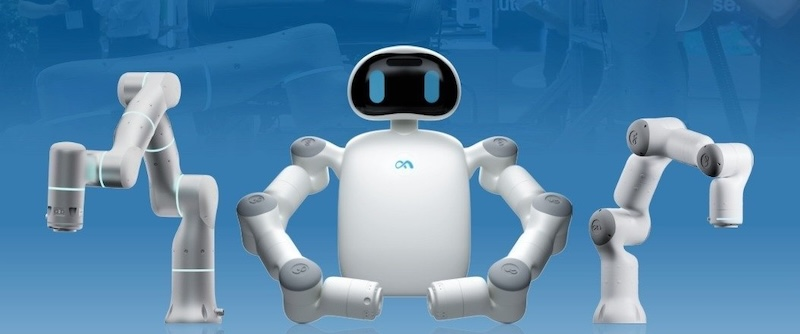
Flexiv has launched two adaptive robot platforms, the Enlight seven-axis robotic arm and the Mico dual-arm system, targeting industrial automation tasks that require tactile sensing, force control, and more flexible manipulation.
Enlight is a seven-axis adaptive robot with multi-dimensional force-torque sensors integrated into each of its seven joints. The design gives the robot whole-body touch sensitivity, enabling it to detect single-touch contact, track multiple contact points, and recognise tactile patterns. Flexiv has developed the platform for automation tasks involving constrained spaces, variable objects, and contact-rich operations.
The robot weighs 15 kg and includes four joints capable of 720 degree rotation. That configuration is intended to provide a large working envelope while maintaining a compact footprint. The platform combines force control with vision capabilities, allowing it to handle changing conditions rather than relying only on fixed, repetitive motion.
Mico is built on the same architecture and combines two Enlight arms under one control system. The modular dual-arm platform is designed for coordinated manipulation and is available in four standard configurations: Armor, Core, Plus, and Ultra. Flexiv has also demonstrated applications developed with technology partners, including manipulation tasks involving graphics cards using Nvidia Isaac Sim simulation for force-controlled robotics.
Industrial automation is moving away from simple repetition towards robots that can react to contact, uncertainty, and variation. Traditional industrial robots remain highly effective where parts, fixtures, paths, and cycle conditions are stable. They become more expensive to deploy when objects vary, locations shift, or the process requires delicate interaction. Force control, tactile sensing, vision, and simulation are being developed to close that gap.
Factory automation is already moving in this direction. Drive and control hardware is being integrated more tightly into automation environments, while logistics operations are pushing mobile robots into more demanding workflows, including chilled fulfilment lines where robotics must adapt to process and product constraints. Flexiv’s launch belongs to the same shift towards automation able to handle edge cases that previously required human dexterity or extensive fixturing.
Force-controlled robotics has clear applications in assembly, electronics handling, polishing, deburring, inspection, machine tending, packaging, and delicate part manipulation. In many of these tasks, the robot must understand contact forces rather than simply move between programmed points. Connector insertion may require a small correction based on resistance, while polishing may need stable force across a curved surface and dual-arm handling may require coordinated gripping, support, and repositioning.
Simulation is becoming part of that deployment route. Nvidia Isaac Sim and similar platforms allow developers to test robot behaviour, generate synthetic data, and refine applications before physical deployment. Simulation cannot fully reproduce real factory variation, but it can reduce early engineering time and help train systems for a wider range of scenarios. Combined with tactile sensing and vision, it supports a more iterative approach to automation development.
The commercial question is whether adaptive robots can reduce deployment cost. Many manufacturers already know which tasks they would like to automate, but the cost of engineering fixtures, guarding, programming, feeding systems, and exception handling can make projects difficult to justify. Robots that are easier to programme and more tolerant of variation could open more applications, particularly for high-mix production where conventional automation has struggled.
Tactile sensing and physical AI do not remove the need for safety assessment, robust tooling, reliable part presentation, maintenance planning, and integration with production systems. Manufacturers will still need evidence around uptime, cycle time, repeatability, support, and total cost before deploying adaptive robots at scale.
Flexiv’s Enlight and Mico platforms show industrial robotics moving beyond payload, reach, and speed as the main performance measures. The next phase of automation will depend on how well robots sense contact, adapt to variation, learn from simulation, and work safely in environments that were never designed for rigid automation.
