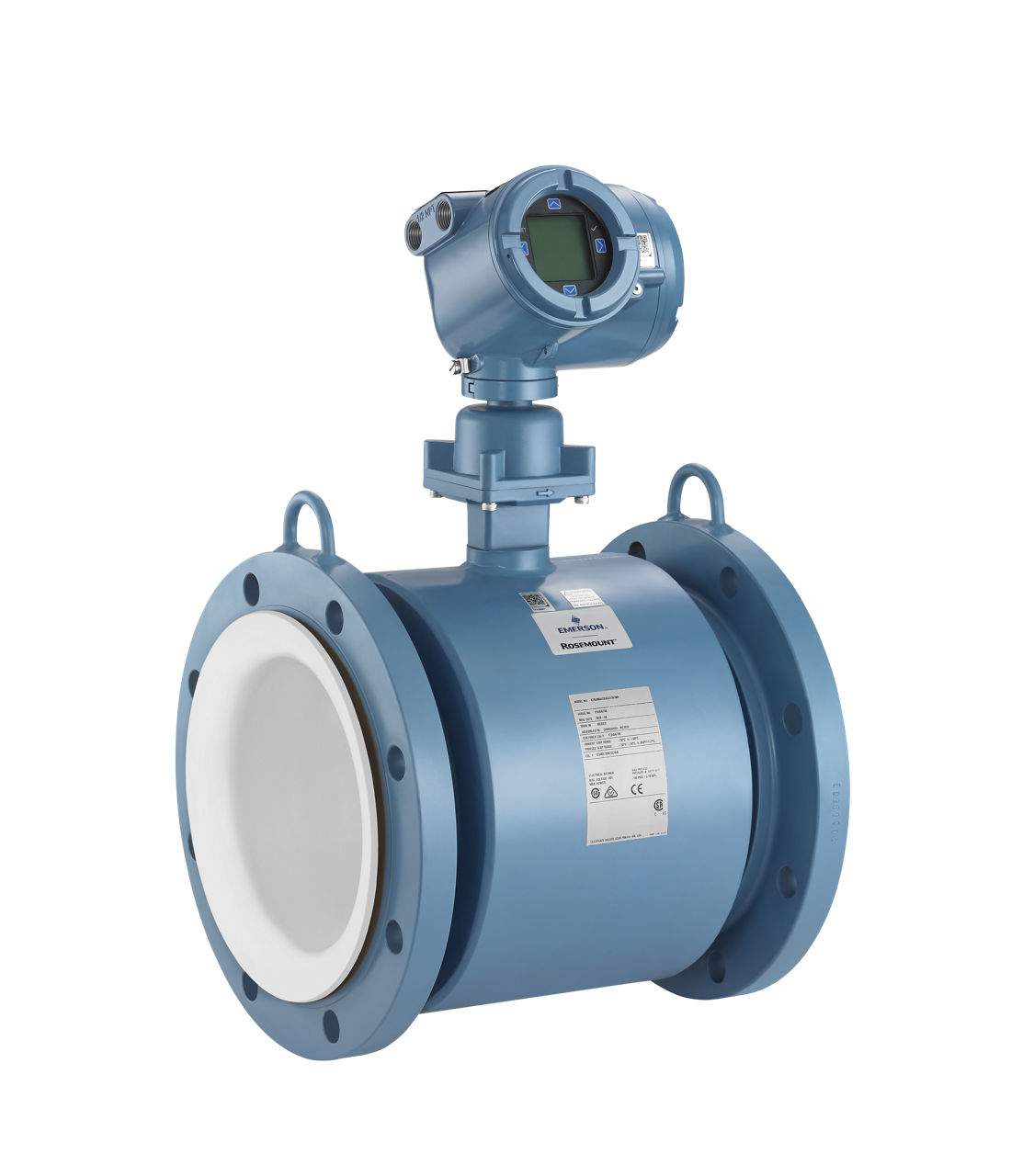
Emerson introduced the Rosemount 8795 Magnetic Flow Sensor on 8 October 2026, positioning it for data centre hydronic cooling systems. The instrument measures flow in water and water-glycol loops and is designed to work with compatible Rosemount transmitters to supply plant control and infrastructure monitoring systems.
The Rosemount 8795 is intended for data-centre hydronic loops containing water or water-glycol mixtures. Emerson positions flow measurement as one input to monitoring cooling operations; the sensor does not itself control rack temperatures or establish the energy performance of a whole cooling system. Such conclusions require additional temperature, power and operating measurements.
Electromagnetic flow measurement uses voltage induced as an electrically conductive liquid passes through a magnetic field. The principle involves no obstructing moving element in the flow path, which can be useful in systems where continued operation and low routine maintenance are important.
Emerson specifies a 0.5% accuracy claim for defined zero-straight-run conditions when the Rosemount 8795 is paired with compatible transmitters and its Short Run Installation software. The value should not be represented as applicable to every pipe layout, fluid or configuration. The release separately describes other accuracy specifications for installations with conventional straight pipe runs.
Conventional installation guidance for magnetic flow meters often specifies straight pipe runs upstream and downstream to manage disturbances caused by bends and valves. Space can be limited in data centre plantrooms, making accurate measurement with shorter pipework potentially useful. Engineers must still check the documented application limits.
The Rosemount 8795 is intended for water and water-glycol cooling loops, not every fluid encountered in industrial operations. Magnetic flow meters require sufficiently conductive liquid. The sensor and transmitter combination must therefore be chosen to match the cooling system’s conditions.
Accurate flow readings can support chilled-water performance calculations when combined with temperature and other data. By themselves, they do not establish overall energy efficiency or a specific reduction in power use. Meaningful measurements require calibrated instruments and consistent definitions of the system boundary.
Data centre operators often work with building management and data centre infrastructure monitoring applications. Transmitting reliable readings into these systems can help teams identify unusual operating conditions and compare loads, but integration and alarm settings still require engineering judgment.
Emerson’s announcement describes an all-welded sensor design intended to protect internal parts against moisture and contaminants. The relevance to uptime depends on how the equipment is installed, maintained and assessed against the temperatures, pressures and water chemistry in the cooling circuit.
The accompanying 9732 transmitter is a separate component that supports the specified short-run measurement configuration. Reporting should preserve that relationship, rather than ascribe every performance claim to the sensor alone. Compatibility with other instruments may offer flexibility but must be checked for each specification.
Industrial buyers will also look at verification and maintenance. Diagnostic functions can improve confidence in a reading, yet a sensor that reports plausible numbers may still need periodic checks against process conditions. The value of continuous measurement depends on trustworthy data and prompt response to deviations.
The announcement introduces Emerson’s launch of a cooling-specific measurement instrument with defined installation capabilities. Evidence of wider operational benefit will come from commissioned sites, maintained accuracy and measured cooling performance rather than supplier predictions alone.
An instrument’s specifications do not eliminate the need for site commissioning, which should assess communications, calibration records and fault handling. The new sensor will be judged by those practical results over time.
The launch also illustrates how instrumentation requirements can change as data centres add densely packed liquid-cooling equipment. Existing process industries have long used flow measurement, but the precise installation conditions of cooling systems require suitable sizing and integration into the supervisory controls.
An accuracy figure must be interpreted in relation to the full measurement chain. The sensor, transmitter, configuration and pipework all contribute to performance. Purchasers should compare the manufacturer’s specified test conditions with the site’s actual arrangements before assuming the quoted value applies.
In many facilities, physical space is constrained by the need to fit pumps, valves, manifolds and maintainable pipework into existing plant. Reducing straight-pipe requirements could provide design flexibility, but equipment accessibility and safe servicing remain essential even where sensor installation is compact.
Reliable measurement is only useful when plant teams can relate flow readings to cooling demand. Comparisons should account for pump operation, water temperature and changes in IT load. This is particularly important for data centres where multiple cooling circuits serve different equipment and measurement errors can propagate into higher-level calculations.