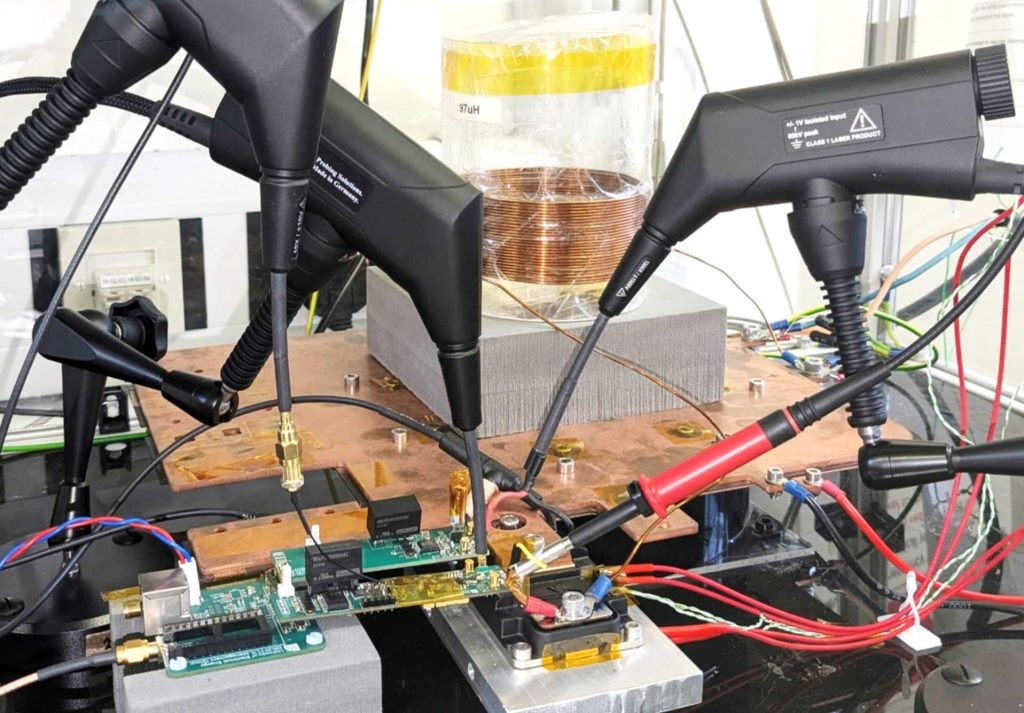
The EleVait electric vehicle inverter programme has demonstrated a three stage gate driving method that reduced semiconductor switching losses by more than 20% without continuous feedback or multiple operating configurations.
Developed by the University of Bristol’s Electrical Energy Management Research Group, the method was tested through the Jaguar Land Rover led Electric Vehicle Advanced Inverter Technology project. EleVait has a total value of £12.5 million, including £6.1 million of public funding administered by the Advanced Propulsion Centre UK.
Testing used a commercial vehicle inverter across temperatures from minus 40°C to 140°C, currents ranging from minus 400A to 400A, and voltages reaching 900V. Those conditions cover much of the electrical and thermal range encountered during cold starts, sustained high load operation, acceleration, and regenerative braking.
Traction inverters convert direct current from an electric vehicle battery into the alternating current required by the motor, using semiconductor devices that switch thousands of times each second. The duration and shape of each switching event influence efficiency, heat generation, electrical stress, and the reliability of the surrounding power electronics.
Faster switching reduces the period during which a semiconductor carries substantial voltage and current simultaneously, limiting energy lost as heat. More aggressive switching can also generate voltage overshoot, however, placing additional stress on the semiconductor, insulation system, busbar, capacitors, and associated control electronics.
Conventional gate drivers commonly use a fixed resistor to control the speed at which a power semiconductor turns on and off. Lower resistance can improve efficiency but increase voltage spikes, while higher resistance limits overshoot at the expense of greater losses and higher operating temperatures.
Choosing a single resistance therefore requires engineers to balance efficiency and protection across changing current, voltage, and temperature conditions. A setting that performs well at one operating point may become too aggressive at high current or unnecessarily conservative during lower load operation.
More advanced drivers can vary resistance dynamically or apply active feedback during individual switching events. Although those systems can provide precise control, they require additional sensing, processing, calibration, protection, and validation within an automotive assembly expected to operate reliably for many years.
The Bristol method sits between a fixed resistor and a fully active gate driver. Its custom circuit applies three fast, high current pulses in a predetermined sequence, shaping the switching event without continually measuring conditions or selecting a new profile.
Researchers evaluated the design through conventional pulsed current testing and a multi pulse process that increased current towards the inverter’s maximum rating. Compared with a fast conventional setting, the three stage approach reduced voltage overshoot; against a more conservative setting operating within the same voltage limit, it lowered switching losses by more than one fifth.
Across the tested current range, the driver retained the same configuration rather than requiring separate calibration for different operating points. That behaviour simplifies control and could reduce the amount of software, sensing hardware, and validation needed before the technology is incorporated into a production inverter.
Lower semiconductor losses reduce the heat that must be removed from the power module, opening scope to alter coolant flow, heat exchanger capacity, packaging, and control strategy. Thermal management equipment contributes weight, cost, and electrical demand to a vehicle, so improvements at semiconductor level can affect the wider electric drive system.
Reduced heat generation may also allow engineers to increase power density without pushing junction temperatures beyond acceptable limits. Smaller inverters are easier to integrate with electric motors, transmissions, and complete drive units, while reduced mass can support vehicle efficiency and simplify installation.
The work is progressing as the UK adds manufacturing capacity around automotive power electronics. Astemo’s £100 million inverter expansion in Bolton is installing assembly and surface mount production equipment ahead of planned volume manufacturing in 2027, strengthening the route from domestic engineering into series production.
EleVait is intended to support Jaguar Land Rover electric first vehicle architectures from 2028, while generating intellectual property that can be used more widely through the UK supply base. Its consortium combines inverter development with wide bandgap semiconductors, integrated packaging, modelling, and manufacturing capability.
Wide bandgap materials such as silicon carbide can operate at higher voltages, temperatures, and switching frequencies than conventional silicon in suitable applications. Their faster electrical behaviour also makes parasitic inductance, electromagnetic interference, insulation, cooling, and gate control more difficult to manage.
A simpler driver architecture could preserve much of the efficiency available from faster switching without introducing the control burden associated with a continuously active system. Automotive adoption will still require durability testing, electromagnetic compatibility assessment, functional safety work, packaging integration, and validation across complete vehicle operating conditions.
Further work will extend testing across additional temperatures and voltages, while development towards production will require the driver, semiconductor module, cooling system, control electronics, and manufacturing process to be engineered as one assembly. The measured loss reduction provides a credible basis for that work, rather than an efficiency gain confined to a single laboratory condition.