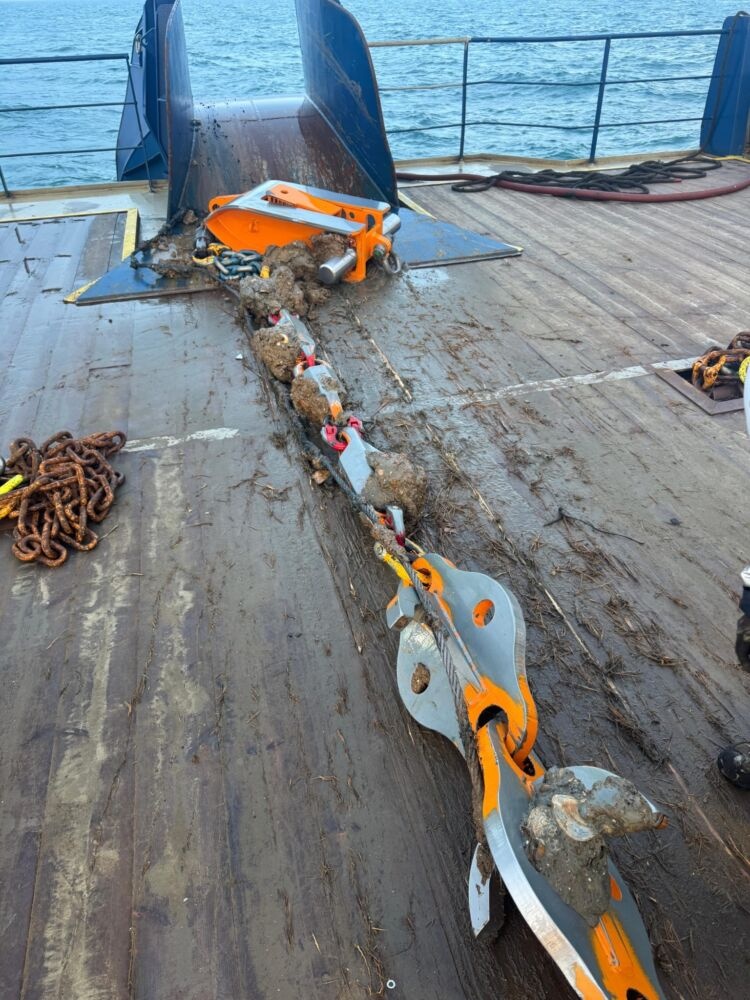
Dynamic Load Monitoring has supplied its Stingray Acoustic Positioning Grapnel to ACSM for subsea project work, adding acoustic tracking capability to pre-lay grapnel run operations.
The Stingray is designed to sit at the rear of a grapnel train during seabed clearance work. It sends acoustic signals back to the towing vessel, allowing operators to understand where the train is positioned as it moves across the seabed. The system is intended for pre-lay grapnel runs, where equipment is towed along a planned route to remove debris, obstructions, and legacy objects before subsea cable installation or other marine infrastructure work begins.
Grapnel trains are practical but demanding tools. They operate out of direct sight, often in difficult seabed conditions, and may need to stay within narrow route corridors where inaccurate tracking can create risk for cable lay, route clearance, and vessel operations. Acoustic tracking gives the vessel team better information on the position of the trailing end of the train without relying solely on towline geometry and assumptions about seabed behaviour.
DLM originally developed the Stingray as an acoustic tow line positioning grapnel suitable for harsh subsea environments. The design uses high strength steel and incorporates a pivot point intended to help the beacon maintain its orientation towards the surface, even if the grapnel flips over. Acoustic communication depends not only on signal strength, but also on orientation, seawater conditions, vessel movement, and the physical behaviour of the train on the seabed.
Subsea route clearance and cable protection are under growing pressure across offshore energy, interconnectors, telecommunications, and wind projects. Demand for subsea work is increasing, while project teams are being pushed to reduce vessel time, improve route assurance, and document operations more clearly. Equipment that reduces uncertainty during remote, weather exposed, and expensive marine operations has become more valuable.
Operational confidence is also central to mature offshore assets, where control systems, inspection, and data quality are being upgraded to sustain reliability. On the seabed, the same discipline applies through positioning accuracy and route evidence. Operators need to know where tools are, what has been cleared, and whether the route is ready for the next stage of work.
Pre-lay grapnel run activity can influence the whole project schedule. If debris or obstructions remain, cable lay can be delayed or forced into corrective work. If the grapnel train drifts away from the planned route, sections of seabed may need to be checked again. If the clearance record is incomplete, later installation teams inherit risk that could have been resolved earlier.
Subsea infrastructure is also becoming more congested. Mature offshore basins contain oil and gas infrastructure, telecoms cables, power export cables, interconnectors, anchors, debris, and historical project remnants. As offshore wind, electrification, carbon capture, and interconnection projects expand, route planning and clearance are becoming more complex rather than less.
DLM’s system sits between mechanical subsea equipment and digital positioning. That blend is increasingly common in offshore engineering. Equipment must survive harsh environments, but it must also provide data that can be used operationally and, where needed, for project records. Mechanical robustness and traceable information now belong together.
The Stingray does not remove the complexity of seabed clearance, but it addresses a specific uncertainty that has long affected grapnel train work: the position of the trailing end. Better knowledge of where a tool is can reduce rework, tighten route confidence, and help vessel teams make decisions while the operation is still underway.