DeepOcean has completed subsea construction, tie-in, protection, and commissioning work at the Teal West development in the UK Central North Sea, connecting new production infrastructure to the existing Anasuria floating production, storage, and offloading vessel.
The company’s scope included installation of a flexible production riser and flowline together with an umbilical linking the Anasuria FPSO with the Teal West subsea Christmas tree. DeepOcean also installed protection for the flowline and umbilical before completing commissioning of the new infrastructure.
Teal West has been developed as a subsea tie-back rather than through a standalone production platform. Production is routed to the existing Anasuria facility for processing and export, allowing the field to use infrastructure already operating in the area instead of duplicating surface facilities.
The field development comprises two production wells and a water-injection well. Initially, one producer is connected to the FPSO through approximately three kilometres of subsea flowline. Anasuria lies about 180 kilometres east of Aberdeen in water approximately 90 metres deep.
The relatively short tie-back distance is central to the project’s development model. Smaller discoveries can struggle to justify the cost of a dedicated platform or floating facility, while nearby infrastructure can provide processing, power, control, storage, and export capacity if the host has sufficient remaining operating life.
Teal West achieved first oil in July, before DeepOcean announced completion of its subsea construction scope on 20 August. The latest milestone therefore closes the contractor’s installation and commissioning package rather than marking the first production event itself.
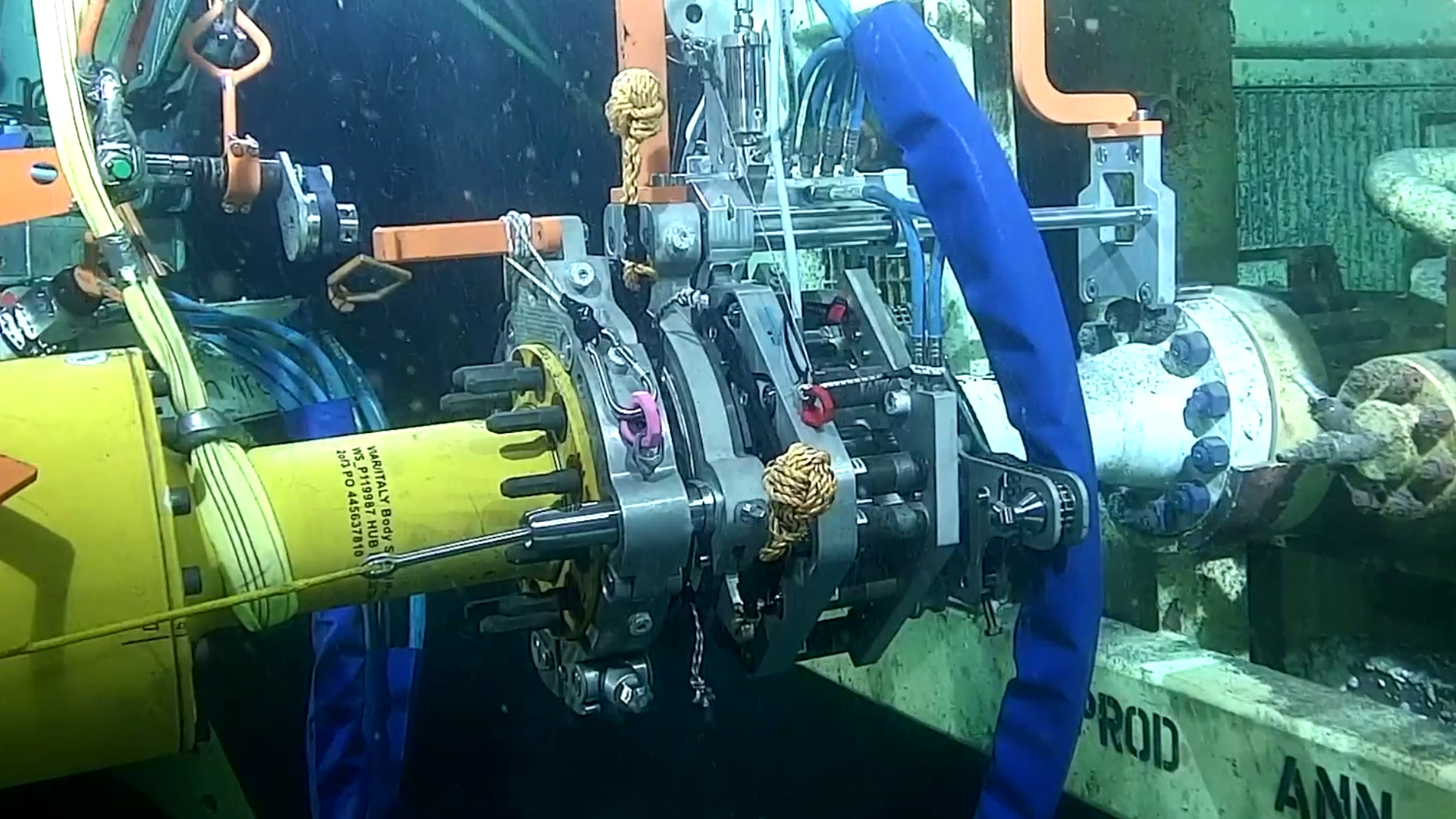
One of the more technically distinctive parts of the work was the use of a remotely operated vehicle and dedicated subsea tooling for tasks that would traditionally have involved divers. DeepOcean’s tie-in system is designed to make high-pressure flange connections between subsea pipework and valves using robotic equipment.
Removing a diver does not simplify the mechanical requirement. Flanges still have to be aligned, brought together, loaded, secured, and verified to the required pressure-integrity standard. The difference is that tooling, cameras, sensors, and ROV manipulators perform work that would otherwise depend on a person operating directly at the connection point.
That places more emphasis on engineering before the vessel reaches the field. Access clearances, tooling reaction loads, connection geometry, visual references, component tolerances, and contingency procedures all have to be designed around robotic operation because correcting an inaccessible interface offshore can quickly consume vessel time.
ROV execution also changes the risk profile. At around 90 metres, Teal West is not an ultra-deepwater development, but reducing direct human intervention removes exposure associated with subsea diving and allows more of the operation to be controlled from the construction vessel.
DeepOcean’s Aberdeen office led engineering and project management for the subsea package. Offshore work was conducted in phases, with construction and tie-in activities completed first before commissioning was carried out using a second offshore construction vessel from the company’s chartered fleet.
The distinction between installation and commissioning is important. A flowline can be physically in place without being ready for production. Testing, flushing, pressure verification, controls checks, communications, leak testing, and confirmation of interfaces between subsea and topside equipment are required before the complete system can be regarded as operational.
Richard Beattie, Chief Executive Officer of Anasuria Operating Company, said: “DeepOcean has been a trusted partner throughout the development, helping to deliver a successful subsea tie-back that maximises the value of existing infrastructure.”
Infrastructure reuse has become increasingly important across the mature UK Continental Shelf. Existing platforms and FPSOs can gain additional throughput from nearby discoveries, while new fields avoid part of the capital cost and construction burden associated with building an independent host.
The arrangement is not automatic. A host needs sufficient processing capacity, power, control-system capability, storage, export capacity, and remaining structural and operating life. Additional wells can also require modifications to topside process systems or water-injection arrangements even when the visible surface infrastructure does not change greatly.
Subsea tie-backs consequently shift a larger share of project complexity below the waterline. Trees, controls, flowlines, flexible risers, umbilicals, protection systems, ROV operations, connection tooling, installation vessels, and subsea commissioning become the equipment through which the new reservoir is integrated with an older production system.
That model can also extend the economic life of the host. Additional production spreads fixed operating costs over more barrels and gives the operator another reason to maintain infrastructure that might otherwise approach decommissioning as its original fields decline.
DeepOcean’s completion announcement shows the engineering work required to make that apparently simple concept function. Reusing an FPSO avoids constructing another one, but it replaces some of that surface investment with subsea integration work that has to perform reliably for the field’s operating life.
With construction and commissioning complete, Teal West moves from project execution into routine production support. The performance of the flowline, umbilical, controls, connections, and host interfaces will now determine whether the economic advantage of reusing existing North Sea infrastructure is realised in operation rather than only in the development plan.