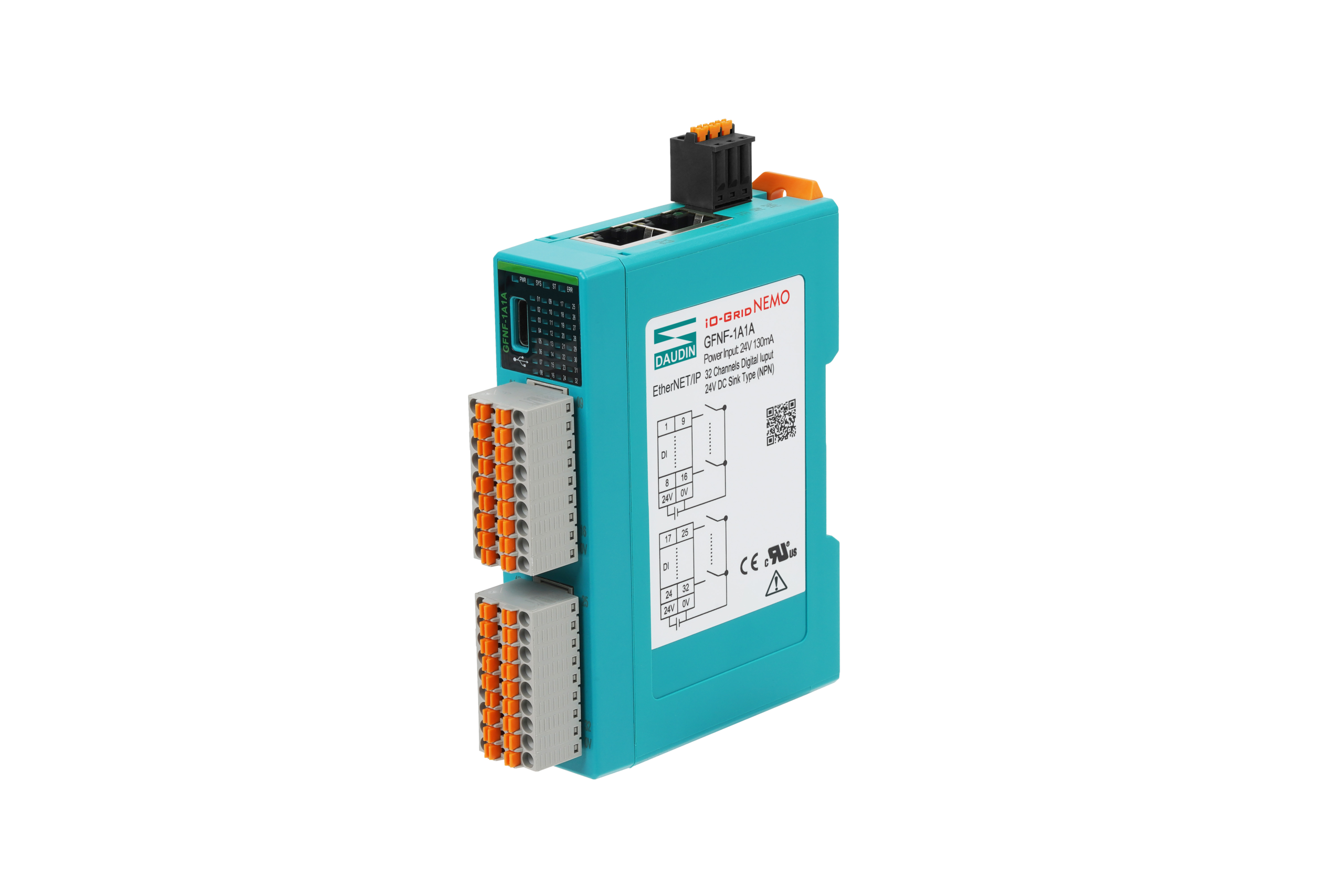
Daudin iO-GRID NEMO remote I/O modules are now being stocked and shipped by Dinkle International, adding another option for connecting distributed discrete input and output signals to industrial control systems.
The iO-GRID NEMO series is designed for applications where small groups of I/O signals are distributed across a site, machine, utility system, or facility. The modules connect those signals to microcontrollers, PLCs, and other host systems for monitoring, digitalisation, and control.
The range supports five industrial Ethernet protocols: PROFINET, EtherCAT, EtherNet/IP, Modbus TCP, and CC-Link IE Field Basic. Ethernet models include two RJ45 ports and an integrated two-port switch for daisy-chain expansion, while CC-Link versions use terminal blocks for network connection and pass-through to the next station.
The modules include LED status indicators and firmware update capability through a USB Type-C connection. They operate from standard 24V DC across an ambient temperature range of -10°C to 60°C, mount to DIN rails, and use detachable terminal blocks with push-in wiring and large wire entries.
Models are available for 32-channel discrete input, 32-channel discrete output, and 16-channel combined input and output, in sinking and sourcing versions. All models are CE and UL certified.
Remote I/O is a practical layer of automation, but its role is expanding as factories and industrial facilities add sensors, condition monitoring, utility monitoring, edge devices, and distributed machine control. Running every signal back to a central cabinet can increase wiring cost, panel space, commissioning time, and maintenance complexity. Distributed modules allow signals to be collected closer to the equipment and passed into the control network through standard protocols.
That approach suits applications such as data centres, building automation, utility systems, packaging lines, water treatment equipment, quarrying plant, and general machine integration. These environments often contain groups of simple signals that still need to be captured reliably, monitored, and acted upon by a controller.
Protocol coverage is particularly useful in mixed industrial sites. A plant may run PROFINET on one machine, EtherCAT on another, Modbus TCP across utilities, and EtherNet/IP in a separate production area. Remote I/O products that cover several network families can reduce supplier fragmentation and simplify stockholding for systems integrators and maintenance teams.
The physical design also affects operating cost. Push-in terminals, detachable blocks, DIN rail mounting, and visible status indicators all influence installation and replacement time. A remote I/O module may be a small device, but if it sits across dozens of panels or field cabinets, wiring and maintenance details quickly become part of the cost of ownership.
Digital transformation projects often depend on this field-level foundation. Data strategies require signals from machines, pumps, valves, conveyors, doors, fans, sensors, alarms, and meters, many of which were not originally designed for modern connectivity. Without reliable I/O, higher-level analytics and dashboards are only as useful as the physical signals feeding them.
Daudin also offers customisation across hardware, firmware, software, labelling, branding, and application-specific design. That may support OEMs and system builders developing repeat machine platforms where standard hardware needs to sit inside a branded or application-specific control architecture.
The iO-GRID NEMO launch reflects the steady movement of distributed intelligence into ordinary plant infrastructure. Not every application requires an advanced edge computer or full IIoT gateway. Many need compact, protocol-compatible I/O that can bring field signals into a digital control layer with less wiring and less cabinet complexity. As factories add more sensing and monitoring, small modules such as these increasingly determine whether data from the physical process reaches the systems expected to use it.