Cranswick has commissioned a robotic end-of-line pick-and-place system for one of its seasonal gourmet food production lines, using automation to improve packaging speed, consistency, and labour productivity.
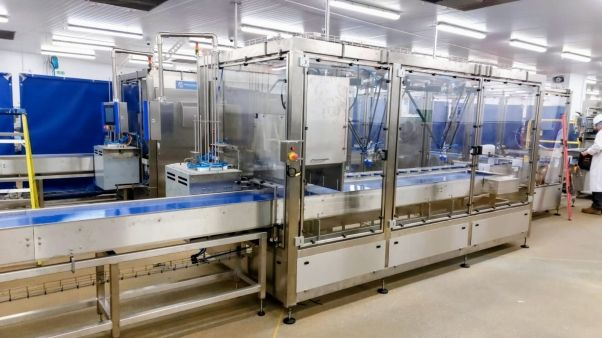
The system has been delivered with CWM Automation, Rockwell Automation, and autonox Robotics. It automates the final stage of a line producing pigs in blankets for the Christmas market, where sausages wrapped in bacon were previously picked from a conveyor and placed into packaging manually.
Built around an autonox Delta robot, Rockwell Automation Allen-Bradley Kinetix VP low inertia servo motors, and an Allen-Bradley GuardLogix 5380 safety controller, the cell detects both the presence and orientation of each sausage. Once identified, the product is aligned and placed into the correct pack at a rate of up to 240 units per minute.
That combination of speed, orientation control, and gentle handling is central to the installation. Food handling tasks can appear simple from outside the factory, but products with natural variation in shape, position, surface texture, and presentation can be difficult to automate reliably. The robot has to sustain throughput without damaging the product, creating pack errors, or introducing stoppages that offset the labour saving.
Seasonal production adds another layer of engineering pressure. Food manufacturers supplying peak retail demand have limited room for late commissioning, unreliable changeover, or avoidable downtime. The system had to be installed in time to support annual production targets, making production readiness as important as the robot hardware itself.
Across food manufacturing, robotics is increasingly being applied to repetitive handling tasks where labour availability, consistency, and line balance are under pressure. A recent processing upgrade at Holmach combined retort technology, robotic handling, inspection, and utility reduction, reflecting a wider move towards production lines rebuilt around automation and process control rather than isolated machine swaps.
Cranswick’s application is more focused, but the operating logic is similar. End-of-line packing is often where constraints become visible. A line may cook, chill, convey, or portion at one rate, yet if the final manual handling stage cannot keep pace, the whole operation is governed by the least automated process step. Removing that bottleneck can increase usable capacity without redesigning every upstream asset.
Labour strategy is also changing. Food plants have long relied on manual teams for repetitive tasks that require dexterity but not necessarily continuous decision-making. Automation allows those roles to shift towards supervision, changeover support, quality checking, cleaning preparation, and maintenance coordination. The transition only works when systems are robust enough to run through real production variation rather than controlled demonstrations.
The technology stack shows why food robotics is primarily an integration challenge. The robot is one part of the system, but motion control, machine safety, product detection, conveyor coordination, guarding, hygiene access, fault recovery, and operator interface design all determine performance on the line. A fast robot will not solve a poorly engineered process environment.
Food manufacturers are also under pressure to justify automation spending against volatile input costs and tight customer pricing. A project that reduces repetitive manual handling, improves throughput, and stabilises seasonal production has a clearer operational case than a broad digital transformation programme. The return is easier to measure when the constraint can be seen at the end of the conveyor.
Pick-and-place automation is likely to grow where products are sufficiently consistent, volumes are high, and handling requirements are well understood. The technology has become more capable as vision, motion control, and end-effector design improve, but success still depends on application detail, cleaning access, operator training, and production discipline.
Cranswick’s installation shows how UK food manufacturers are likely to adopt robotics in practice: targeted cells built around defined production pain points, engineered to fit existing lines, and justified by measurable gains in speed, consistency, and resilience. The industry may talk often about the automated factory, but the route towards it is being built one constrained process at a time.