CNC Onsite is establishing its first international subsidiary in Houston, Texas, creating a permanent US base for mobile machining services designed to repair major wind-turbine components without removing them from the nacelle.
CNC Onsite Inc. has already completed its first repair jobs in the United States and is being positioned to serve wind farms across North America. The business plans initially to deploy Danish specialists while recruiting a local technical workforce to establish a permanent American service capability.
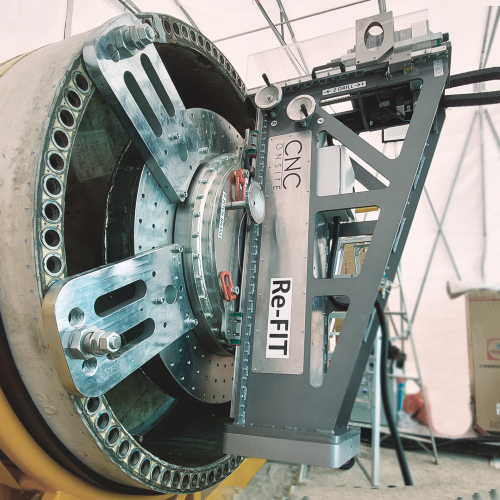
The engineering model is based on taking precision machining equipment to the failed component rather than removing a major turbine assembly and transporting it to a workshop. CNC Onsite applies that approach to yaw-ring damage, shafts, bearing housings, threaded interfaces, rotor-lock components, and other repairs that would otherwise require significantly heavier logistics.
The company’s machining equipment is modular enough to be moved into a turbine nacelle using internal lifting equipment before being assembled around the repair location. Once installed, technicians use the machinery to restore damaged geometry while the wider component remains in place.
For operators, the largest potential saving comes from avoiding heavy external lifting. Replacing a yaw ring or other major nacelle component can require specialist cranes, road transport, permitting, temporary hardstanding, extensive disassembly, and a suitable weather window before repair work itself begins.
CNC Onsite estimates that full heavy-crane mobilisation in the US can cost roughly $150,000 to $250,000 for a major repair before the value of lost generation is added. Those are company market estimates rather than universal industry figures, and individual costs will vary substantially with turbine type, crane class, geography, site access, and weather.
The company says its uptower approach can reduce total costs by as much as 80% in suitable cases compared with replacing the complete damaged component. Again, that figure depends on the repair and should not be treated as a guaranteed saving across every turbine, but the underlying economics are straightforward: leaving the nacelle and much of the existing hardware in place removes some of the most expensive operations from the job.
Søren Kellenberger, chief executive officer and partner at CNC Onsite, said the company was responding to US demand after already completing several uptower projects in the market. Houston is intended to turn that project activity into a permanent service base rather than continuing to mobilise every job from Denmark.
Yaw-ring repair is one of the clearest examples. Damaged gear teeth can be machined away and replaced with accurately manufactured segments without removing the complete yaw system from the turbine. CNC Onsite has already adapted the process to multiple turbine platforms and carried out repairs across several international markets.
The same principle extends to generator shafts and other large interfaces. Local damage does not automatically mean the remaining component has reached the end of its useful life; if engineering assessment confirms that material can be restored, machining only the affected area can preserve far more of the original equipment.
That makes lifetime extension an increasingly relevant part of turbine maintenance as the installed wind fleet matures. Operators have to choose between local repair, major component replacement, repowering, and eventual retirement, with the right answer depending on structural condition, remaining design life, power output, spares availability, and the cost of downtime.
CNC Onsite also works with rotor-blade specialist We4Ce on blade-root bushing repairs. Blade-root inserts carry substantial loads between the blade and hub, making dimensional accuracy and repair validation essential where worn interfaces are restored instead of replacing the complete blade.
The attraction of mobile machining is matched by a demanding service model. Machinery, measurement equipment, technicians, replacement material, programming, documentation, and quality controls all have to arrive at the turbine and operate inside a constrained working environment.
A US base can reduce some of that mobilisation burden. Houston provides access to a large energy-service ecosystem and places people and equipment considerably closer to wind assets across Texas and the central United States than CNC Onsite’s Vejle headquarters.
The company says the expansion follows its strongest financial performance to date, including a 74% increase in gross profit to DKK58.7 million in 2025 and workforce growth to more than 60 specialists. The Houston operation represents its first subsidiary outside Denmark, although initial US headcount and capital investment have not been disclosed.
Recruiting locally will be important if the service is to scale beyond occasional specialist interventions. Uptower machining combines conventional machining knowledge with turbine access, field safety, measurement, and experience working in confined nacelle environments, making competent technicians harder to replace than the portability of the machinery might suggest.
The North American expansion will therefore be judged on mobilisation and repeatability as much as repair technology. CNC Onsite has already demonstrated that precision machining can be carried out inside operating wind-farm environments; the Houston subsidiary now has to turn that capability into a service that can respond across a continent without recreating European mobilisation logistics around every job.