ABB has confirmed that a Chinese foreign investment security review body has prohibited SoftBank Group’s proposed acquisition of the company’s robotics business in China, creating a significant obstacle to the planned $5.375 billion sale of ABB Robotics.
The Swiss engineering group was informed of the decision by SoftBank, which is responsible for securing regulatory approvals for the transaction. ABB said on 5 November that the companies remained in close dialogue and were working constructively on the proposed sale.
The prohibition concerns the transfer of ABB Robotics’ Chinese business. ABB has not announced that the global agreement has been terminated, and neither company has set out a revised transaction structure, new completion timetable or financial terms reflecting the regulatory decision.
ABB signed the original agreement in October 2025, when SoftBank agreed to acquire the Robotics division at an enterprise value of $5.375 billion. The planned sale replaced ABB’s earlier intention to separate the business through a stock market listing, and closing was subject to the necessary approvals and customary conditions.
China’s Office of the Working Mechanism for Foreign Investment Security Review made the prohibition, according to ABB’s statement. The company did not identify the authority’s reasons or say whether any conditions could permit a different arrangement.
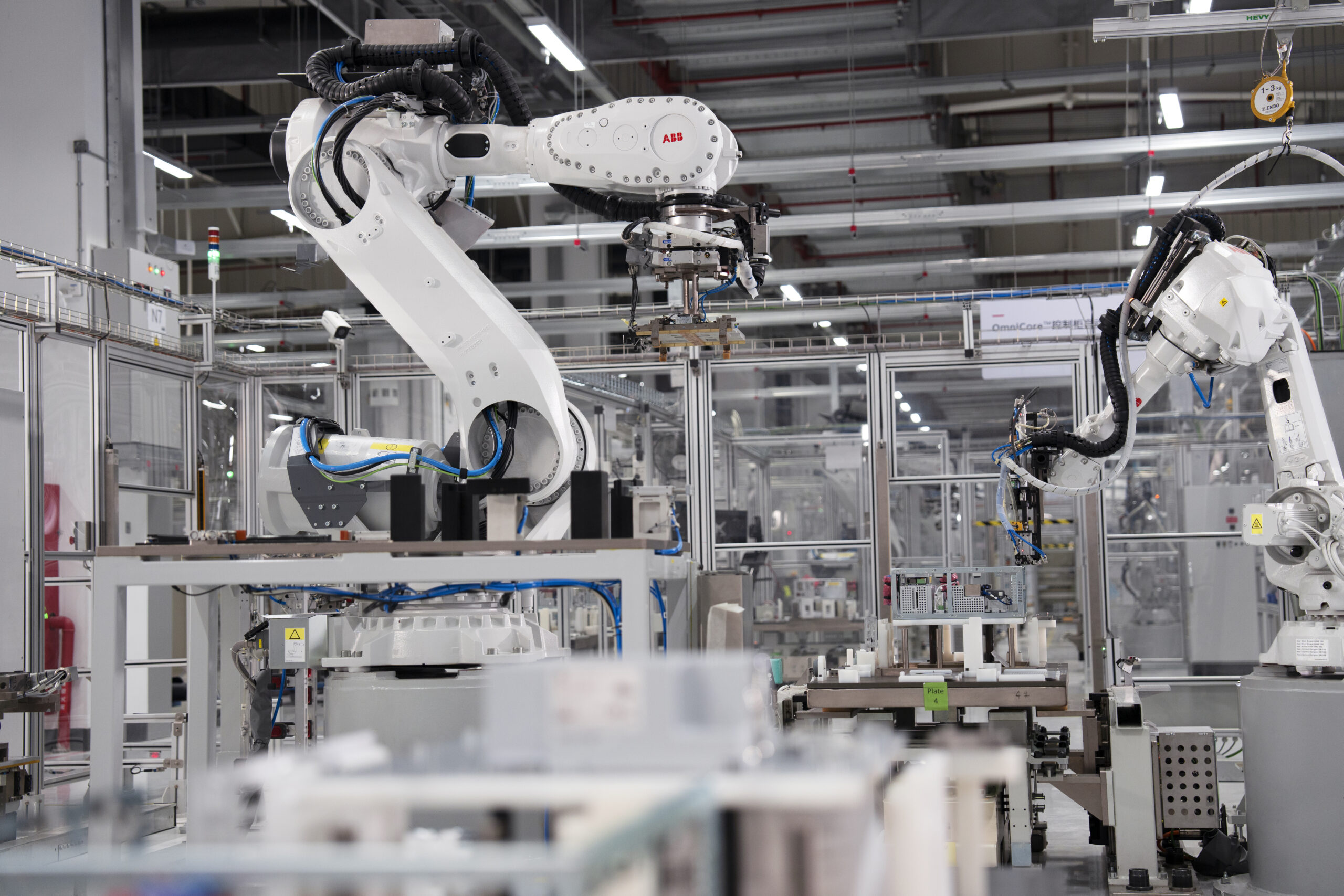
ABB Robotics supplies industrial robots, associated controllers, software and automation services used in vehicle production, assembly, welding, packaging and materials handling. Industrial installations often combine the robot arm with application tooling, sensors, safety systems and a connection to the production line’s wider controls.
The division’s business is therefore linked to the equipment that customers have installed in factories and warehouses, as well as engineering and support work carried out over the machinery’s service life. Ownership changes can involve manufacturing facilities, product development, supply agreements and the commercial organisations serving local customers.
In China, ABB has an extensive robotics manufacturing and research presence. The company opened a $150 million production and research facility at Kangqiao in Shanghai in December 2022, establishing a 67,000m² site intended to support its local industrial automation market.
That factory combines automated robot production with research and development in software, artificial intelligence, digital manufacturing and related technologies. ABB describes an integrated manufacturing system using connected equipment and digital modelling to plan and manage production activities.
The investment formed part of an ‘in China, for China’ strategy, under which locally manufactured robots serve customers in the Chinese market. ABB previously stated that more than 90% of its sales to customers in China were supported by its factory operations in the country.
Those historical company figures describe the local manufacturing strategy at the time and do not establish the current proportion of global Robotics revenue or the value of the Chinese assets affected by the proposed sale. ABB has not disclosed separate current financial information for the Chinese business in its latest update.
When the acquisition was agreed, ABB reported that the global Robotics division had approximately 7,000 employees and generated $2.3 billion in revenue in 2024, equivalent to about 7% of group revenue. Its operational EBITA margin for that year was 12.1%.
These worldwide figures cannot be used to calculate the financial consequences of the Chinese prohibition without information on the transaction’s legal structure and the contribution of the affected operations. A revised valuation or break fee has not been announced.
SoftBank’s original investment rationale centred on combining industrial robotics technology with the group’s artificial intelligence and advanced computing activities. ABB, meanwhile, intended to concentrate its continuing business on electrification, motion and automation after the divestment.
The sale had been anticipated for completion during 2026, subject to regulatory clearance. The Chinese decision now creates uncertainty about whether the agreed transaction can proceed in its existing form, but ABB’s statement does not establish which alternatives, if any, are being considered.
Potential alternatives might require changes to legal ownership, asset scope or other commercial arrangements. Such possibilities have not been confirmed by either party, and the regulator’s decision should not be interpreted as an agreement to accept a remedy or carve-out.
The review has attracted attention because China is a major industrial robotics market and ABB maintains local production and technical capabilities there. Commercial and manufacturing relationships that cross national boundaries can complicate the transfer of an international equipment business, even when the parties have agreed a single headline valuation.
Industry reporting has raised questions about technology and data security as potential issues in the review. ABB’s own statement gives no reason for the prohibition, so those reported concerns cannot be presented as the company’s account of the regulator’s decision.
Installed ABB robots and associated production equipment are not themselves affected by an announced change of ownership until the relevant business arrangements change. The company has disclosed no alteration to existing warranties, service provision, spare parts supply or customer support in connection with the review.
ABB continues to operate its Robotics business while the parties discuss the transaction. As a supplier to industrial operations, the division must maintain manufacturing, engineering, logistics and support services independently of the uncertain timing of the divestment.
At present, the established facts are the prohibition on acquisition of the Chinese business, the original $5.375 billion agreement and ABB’s confirmation that discussions continue. Any effect on the wider deal, ownership of individual plants or completion timetable will require a further announcement from the companies.